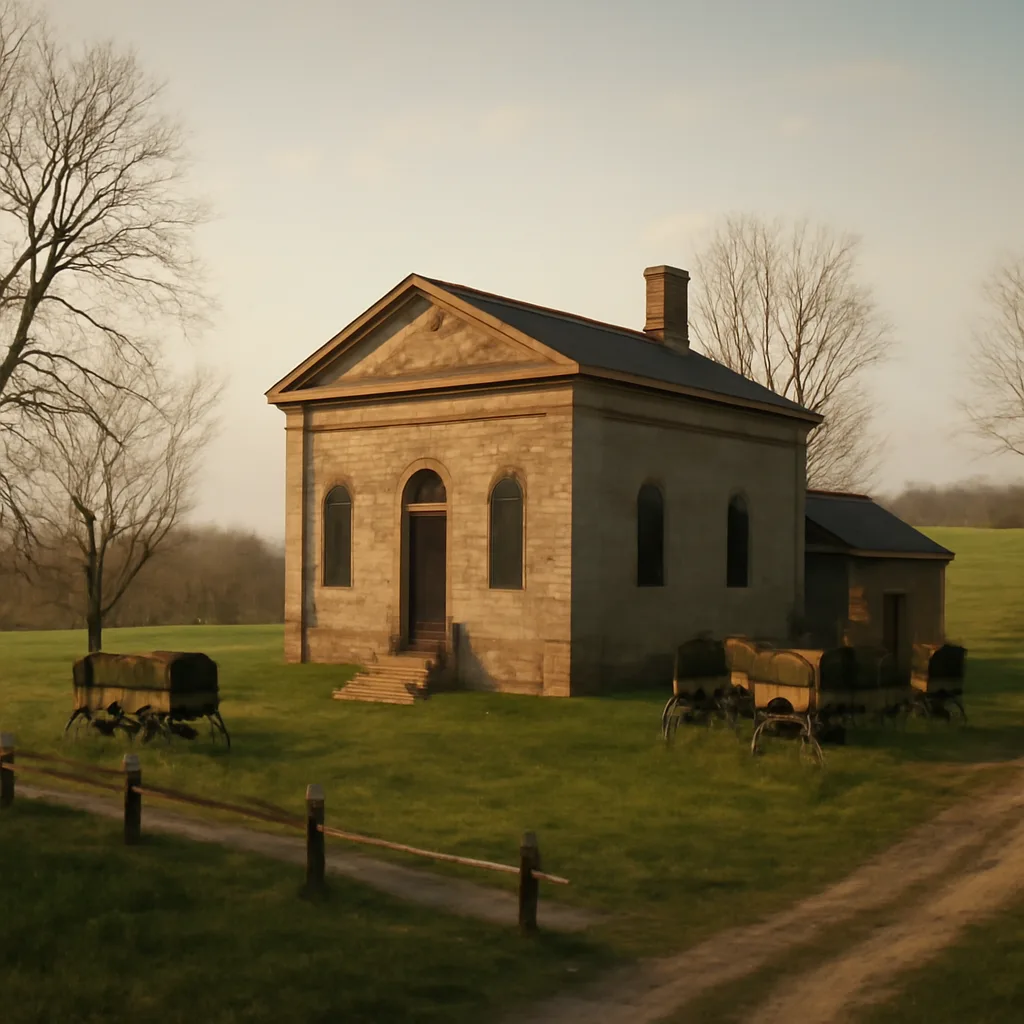
On March 26, 1876, the first public crematory in the United States began operating in Washington, Pennsylvania, marking a shift in burial practices amid growing debates about sanitation, religion, and modernity.
On March 26, 1876, Dr. Francis Julius LeMoyne’s crematory in Washington, Pennsylvania, conducted the first recorded public cremation in the United States. LeMoyne, a physician and abolitionist, had long advocated cremation as a sanitary and progressive alternative to conventional burial. He financed and built the structure on his estate, and the crematory—designed in a modest classical style—was intended both as a practical facility and as a tangible statement in favor of reforming funerary customs.
The cremation movement in the 19th century arose from multiple concerns. Rapid urbanization and crowded cemeteries raised public-health anxieties among physicians and municipal authorities, while advances in scientific knowledge and changing religious attitudes opened space for alternative practices. Advocates argued that cremation reduced the risk of disease transmission from decaying graves, conserved land, and was more sanitary and efficient. Opponents cited religious objections, cultural attachment to burial, and unfamiliarity with the process.
LeMoyne’s interest in reform reflected broader mid-19th-century currents. Educated in medicine, he combined scientific reasoning with a commitment to social causes; he had been active in abolitionist circles and invested in public improvements. In 1873 he erected the crematory on a hillside of his property; its kiln-style furnace was influenced by contemporary European designs, where cremation had been gradually gaining legal and cultural acceptance—particularly in parts of Germany and Italy.
The first actual public cremation at the Washington facility in March 1876 was a landmark but did not immediately normalize cremation across the United States. Legal, religious, and cultural resistance remained strong. Many states had no explicit laws addressing cremation, and some courts and legislatures were slow to accept it. Religious traditions—especially within Catholicism and many Protestant denominations—continued to favor burial. Nevertheless, the LeMoyne crematory served as a practical demonstration that cremation could be carried out in America according to contemporary standards of engineering and hygiene.
Over subsequent decades the use of cremation grew unevenly. Professional organizations, sanitary reformers, and some medical authorities gradually influenced public opinion. The late 19th and early 20th centuries saw the establishment of additional crematories in the United States and the founding of cremation societies to promote the practice. It was not until the mid-20th century, however, that cremation became a widely accepted alternative to burial for large segments of the American population.
Historical assessments of the 1876 crematory emphasize its symbolic importance as well as its practical role. It illustrated how individual initiative—backed by financial resources and scientific rhetoric—could introduce and legitimize a controversial innovation. At the same time, the facility’s existence highlights the contested nature of death practices: changes in funerary custom often proceeded slowly and required negotiation among medical authorities, legal systems, religious institutions, and families.
Today the LeMoyne crematory site is recognized by historians as a significant milestone in U.S. funerary history. Sources documenting the event include contemporary local newspapers, writings by LeMoyne and his supporters, and later historical studies of cremation and public health reform. Where details or interpretations vary among sources, historians note differences in timing, public reaction, and legal responses—underscoring that while March 26, 1876, is widely cited as the date of the first public cremation, the broader story involves gradual cultural change rather than a single decisive moment.