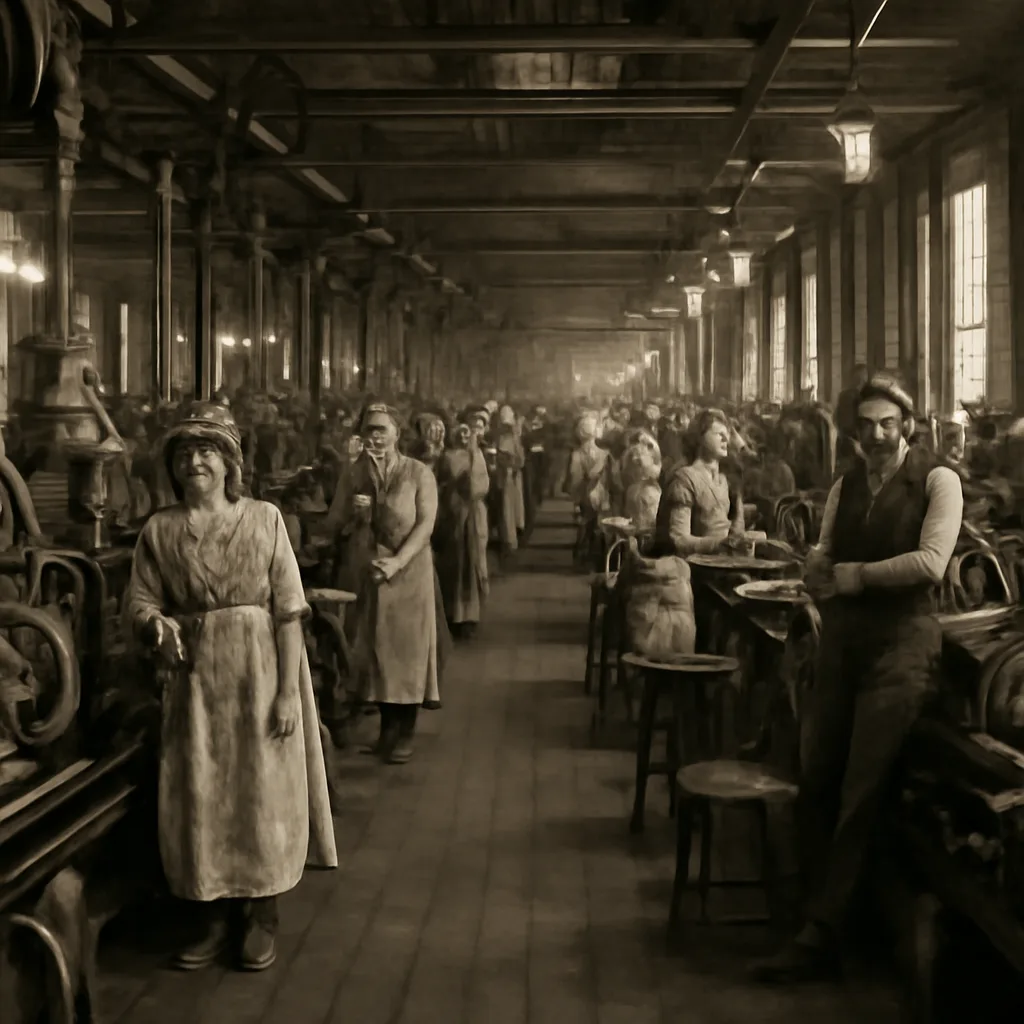
Factory Fits: A Documented Episode of Collective Hysteria, 12 February 1913
On 12 February 1913, medical and press accounts recorded an episode of collective nervous disturbance at a European factory, later described as 'hysteria' in period sources; contemporaries debated whether the cause was social contagion, workplace stress, or environmental factors.
On 12 February 1913, contemporary medical reports and newspaper accounts described an outbreak of acute nervous symptoms among workers at an industrial workplace that period sources labeled "hysteria." The incident fits into a wider pattern of early 20th-century accounts in which clusters of fainting, trembling, hyperventilation, or psychogenic seizure-like episodes occurred in factories, schools, and military units across Europe and North America. These events were interpreted through the medical, social, and gendered frameworks of the time.
Documentation: Primary documentation for such factory incidents typically appears in local newspaper reports, hospital records, and the publications of public health or occupational medicine authorities of the era. Exact details—such as the factory’s industry, the number of affected workers, and the interventions used—vary across accounts and locations. In many cases the workforce was largely female or included young women, a factor that influenced contemporary characterizations and medical interpretations of the events.
Contemporary interpretation: Physicians and journalists in 1913 commonly described these episodes as forms of "hysteria" or "mass nervousness." Those terms reflected prevailing medical theories that linked emotional and somatic symptoms to social conditions and gendered notions of susceptibility. Some physicians emphasized psychogenic contagion—suggesting symptoms spread by suggestion or shared stress—while others investigated possible environmental contributors such as poor ventilation, noxious fumes, extreme heat, or infectious agents. Factory managers and public authorities often responded by temporarily closing workplaces, improving ventilation, or removing perceived irritants, and sometimes by calling in medical examiners to assess fitness for work.
Modern perspectives: Retrospective scholarship treats such episodes with greater nuance. Historians of medicine and occupational health situate them at the intersection of workplace conditions (long hours, monotonous labor, overcrowding), socio-economic pressures, gender dynamics, and evolving understandings of neurology and psychiatry. Today, historians prefer terms such as "mass psychogenic illness" (MPI) or "mass sociogenic illness" to describe clusters of symptoms without an identifiable organic cause. MPI emphasizes social and psychological mechanisms—stress, expectation, and social contagion—while recognizing that environmental stressors and genuine physiological illness must be ruled out through careful investigation.
Uncertainties and limits: Specific facts about individual 1913 factory incidents can be uncertain. Period sources are uneven in accuracy and may reflect moralizing or sensational reporting. Medical terminology and diagnostic standards have changed substantially since 1913; labels like "hysteria" carried cultural meanings that are not equivalent to modern diagnoses. Where primary documents survive—newspaper articles, municipal health reports, or hospital admission logs—they provide important, though often partial, evidence. Absent such sources, generalizations about any single event should be treated cautiously.
Significance: Episodes labeled "hysteria" in factories illuminate the social history of industrial work, gender, and medicine. They show how workers’ bodies were interpreted and managed, how industrial hazards were addressed (or dismissed), and how public health responses developed in the early 20th century. Studying these incidents sheds light on how communities understood and responded to collective distress before the modern frameworks of occupational health and psychosomatic medicine were widely established.
For readers: When consulting contemporaneous accounts from 1913, it is important to cross-reference multiple sources—local newspapers, municipal health reports, and surviving medical records—while remaining aware of period biases in language and interpretation. Modern historians use such triangulation to reconstruct what happened and how people at the time made sense of it.