
← Back
10/11/1973 • 4 views

Military Coup Topples Elected Government in South America, October 11, 1973
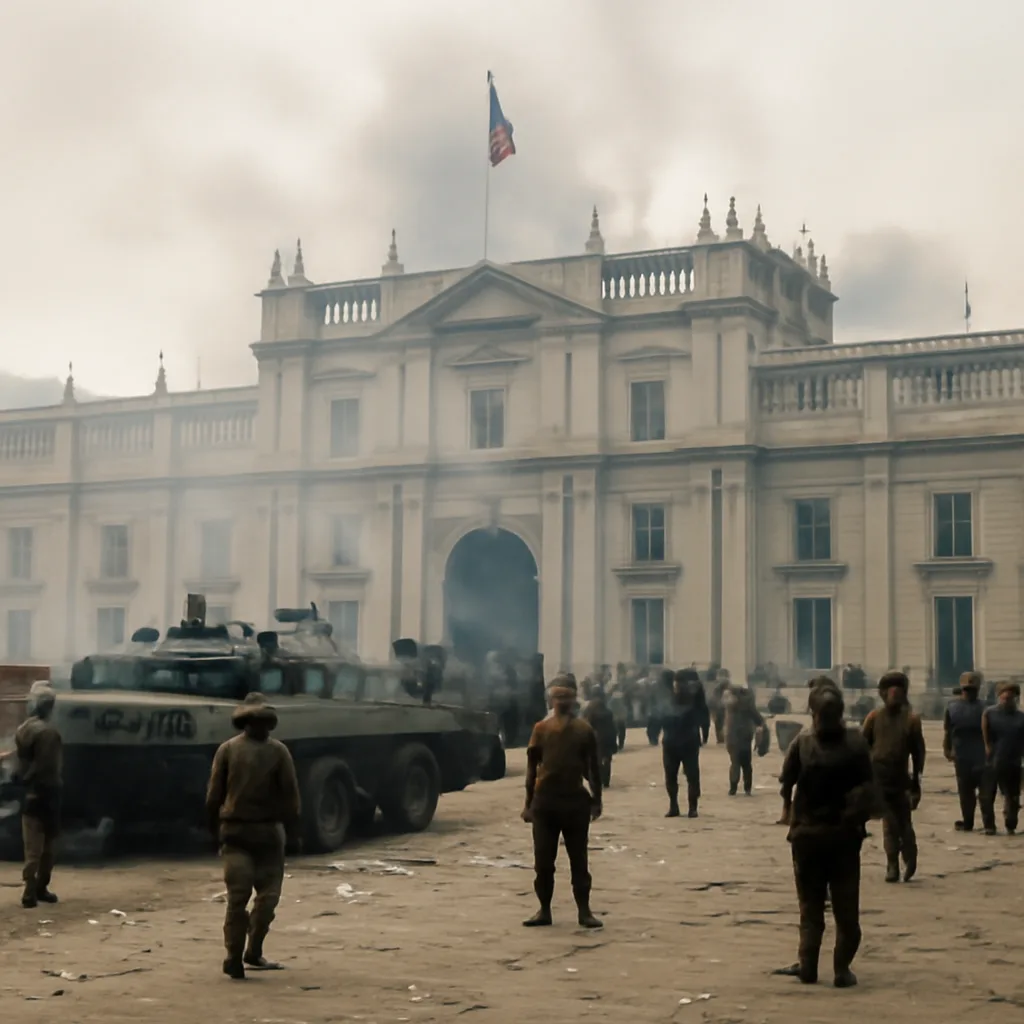
Soldiers and armored vehicles in front of La Moneda presidential palace in Santiago, Chile, during the 1973 military coup; smoke and damage visible around the building.

On October 11, 1973, Chile’s military seized power from the democratically elected government in a coup led by General Augusto Pinochet, ending Salvador Allende’s presidency and beginning a long period of military rule marked by repression and political change.


On October 11, 1973, the Chilean military overthrew the government of President Salvador Allende in a coordinated coup culminating in a violent assault on the presidential palace, La Moneda. The overthrow followed months of intense political polarization, economic strain, social unrest, and confrontations between the leftist Popular Unity government and conservative sectors of Chilean society, the military, and congress. Allende, elected in 1970 as the first Marxist president to come to power through open elections in Latin America, pursued nationalizations and redistributive policies that deepened domestic divisions and prompted fierce opposition from business leaders, conservative politicians, and other actors.

In the days and hours before the coup, tensions escalated with strikes, street clashes, and reports of plots within the armed forces. On the morning of October 11, units of the army, air force, and navy moved to seize key installations across the capital, Santiago, and other cities. The military declared a state of emergency and announced it had assumed power. La Moneda was shelled and occupied; President Allende died in the palace during the assault (circumstances of his death have been subject to official investigation and are widely reported as suicide). The coup leaders installed a military junta headed by General Augusto Pinochet, who within weeks consolidated power as commander-in-chief and later as head of state.

The junta dissolved congress, suspended the constitution, banned political parties, and imposed censorship. Security forces carried out widespread arrests, detentions, forced disappearances, and executions of those associated with Allende’s government or the left more broadly. Thousands were detained and many were tortured or exiled; exact casualty figures remain the subject of historical research and official investigations. The junta also implemented sweeping economic reforms guided by a group of economists known as the Chicago Boys, shifting toward neoliberal policies including privatization, deregulation, and opening the economy to foreign investment. These policies produced deep social and economic changes whose effects are debated among scholars and Chileans.

International reactions were mixed. Some governments and business interests welcomed the junta’s anti-communist stance and economic orientation; others condemned the overthrow of a democratically elected government and reported human-rights abuses. The United States government’s role before and after the coup has been extensively examined: declassified documents show U.S. intelligence and diplomatic activity involved in efforts to oppose Allende’s government, though the extent and nature of direct involvement in the coup itself remain subjects of historical inquiry and debate.

Pinochet’s rule lasted until 1990, when a transition to civilian government began after a 1988 plebiscite rejected extending his presidency. The legacy of the 1973 coup and the subsequent military government remains a central and contested element of Chilean politics and memory. Debates persist over responsibility for human-rights violations, the social and economic consequences of the junta’s policies, and how to address truth, justice, and reconciliation. Official truth commissions and courts in Chile and abroad have investigated abuses and issued findings; however, some questions and disputes about individual cases and broader responsibilities continue to be litigated and debated.

The October 11, 1973 coup is widely regarded by historians as a watershed moment in Chilean and Latin American history, emblematic of Cold War-era interventions and ideological conflicts that reshaped political trajectories across the region.

Share this

Email Share on X Facebook Reddit

Did this surprise you?