
← Back
05/30/1896 • 7 views

First Modern Motorcycle Race Held in Paris, 1896
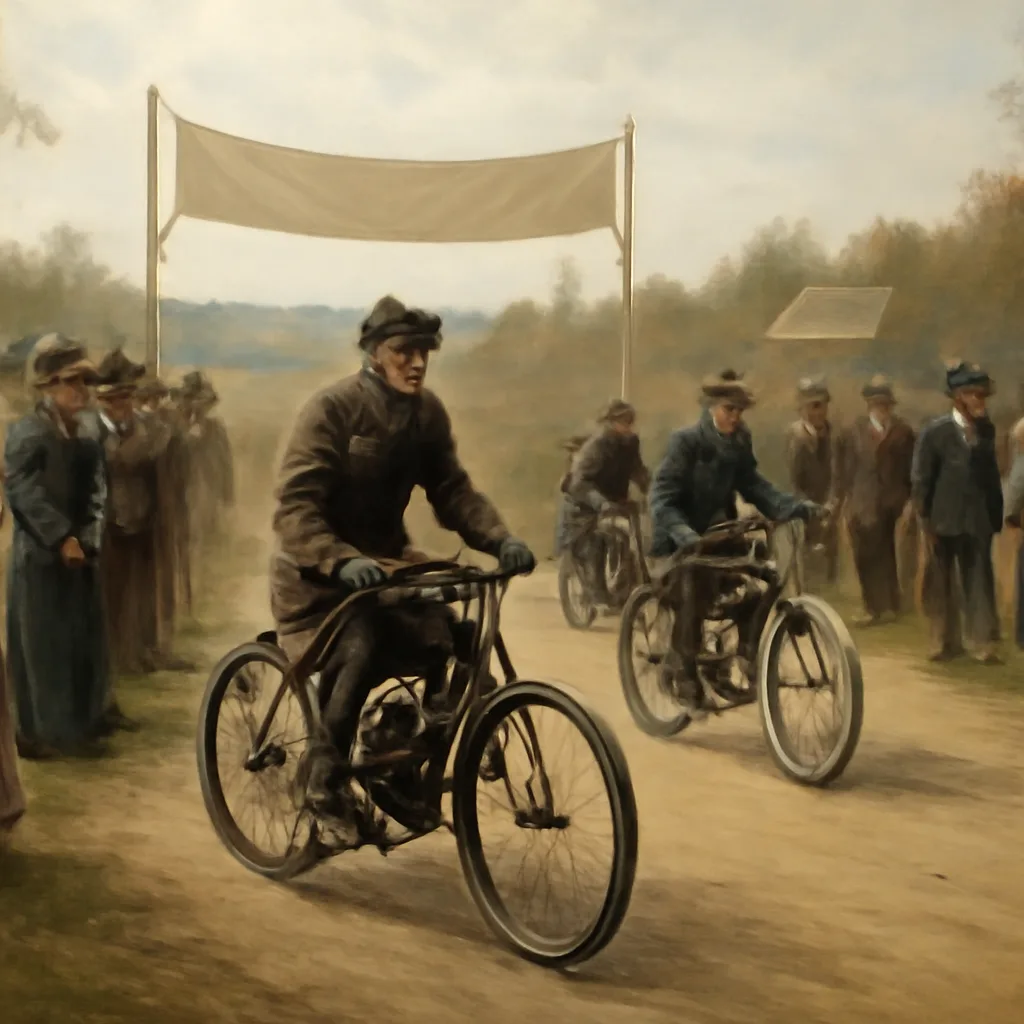
Late 19th-century open road near Paris with several motor-bicycles—bicycle frames fitted with small petrol engines—riders in period clothing and a small crowd of onlookers in late-1800s attire.

On 30 May 1896 a motorized bicycle race near Paris is widely regarded as the first modern motorcycle race, pitting early internal-combustion machines against each other in a public competition that helped define the new sport and technology.


On 30 May 1896 a public contest in the Paris area is commonly cited as the first modern motorcycle race. The event took place during the Paris-Bordeaux-Paris era of motor trials and demonstrations that followed the rapid development of small internal-combustion engines in the 1890s. Inventors and mechanics adapted lightweight single-cylinder petrol engines to bicycle frames, creating what contemporaries called "motor-bicycles" or "motorcycles." These machines differed from earlier steam-powered two-wheelers and from pedal-only bicycles fitted with auxiliary motors, representing a distinct move toward the motorized motorcycle as a vehicle class.

The 1896 contest was organized amid growing public fascination with internal-combustion propulsion and its potential for personal transport. Riders on motor-bicycles competed over a set course near Paris; accounts from the period emphasize both the novelty of powered two-wheel travel and the technical fragility of the machines. Speeds were modest by later standards, reliability varied widely, and many entrants relied on recent experimental designs rather than production models. Nonetheless, the event drew spectators and press attention, helping to popularize motorized two-wheelers and encouraging further development by manufacturers and independent builders.

Historians identify several milestones in early motorcycle racing and technology that feed into the claim that the 1896 Paris-area contest was the first modern motorcycle race. Important context includes Gottlieb Daimler and Wilhelm Maybach’s 1885–1886 experiments with a petrol engine applied to a wooden bicycle frame in Germany, often cited as an early motorized two-wheeler prototype, and various steam- and petrol-driven experiments elsewhere in Europe. By the mid-1890s, petrol-engine miniaturization and bicycle-frame adaptations had reached a point where more than one entrant could contest a public contest under similar rules, which is why the 1896 event is singled out by many scholars and historical summaries.

It is important to note areas of dispute and uncertainty. Sources differ on whether earlier, localized trials or exhibitions should count as racing, and national histories sometimes emphasize domestic milestones. Some historians point to later, more formalized races (for example, events organized in the 1900s with clearer classes and timed results) as the true beginning of sanctioned motorcycle racing. Contemporary press reports from 1896 often use varied terminology—"motor-bicycle," "motor tricycle," "automobile," and "bicycle with engine"—which complicates direct comparisons with later, standardized categories.

Despite these ambiguities, the 30 May 1896 Paris-area contest remains a useful reference point: it marked public competition among petrol-driven two-wheel vehicles, drew attention to their prospects, and spurred further technical refinement. Within a few years, manufacturers were producing purpose-built motorcycle frames and engines, and organized races with clearer regulations became more common, laying the foundations for the sport and industry that followed.

Today, motorcycle historians treat early events like the 1896 contest as part of a transitional era. Rather than a single definitive origin, the development of motorcycle racing is better seen as a sequence of experiments, exhibitions, and early competitions across Europe that collectively established the modern motorcycle and its sporting culture.

Share this

Email Share on X Facebook Reddit

Did this surprise you?