
← Back
06/29/1926 • 4 views

John Logie Baird Gives First Public Television Demonstration, June 29, 1926
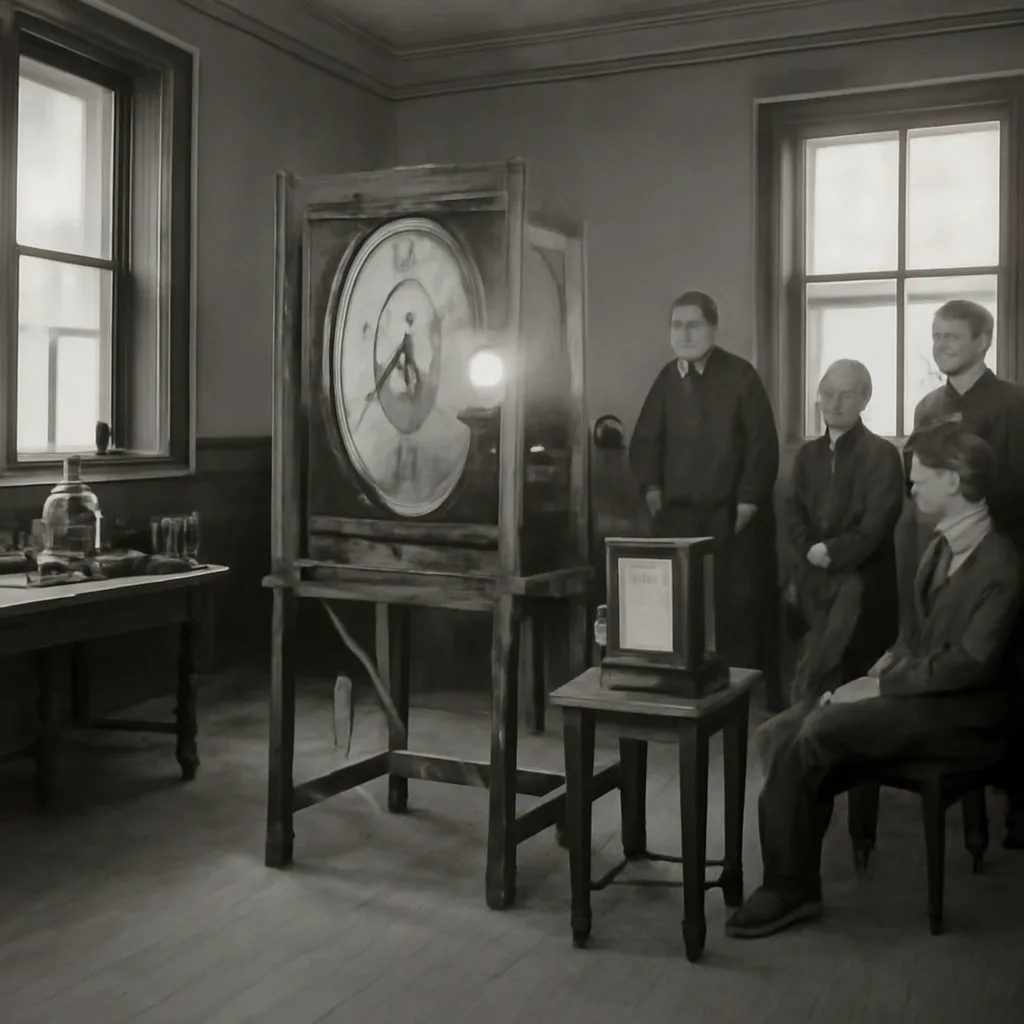
Early 20th-century laboratory room with mechanical television apparatus: a large rotating perforated disc, lamp for illumination, wiring, and a crude receiving screen; attendees in 1920s dress observe from a distance.

On 29 June 1926 in London, Scottish inventor John Logie Baird delivered the first public demonstration of a working television system, using mechanical scanning to transmit live moving silhouette images between rooms at the Royal Institution.


On 29 June 1926 at the Royal Institution in London, John Logie Baird staged what is widely recognized as the first public demonstration of a working television system. Baird, a Scottish inventor who had been experimenting with mechanical scanning methods, used a Nipkow disc-based system and incandescent illumination to transmit crude moving images across a short distance within the building. The demonstration was attended by members of the press, scientists and engineers; Baird later invited the Bakelite manufacturer and other observers to view the apparatus.

Technical context
Baird’s system was a mechanical television: it relied on a rotating perforated disc (the Nipkow disc) to scan an image line by line, a photoelectric cell to convert light variations into electrical signals, and a synchronized disc and light source at the receiver to reconstruct the image. Resolution was extremely low by modern standards — typically on the order of tens of lines — and images lacked continuous tone, appearing as moving silhouettes or crude outlines rather than photographic reproductions. Baird’s setup also required bright illumination and careful mechanical synchronization between transmitter and receiver.

What was shown
Contemporary reports describe the transmitted images as the head of a ventriloquist’s dummy and the face of a human subject, both rendered in low resolution and with flicker. Observers saw moving outlines and facial motions rather than fine detail. The demonstration proved that television could transmit recognizable moving images in real time, even if practical picture quality and reliability were far from solved.

Significance and limitations
The June 1926 demonstration is historically significant because it moved television from laboratory experiments and one-off trials to a public, documented presentation at a respected scientific venue. It helped attract attention from engineers, journalists and potential investors, and it established Baird as a pioneering figure in early television development. However, mechanical television systems such as Baird’s had inherent limitations in resolution, brightness and scalability. Within a decade electronic scanning methods, using cathode-ray tubes and later fully electronic camera tubes, would eclipse mechanical approaches.

Reception and legacy
Press coverage of the demonstration was mixed: some reports emphasized the novelty and potential, while others noted the crude image quality. Baird continued development after 1926, achieving further milestones — including experimental transatlantic transmissions and public broadcasts in the late 1920s and early 1930s — but his mechanical approach was ultimately supplanted by electronic systems. Historians regard the 29 June 1926 event as a key milestone in the chronology of television, marking the first organized public showing of a working, real-time picture-transmission system.

Notes on sources
Descriptions of the 1926 demonstration derive from contemporary newspaper reports, technical accounts of early television history, and histories of John Logie Baird’s work. Exact details (such as the identities of every attendee and the minute-by-minute program) vary among sources; where accounts differ, historians agree on the core fact that Baird publicly demonstrated a mechanical television system at the Royal Institution on 29 June 1926.

Share this

Email Share on X Facebook Reddit

Did this surprise you?