
← Back
11/22/1963 • 4 views

President John F. Kennedy Assassinated in Dallas, Texas
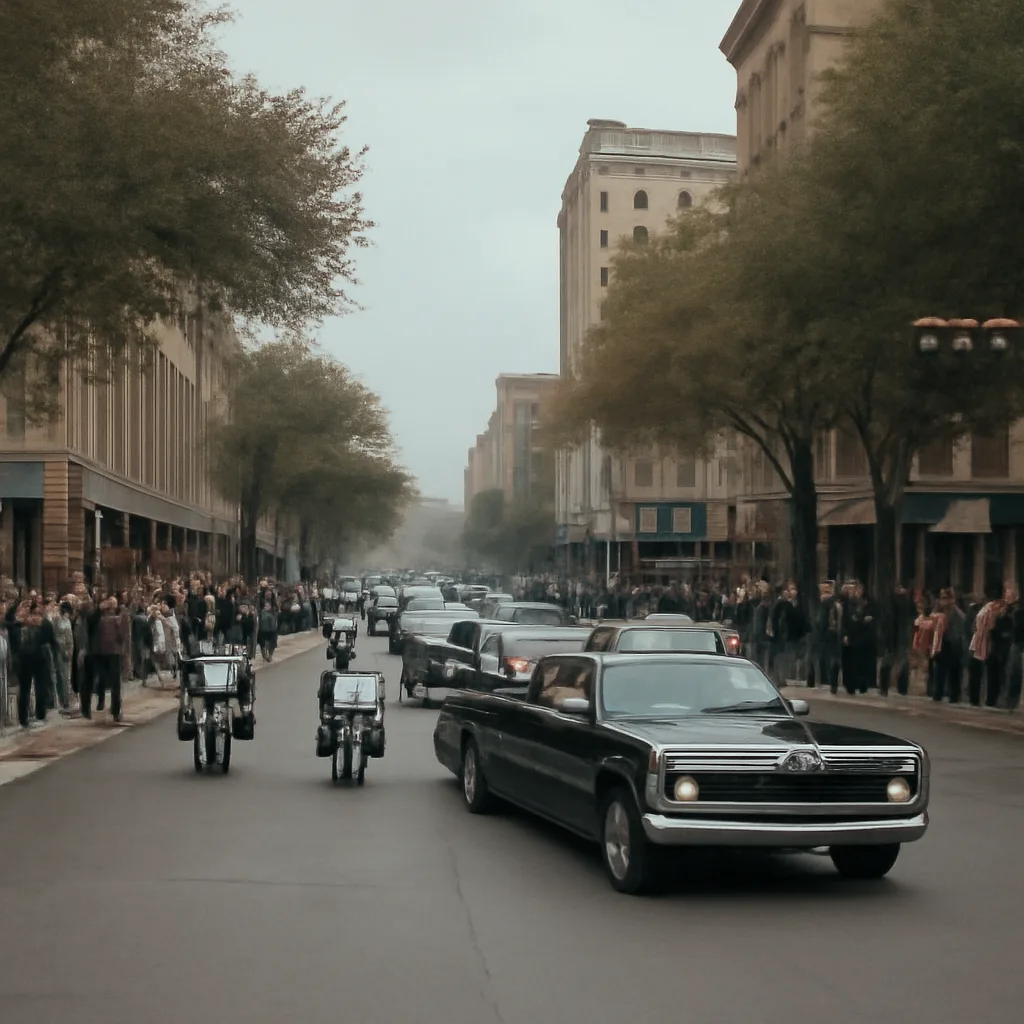
Motorcade in downtown Dallas, 1960s, showing an open-top presidential limousine on a city street with crowds along the sidewalks and police escort vehicles.

On November 22, 1963, President John F. Kennedy was fatally shot while riding in a motorcade in Dallas, Texas; Vice President Lyndon B. Johnson was sworn in as president later that day. The killing prompted a nationwide outpouring of grief and immediate federal investigation.


On November 22, 1963, President John F. Kennedy was assassinated in Dallas, Texas, during a presidential motorcade through downtown. Kennedy, 46, was riding in an open-top limousine with First Lady Jacqueline Kennedy, Texas Governor John Connally, and his wife when shots were fired. The president was struck and taken to Parkland Memorial Hospital, where physicians pronounced him dead at 1:00 p.m. Central Standard Time.

Vice President Lyndon B. Johnson, who was three cars behind Kennedy in the motorcade, was sworn in as the 36th president aboard Air Force One at Dallas Love Field later the same day, with Jacqueline Kennedy standing beside him still wearing her blood-stained clothing. The swift transfer of power sought to ensure continuity of government during a moment of national crisis.

Dallas Police arrested Lee Harvey Oswald later that afternoon and charged him with the murder of President Kennedy and the killing of a Dallas police officer, J.D. Tippit. Two days later, on November 24, while being transferred from the city jail to county jail, Oswald was shot and killed by nightclub owner Jack Ruby in the basement of the Dallas police headquarters; the shooting was broadcast live on television. Oswald never stood trial.

The federal government launched an immediate investigation. President Johnson established the Warren Commission, headed by Chief Justice Earl Warren, to investigate the circumstances surrounding the assassination. In 1964 the Warren Commission concluded that Lee Harvey Oswald acted alone in assassinating President Kennedy and that no conspiracy—domestic or foreign—was involved. The commission also concluded that Jack Ruby acted alone in killing Oswald.

The assassination and the findings of the Warren Commission generated widespread public debate, controversy, and a proliferation of alternative theories over subsequent decades. In 1979, the House Select Committee on Assassinations concluded that Kennedy was probably assassinated as a result of a conspiracy, though it did not identify all participants and its conclusions have been debated.

The assassination had immediate and lasting impacts: it shocked the nation and world, altered the course of U.S. politics, and prompted changes in presidential security practices, including expanded protection by the Secret Service. The event also intensified Cold War anxieties and prompted numerous official and private investigations, archival releases, and scholarly studies over the decades that followed.

Historical accounts of the assassination rely on contemporaneous records—police reports, medical records, eyewitness testimony, film and photographic evidence (including the Zapruder film)—and the reports of official investigations. Many primary documents have been declassified over time, though some records remained restricted for years and controversies about interpretations persist. Where interpretations vary, historians note disputed or unresolved elements rather than asserting uncertain details as fact.

Kennedy’s assassination remains one of the most studied and discussed events in modern American history, notable both for the abrupt loss of a young president and for the complex legal and historical debates it generated about what occurred and why.

Share this

Email Share on X Facebook Reddit

Did this surprise you?