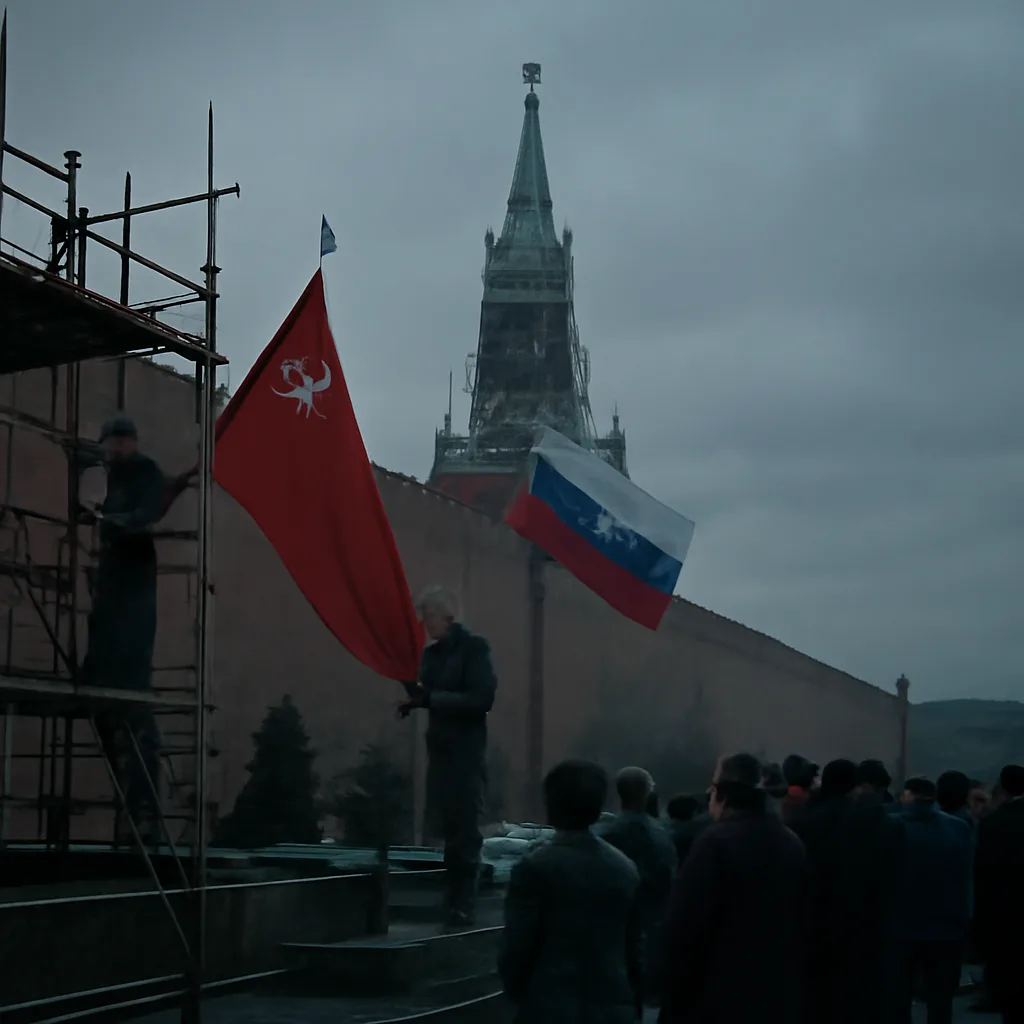
On December 25, 1991, following the dissolution of the Soviet Union, U.S. and Russian leaders acknowledged that the Cold War had effectively ended, marking a formal close to decades of ideological, political and military rivalry.
On December 25, 1991, the Cold War era—an extended period of geopolitical tension between the United States and the Soviet Union and their respective allies—was widely acknowledged to be over following the formal dissolution of the Soviet Union. The Soviet state ceased to exist when Mikhail Gorbachev resigned as president of the USSR and declared the office extinct; the Soviet flag over the Kremlin was lowered and replaced by the Russian tricolor. Leaders in Washington and Moscow responded by recognizing a fundamental change in the international order that had defined global politics since the end of World War II.
The Cold War had encompassed competing political and economic systems, an arms race (including nuclear deterrence and mutually assured destruction), proxy wars in Asia, Africa and Latin America, intense ideological competition, and tightly managed spheres of influence. By the late 1980s, internal economic strain in the Soviet Union, political reforms driven by Gorbachev—perestroika (restructuring) and glasnost (openness)—and popular movements in Eastern Europe had already eroded Soviet control over the region. The fall of the Berlin Wall in 1989 and subsequent democratic transitions in Eastern Europe signaled a dramatic reversal of Cold War dynamics.
The sequence of events culminating in December 1991 included the formation of the Commonwealth of Independent States (CIS) by several former Soviet republics in December, the August 1991 coup attempt against Gorbachev, and increasing declarations of independence by Soviet republics earlier that year. On December 8, 1991, leaders of Russia, Ukraine and Belarus signed the Belavezha Accords declaring the Soviet Union effectively dissolved and establishing the CIS. Gorbachev’s resignation on December 25 was a symbolic end point: he acknowledged that the Soviet Union no longer existed and handed nuclear launch codes and presidential authority to Boris Yeltsin, the president of the Russian Federation.
U.S. officials, including President George H. W. Bush, framed these developments as the end of the long-standing U.S.–Soviet rivalry and the start of a new relationship with the Russian Federation. Diplomatic relations continued, and arms control negotiations carried forward into the 1990s, yielding further reductions in strategic arsenals and conversion of former Cold War institutions and missions. At the same time, the post-Cold War era proved complex: new security challenges emerged, regional conflicts persisted, and the economic and political transitions within Russia and many former Soviet republics were turbulent and uneven.
Historians and contemporaneous leaders often mark December 1991 as the formal conclusion of the Cold War because it signaled the end of the Soviet Union as a superpower adversary. However, scholars note that the Cold War’s end was not a single event but a process extending over several years, with key milestones—including the late-1980s reforms, the collapse of communist governments in Eastern Europe, and treaties limiting nuclear arsenals—contributing to the broader transformation. The legacy of the Cold War continues to shape international institutions, military posture, and political memory in both Russia and the United States.
This account refrains from attributing invented statements to individuals and is based on widely documented historical events and public records from late 1991.