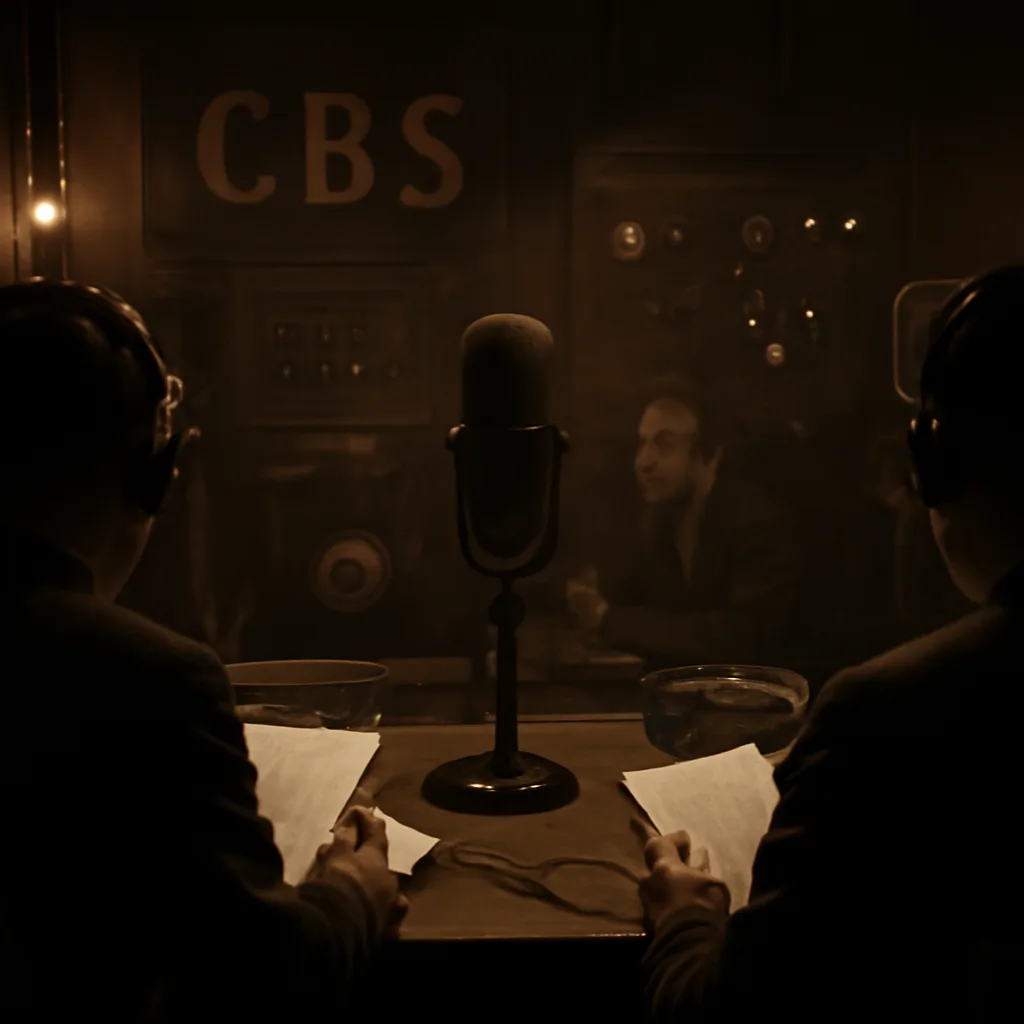
Orson Welles’ Halloween Broadcast of The War of the Worlds Triggers Nationwide Alarm
On October 30, 1938, a radio adaptation of H.G. Wells’s The War of the Worlds, presented by Orson Welles and the Mercury Theatre on the Air, led to widespread reports of panic across the United States as some listeners interpreted the program’s simulated news bulletins as real events.
On the evening of October 30, 1938, the Columbia Broadcasting System (CBS) aired a 60-minute radio drama by the Mercury Theatre on the Air that adapted H. G. Wells’s 1898 novel The War of the Worlds. Directed and narrated by 23-year-old Orson Welles, the broadcast used a format that alternated standard music-program opening announcements with realistic-sounding on-the-scene news bulletins describing an apparent invasion by extraterrestrials in Grovers Mill, New Jersey. The delivery—intentionally dramatic and presented in the style of live news reports—led some listeners to believe they were hearing authentic news of an unfolding catastrophe.
The program began as a conventional theater broadcast, but after several minutes it broke into simulated news interruptions: reports of explosions on Mars (later clarified as background from the story), a meteor-like object crashing on a farm in Grovers Mill, and subsequent accounts of casualties, military mobilization, and evacuations. Sound effects and actors portraying reporters, military officials, and scientists contributed to the sense of immediacy. The broadcast closed with a postscript making clear the program’s fictional nature, but for many listeners that disclaimer came too late or was missed entirely.
Contemporary reactions were uneven and have been the subject of historical debate. Newspapers of the era reported incidents of panic: calls to police and the press, traffic congestion, and people fleeing perceived danger. Some radio listeners said they had been alarmed and sought help or information; others later said they found the program entertaining or recognized it as drama. Scholars have since shown that the extent of mass hysteria was likely exaggerated by newspapers—many of which were in direct competition with radio—and that a combination of factors shaped reactions: the placement of the broadcast in local program schedules, whether listeners tuned in after the initial disclaimer, existing anxieties of the late 1930s, and demographic differences in radio audiences.
The broadcast had significant and lasting consequences. It made Orson Welles a national figure almost overnight and sparked fierce public debate about the power and responsibility of broadcast media. Congressional hearings examined whether broadcasters should be regulated to prevent similar incidents. The Federal Communications Commission (FCC) investigated but ultimately did not impose new censorship rules; the episode did, however, influence broadcasters’ practices and public expectations about program labeling and disclaimers.
Historians emphasize caution in interpreting the event. Early press accounts often amplified sensational anecdotes, while later academic studies have sought to contextualize the reactions and dispel myths of an apocalyptic, nationwide panic. Reliable scholarship indicates that while genuine fear and confusion occurred in some communities, the narrative of mass hysteria across the nation is overstated. The episode remains an important case study in media effects, rumor formation, and the cultural power of radio in the pre-television era.
Today the War of the Worlds broadcast is remembered both as a landmark in radio drama and a reminder of how format, context, and audience expectations can shape the reception of media. Recordings of the broadcast and contemporary documents are available in archives and have been analyzed by historians and media scholars seeking to separate fact from wartime-style embellishment and press-driven exaggeration.