
← Back
03/06/1927 • 7 views

The First Talking Feature Premieres: The Jazz Singer Debuts (1927)
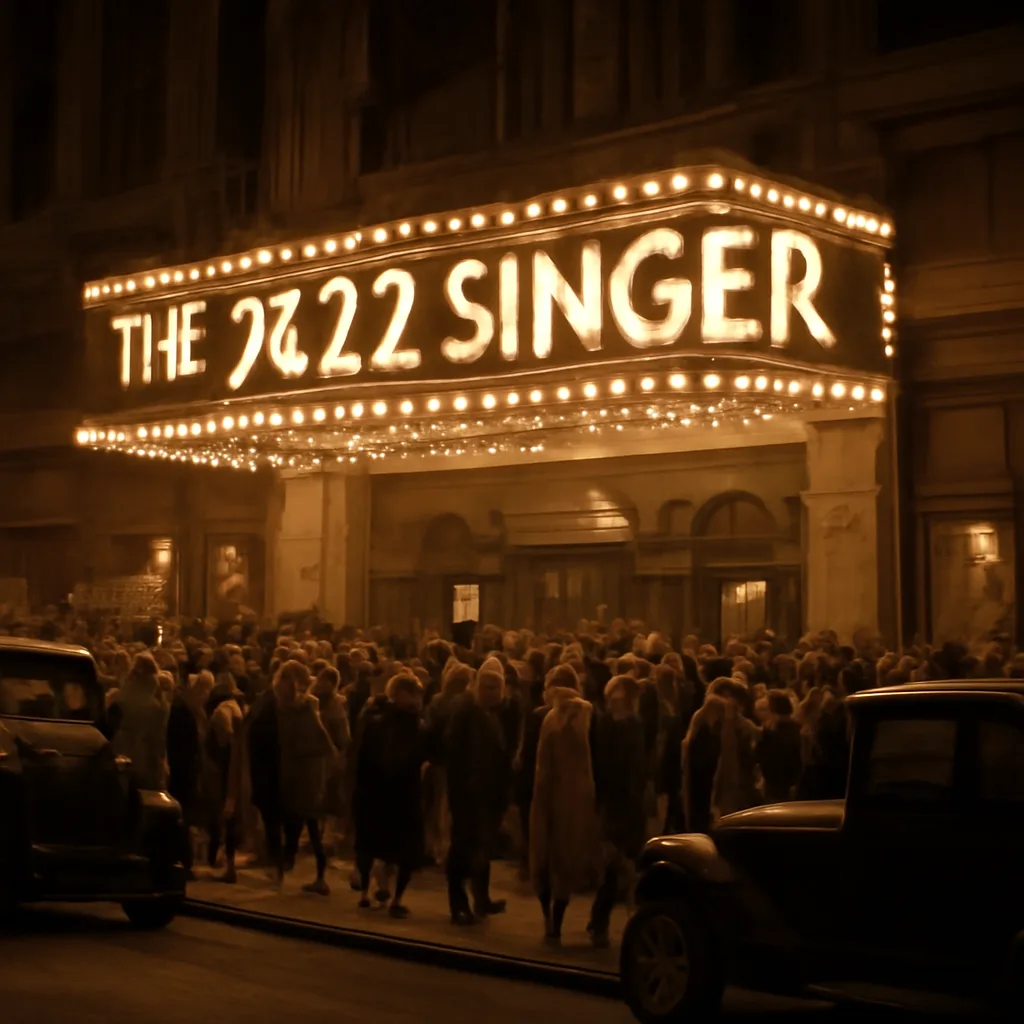
Crowd outside the Warner Theatre in New York on premiere night in 1927, with marquee advertising The Jazz Singer; 1920s street dress and theater signage visible.

On March 6, 1927, Warner Bros. premiered The Jazz Singer in New York, marking the first widely distributed feature film with synchronized spoken dialogue and musical performances using the Vitaphone sound-on-disc system.


On March 6, 1927, Warner Bros. opened The Jazz Singer at New York’s Warner Theatre, a landmark event in cinema history widely credited with launching the era of sound films. Directed by Alan Crosland and starring Al Jolson, the picture combined largely silent filmed sequences with several segments of synchronized music and spoken lines recorded on the Vitaphone sound-on-disc system developed by Western Electric and Bell Laboratories and commercially adopted by Warner Bros.

The Jazz Singer was adapted from a 1925 stage play by Samson Raphaelson. Its storyline follows Jakie Rabinowitz (Al Jolson), a young man who defies his devout Jewish family’s expectations to pursue a career as a jazz singer. The film is best known for its musical numbers and for several brief spoken lines by Jolson, including the improvised-sounding address to the audience, which signaled to many viewers the arrival of ‘‘talking pictures.’’ Historians note that while The Jazz Singer was not the first film to synchronize sound and image, its commercial success and wide distribution made it the pivotal mainstream breakthrough.

Technically, The Jazz Singer used the Vitaphone system, which played 16-inch phonograph discs in sync with the projected film. Earlier experiments and short films with synchronized sound and music had existed for years, and studios had demonstrated sound-on-film and sound-on-disc systems in various forms. Nevertheless, Warner Bros.’s combination of popular performers, a feature-length narrative, and aggressive distribution turned the film into a cultural and industrial turning point. Within months of its release, many theaters sought sound equipment, and studios accelerated investments in sound film production and exhibition.

The film’s impact was immediate and complex. It helped transform acting, directing, and production practices to accommodate recorded dialogue and music. For actors and filmmakers accustomed to silent-era techniques, sound introduced new technical constraints—such as microphone placement and noise control—but also new artistic possibilities. Theatrical and musical performers, including vaudeville and Broadway stars, gained fresh avenues into cinema. Conversely, some silent-era stars whose voices or delivery did not suit sound film found their careers challenged.

The Jazz Singer’s legacy is also contested. While widely celebrated for initiating the sound era, the film contains content—most notably Al Jolson’s use of blackface in several performances—that reflects and perpetuates racist entertainment practices of the period. Scholars and critics emphasize both the film’s technological importance and the need to acknowledge its participation in problematic racial representation that was common in American popular culture of the 1920s.

In the years after the premiere, the film industry underwent rapid technological and economic shifts. By the end of the 1920s, major studios had largely converted to sound production, and audiences came to expect spoken dialogue as a standard element of narrative films. The Jazz Singer remains an often-cited milestone: not the absolute first experiment with synchronized sound, but the first feature-length release whose commercial success and cultural visibility accelerated the adoption of talking pictures across the industry.

For contemporary viewers and historians, The Jazz Singer stands as both a technical milestone and a document of its era—simultaneously emblematic of cinematic innovation and reflective of social attitudes that require critical context and examination.

Share this

Email Share on X Facebook Reddit

Did this surprise you?