
10/30/1961 • 5 views
Soviet Union Tests the Largest Nuclear Device in History
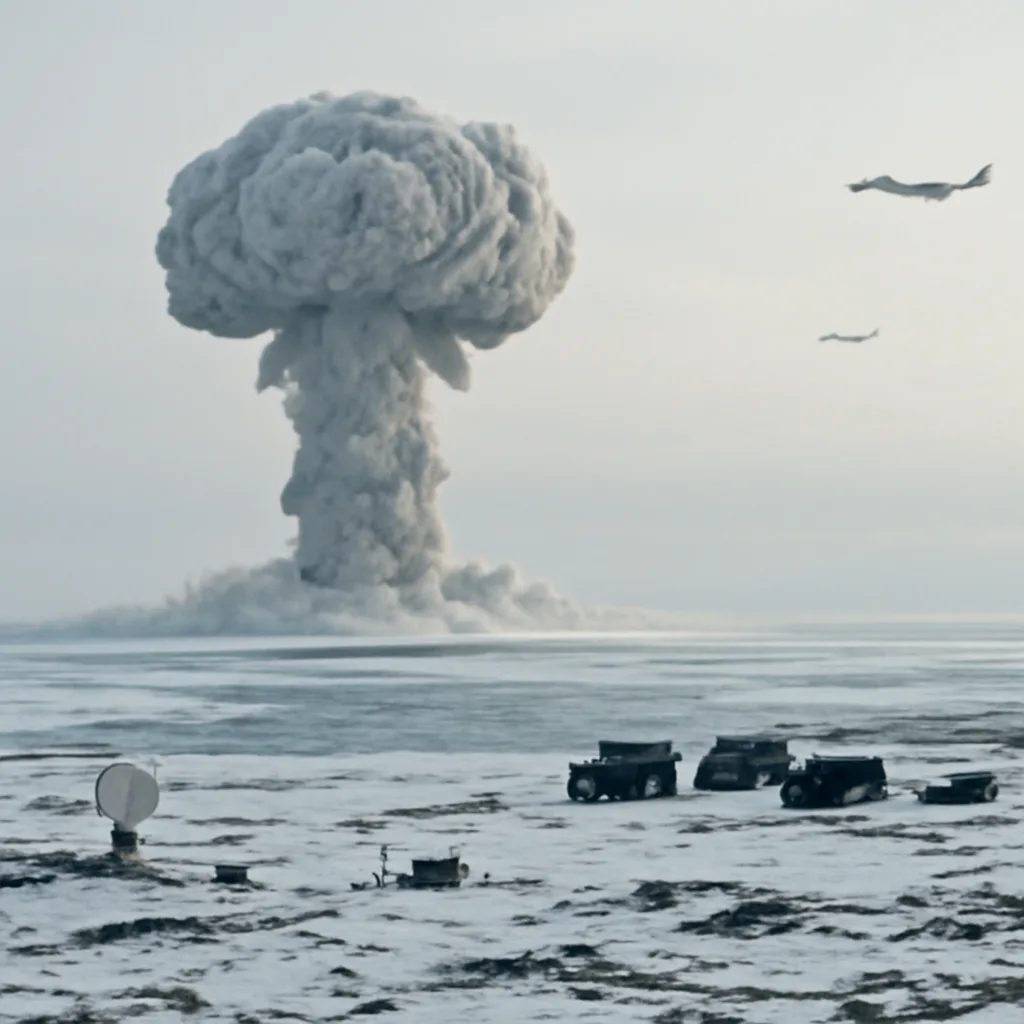
On October 30, 1961, the Soviet Union detonated the Tsar Bomba over Novaya Zemlya — the most powerful nuclear explosion ever tested — reverberating worldwide with unprecedented blast and atmospheric effects.
The test was conducted from a specially modified Tu-95V bomber that released the weapon over the Sukhoy Nos test site on the northern island of the archipelago. The bomber and accompanying observation aircraft were flying at high altitude; the delivery aircraft escaped but was reportedly damaged by the blast’s shockwave. Photographs and film released by the Soviets showed a massive mushroom cloud rising tens of kilometers into the atmosphere and a fireball visible from hundreds of kilometers away.
Physical and environmental effects were extraordinary by nuclear-test standards. The blast produced a shock wave that circled the globe multiple times and broke windows hundreds of kilometers from the detonation site. Thermal radiation reportedly caused third-degree burns at distances tens of kilometers away under certain conditions, and the rising cloud reached the stratosphere. Because the device’s design removed the third-stage fission tamper, radioactive fallout was reduced compared with what a full 100-megaton fission-fusion-fission device would have produced, but the explosion nevertheless contributed to atmospheric nuclear testing’s cumulative global contamination.
The test was both a technological demonstration and a political signal. In the context of 1961, the Soviet leadership sought to showcase strategic capability and deterrence amid intense superpower rivalry. Western governments and public opinion reacted with alarm; the test intensified debates over civil defense, nuclear strategy, and arms control. It also fed into the growing international movement toward limiting atmospheric nuclear testing, culminating in the 1963 Partial Test Ban Treaty, which banned nuclear weapons tests in the atmosphere, outer space, and underwater.
Historical assessments emphasize that Tsar Bomba had little practical military utility: its extreme yield made deployment impractical for most strategic scenarios, and the reduction to 50 megatons reflected Soviet concerns about fallout and delivery constraints. The test instead functioned as a statement of scientific and industrial capacity and as a psychological instrument in Cold War diplomacy.
Details about the event derive from a mix of Soviet-era releases, post-Soviet archival material, Western intelligence analyses, and contemporary journalism. Some technical specifics — including exact yield and internal design choices — retain elements of uncertainty or rely on declassified or eyewitness sources whose precision varies. Nonetheless, the broad outlines — date, location, platform, approximate yield, and geopolitical significance — are well established in the historical record.
The Tsar Bomba remains a landmark in nuclear history: a demonstration of the vast energies accessible through nuclear fusion and a reminder of the environmental and political consequences of atmospheric testing. It helped shape subsequent arms-control efforts and public awareness of the global risks posed by nuclear weapons.