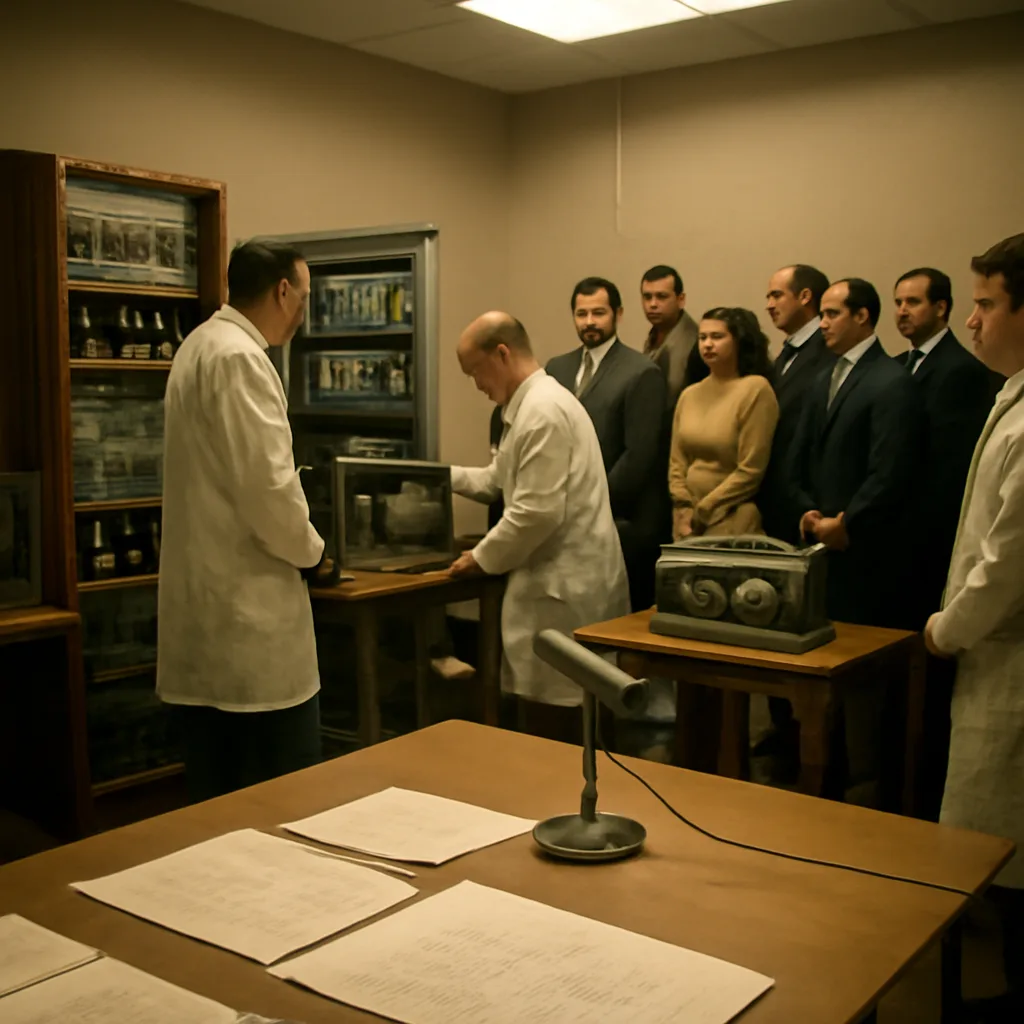
First public demonstration of voice recognition technology, May 11, 1961
On May 11, 1961, researchers publicly demonstrated an early voice recognition system that could distinguish spoken digits and limited vocabulary, marking a milestone in speech-processing research though performance remained limited by contemporary hardware and algorithms.
On May 11, 1961, an early public demonstration showcased a machine capable of recognizing spoken words, an event often cited as a milestone in the development of automatic speech recognition (ASR). The demonstration reflected decades of prior research in acoustics and computing and helped shift speech processing from laboratory curiosity toward practical engineering challenge.
Background
By the late 1950s and early 1960s researchers had developed theoretical and experimental tools for analyzing speech sounds and building systems that could respond to limited vocal input. Work at Bell Laboratories, IBM, and several universities explored how to extract acoustic features and map them to linguistic units. Early systems were constrained by available computing power, rudimentary microphones, and incomplete models of speech variability across speakers and environments.
The demonstration
The May 11, 1961 demonstration presented a system that could recognize a small vocabulary—commonly digits or a limited set of words—spoken by one or a few trained speakers. Systems of that era typically relied on template-matching methods or simple spectral analyses implemented on analogue or early digital equipment. While exact technical details of the specific machine shown at this public demonstration vary among contemporary reports, the showcased capability was to accept spoken input and produce a reliable, repeatable output under controlled conditions. Performance degraded with background noise, unfamiliar speakers, or spontaneous speech, which limited immediate practical application.
Significance
Although primitive by later standards, the 1961 demonstration had several important effects. It drew public and scientific attention to the possibility of human–machine vocal interaction, helping secure funding and institutional support for further research. The event also exposed limitations of the approaches then in use, stimulating new lines of inquiry such as statistical modeling of speech, improved signal processing, speaker-independence, and the need for larger speech corpora.
Technical context and limitations
Systems at that time typically recognized only a few words and often required speaker training. They relied on handcrafted signal features and direct template comparisons rather than the probabilistic and machine-learning methods that would emerge decades later. Hardware constraints—limited memory, slow processors, and analog components—meant that demonstrations were feasible only in controlled acoustic environments and often required human intervention for preprocessing or disambiguation.
Aftermath and legacy
The demonstration is remembered as an early public milestone rather than the moment speech recognition became practical. Subsequent research through the 1960s and 1970s investigated dynamic time-warping, hidden Markov models, and other statistical techniques that addressed variability in speech. Progress was incremental: systems gradually expanded vocabularies, improved robustness to different speakers, and moved from laboratory prototypes to specialized applications. The 1961 demonstration thus occupies a place in a longer arc that eventually produced widely deployed speech technologies decades later.
Historical caveats
Contemporary descriptions of the May 11, 1961 demonstration sometimes differ in technical detail and in claims about what exactly was recognized and under what conditions. Some accounts emphasize digit recognition; others describe recognition of a small command set. Because reporting from the period was uneven and standards for performance measurement were not yet established, precise, universally agreed technical specifications for the system shown are not always available. Nonetheless, historians of computing and speech science generally treat the event as an early, influential public showing of automatic voice recognition technology.