
← Back
01/25/1985 • 7 views

First Recorded Robotic-Assisted Surgery Performed
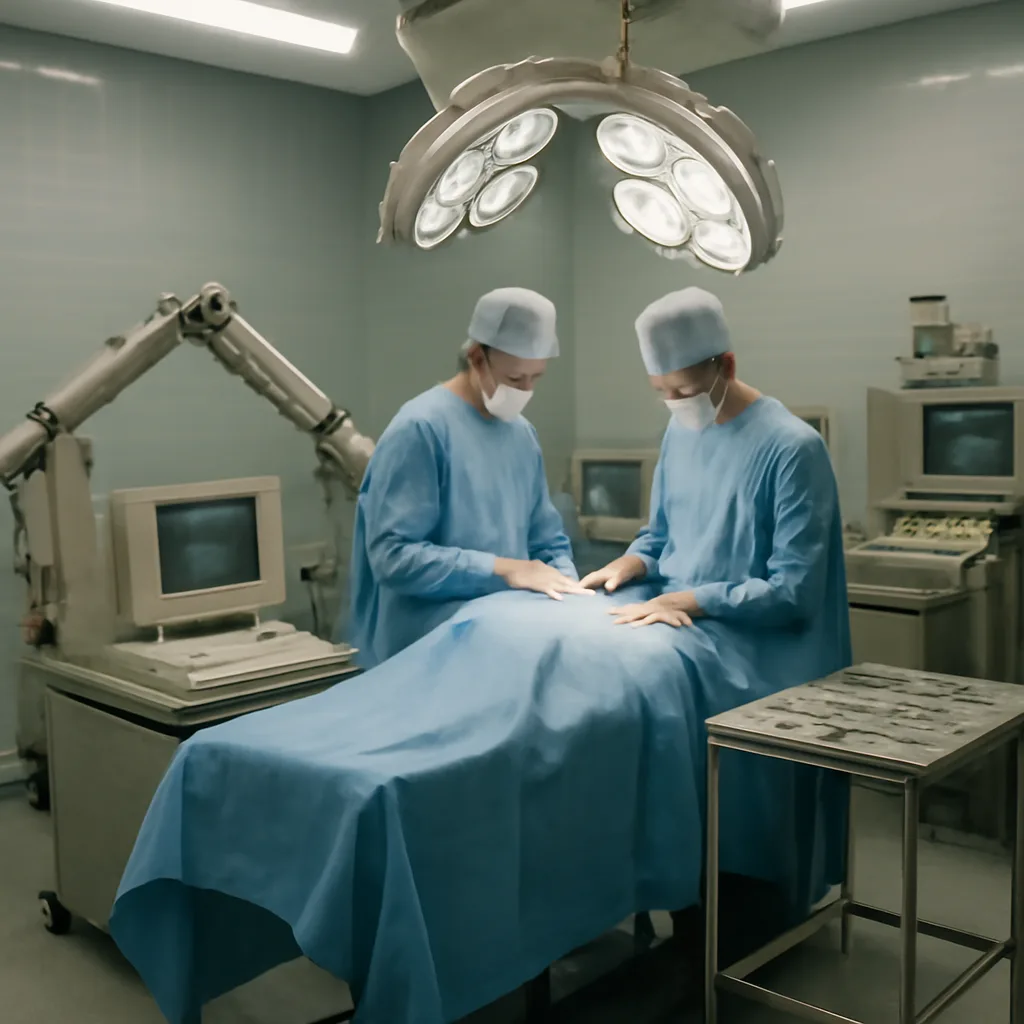
Operating room in the mid-1980s showing a surgeon and an assistant working with a computer-controlled mechanical arm beside an operating table, surgical instruments and a CRT monitor visible.

On January 25, 1985, surgeons used a computer-controlled robotic system to assist in a surgical procedure—an early milestone in robotic surgery that marked the beginning of decades of development in computer-assisted operative techniques.


On January 25, 1985, a surgical team performed what is widely cited as one of the first instances of robotic-assisted surgery, using a computer-controlled manipulator to aid in a procedure. The event did not involve an autonomous robot acting independently; rather, it featured an electromechanical device controlled by surgeons and/or a computer to enhance precision, dexterity, or remote manipulation. This milestone is commonly referenced in histories of computer-assisted and robotic surgery as an early demonstration of integrating robotic manipulators into the operating room.

Context and technology

By the early 1980s, engineers and clinicians were experimenting with combining robotics, computer control, and imaging to address surgical challenges. Systems developed in that era aimed to stabilize instruments, scale motion, filter hand tremor, or enable remote manipulation in constrained environments. The devices typically consisted of robotic arms or manipulators, servo motors, and control software, and they were tested initially in lab settings, on models, cadavers, or in limited clinical cases under careful supervision.

The 1985 procedure

Details about the specific January 25, 1985 procedure vary in descriptions and secondary sources, and contemporary reporting was limited. What is clear from the historical record is that the procedure involved a computer-controlled manipulator used under surgeon control, rather than an autonomous decision-making machine. The goal was to assist the surgeon’s movements and demonstrate that robotic systems could operate in the sterile, delicate environment of the operating room.

Significance and legacy

This 1985 case is significant as an early proof of concept showing that robots could be integrated into surgical workflows. It helped catalyze further research and investment throughout the late 1980s and 1990s into more advanced telemanipulators, image-guided systems, and force-feedback controls. Those developments eventually led to commercially adopted systems in the late 1990s and 2000s that expanded minimally invasive and remote surgical capabilities.

Limitations and caution

Contemporary accounts and later histories emphasize that early robotic-assisted procedures were experimental, limited in scope, and conducted with extensive human oversight. There is not a single universally accepted "first" robotic surgery; claims depend on how one defines "robotic" (e.g., remote telemanipulation, computer-assisted positioning, or autonomous function). Because primary-source contemporaneous documentation is sparse or distributed across engineering and medical publications, some details about the January 25, 1985 case are summarized from later historical reviews rather than abundant original reporting.

Why it matters now

Understanding the 1985 event helps place today’s surgical robotics in context: modern systems evolved through incremental technical advances, regulatory processes, and clinical validation. The early experiments demonstrated feasibility and safety concerns, informed design priorities (precision, ergonomics, imaging integration), and shaped clinicians’ and engineers’ collaborations that underpin current robotic surgery practice.

Further reading

For a rigorous historical account, consult peer-reviewed histories of surgical robotics and primary reports from engineering and surgical journals from the 1980s and 1990s, which discuss specific systems, laboratory tests, and early clinical cases in detail.

Share this

Email Share on X Facebook Reddit

Did this surprise you?