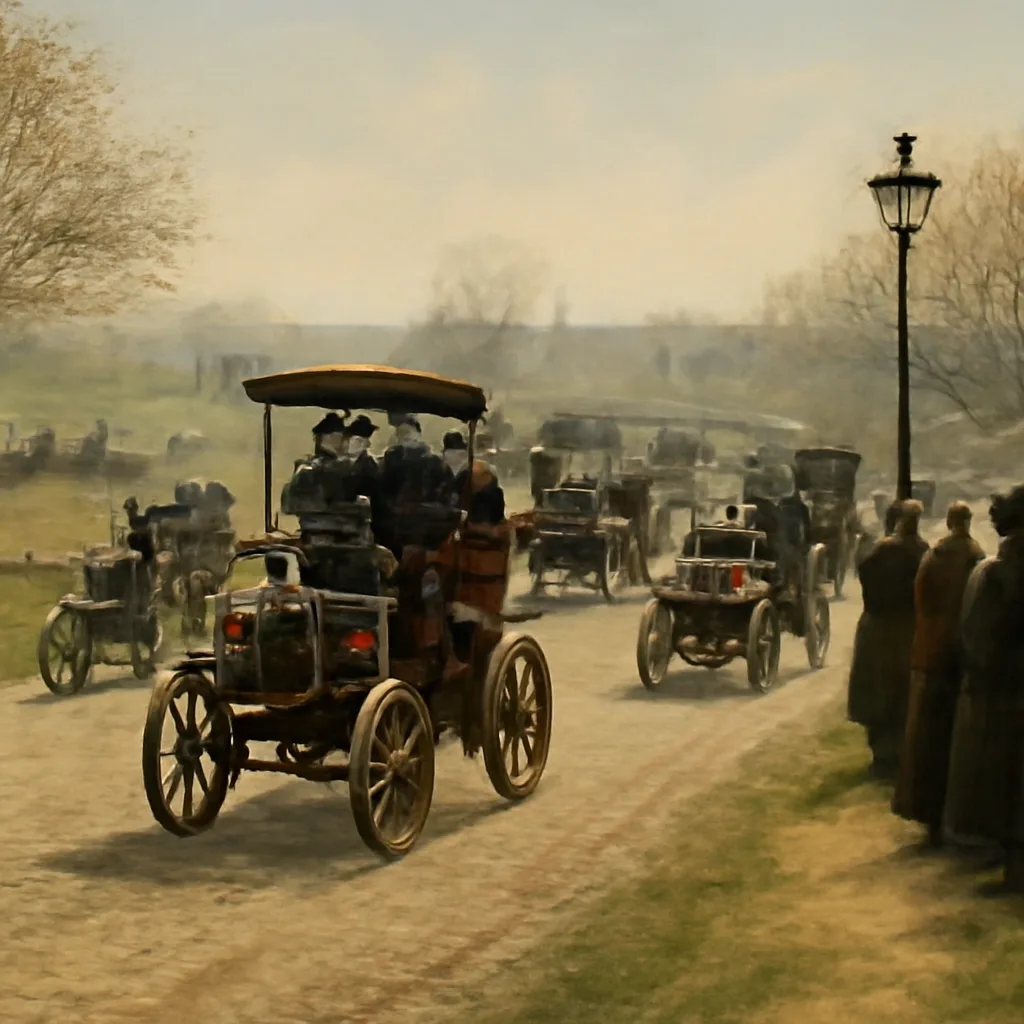
France’s First Recorded Automobile Race, Paris–Rouen, April 28, 1894
On April 28, 1894, the Paris–Rouen trial, organized by Le Petit Journal, ran as the first widely recognized automobile competition: a judged contest of reliability and safety over roughly 126 km between Paris and Rouen that helped launch public interest in horseless vehicles.
On 28 April 1894, a motor-vehicle trial held between Paris and Rouen is widely regarded as the first recorded automobile competition. Organized by the French newspaper Le Petit Journal, the event was billed as a contest to find the "best" horseless carriages suitable for everyday use rather than a speed-only race. Entrants left Paris on a route to Rouen of roughly 126 kilometres (about 78 miles), passing through a mix of paved and unpaved country roads of the late 19th century.
The Paris–Rouen event grew out of growing experimentation with steam, electric, and internal-combustion vehicles. Organizers set conditions emphasizing safety, ease of operation, and economy—criteria intended to encourage practical designs for public roads. Vehicles were evaluated not only for time but for handling, braking, and general suitability for ordinary drivers. This emphasis reflected contemporary public concern about reliability and the intended audience of potential users rather than purely competitive motoring.
A range of propulsion technologies took part, including small steam cars, battery-powered vehicles, and petrol (gasoline) engines. Although several entrants completed the course, the organizers awarded the main prize differently than in modern races: while the fastest entrants were noted, the official jury recognized those judged most reliable and practical for everyday use. The Paris–Rouen trial thus functioned as both demonstration and competition, attracting public spectators and press attention that helped popularize the concept of motorized road transport.
The event’s legacy is twofold. Practically, it stimulated interest and investment in motor vehicles and encouraged improvements in engines, chassis, and controls. Culturally, it marked a public, organized moment when horseless carriages transitioned from experiments and curiosities to candidates for ordinary road use. Historians often cite the 1894 Paris–Rouen trial as the first recorded automobile competition because of its documented route, participants, and newspaper-sponsored organization, though earlier informal tests and local demonstrations of motor vehicles occurred elsewhere.
It is important to note nuances in the historical record: some earlier experiments and contests involving self-propelled vehicles—particularly steam-powered road vehicles and horseless carriage demonstrations—precede 1894, and definitions vary about what constitutes a "race." The Paris–Rouen event is widely accepted as a first formal, widely reported competition combining multiple vehicles over a public route with evaluative criteria published in advance.
For readers today, the 1894 trial offers a window into the era’s technical variety and public attitudes. Competitors faced rough roads, limited infrastructure, and evolving safety norms. The publicity generated by Le Petit Journal and contemporary newspapers helped shape public perception and policy debates about speed, regulation, and the place of motor vehicles in urban and rural life. From that spring day in 1894, organized motor competitions and demonstrations multiplied across Europe, eventually evolving into the motor-sport and automotive industries known in the 20th century.