
← Back
06/22/1941 • 4 views

Germany Launches Operation Barbarossa, Invades the Soviet Union
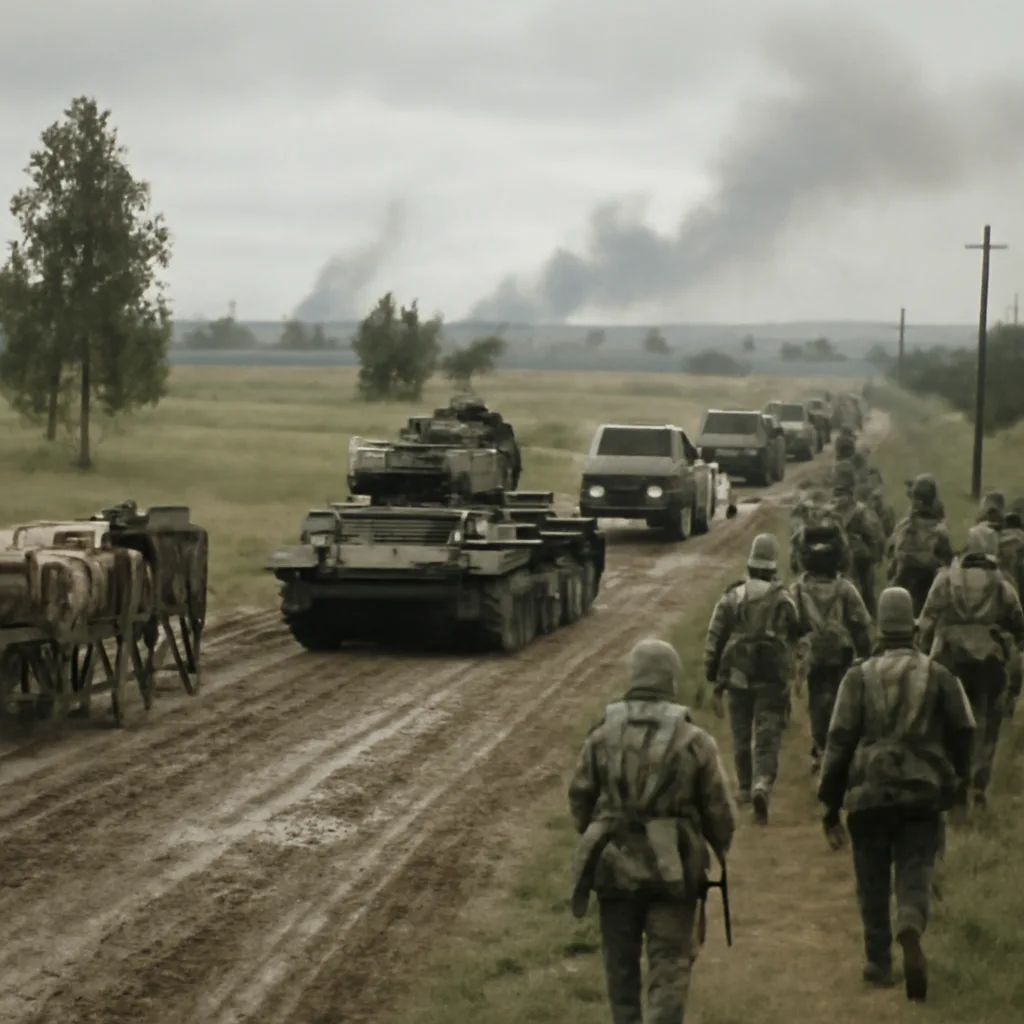
German armored columns and infantry advancing on a broad rural road toward a distant town in summer 1941, with military vehicles, horse-drawn carts, and soldiers in Wehrmacht uniforms; smoke on the horizon and a wide sky.

On 22 June 1941, Nazi Germany and its Axis allies launched Operation Barbarossa, a massive surprise invasion of the Soviet Union that opened the Eastern Front of World War II and transformed the conflict into the largest land war in history.


On 22 June 1941, German forces and their Axis partners initiated Operation Barbarossa, a large-scale surprise invasion of the Soviet Union that marked a decisive escalation of World War II. Conceived during 1940–41 by Adolf Hitler and the German High Command, Barbarossa aimed to defeat the Soviet state rapidly, seize territory for Germany’s strategic and ideological goals, and eliminate what Nazi leaders framed as the perceived Bolshevik threat.

The operation deployed roughly three million Axis personnel along a front stretching more than 1,800 miles (≈3,000 km), organized into three army groups: North toward Leningrad, Centre toward Moscow, and South toward Ukraine and the Black Sea. Germany committed vast numbers of tanks, motorized infantry, artillery and close air support, while Romania, Hungary, Finland and Italy provided auxiliary forces in certain sectors. The German plan relied on blitzkrieg tactics—rapid armored thrusts supported by air power—to encircle and destroy Soviet forces before Moscow could be reinforced.

Initial phases saw remarkable German territorial gains and heavy Soviet losses. Large encirclements at battles such as Bialystok–Minsk and Smolensk led to the capture of hundreds of thousands of Soviet troops and vast quantities of materiel. The Luftwaffe gained air supremacy in many sectors, aiding rapid advances. However, despite operational successes, Germany failed to achieve a decisive collapse of Soviet resistance. Soviet forces, often retreating in disorder early on, repeatedly regrouped, imposed heavy casualties, and conducted counterattacks that slowed German momentum.

Several factors undercut German prospects of a quick victory. The sheer scale of the front stretched logistics, leaving supply lines vulnerable to breakdowns. The vast distances, poor road and rail infrastructure, and onset of the Russian winter strained mechanized units ill-prepared for prolonged cold-weather operations. Soviet industrial capacity and wartime mobilization—partly enabled by relocating factories east of the Urals—sustained prolonged resistance. Additionally, Hitler’s strategic decisions, including diverting forces to secondary objectives such as the southern campaign for Ukraine and the Siege of Leningrad, diluted the drive toward Moscow.

Barbarossa transformed the nature of the war: it unleashed a brutal and ideologically driven conflict characterized by mass atrocities, widespread civilian suffering, and the targeting of Jews, political commissars and other groups in occupied territories. The warfare on the Eastern Front became marked by staggering casualty figures and extensive destruction. By late 1941 and into 1942, German advances had stalled, and the campaign evolved into a prolonged, attritional war that ultimately contributed to Nazi Germany’s defeat.

Historians debate aspects of the planning and inevitability of Barbarossa, including whether Germany could have achieved its objectives and the degree to which ideological imperatives affected military strategy. What is widely agreed is that the 22 June 1941 invasion opened the Eastern Front—a theater whose scale, intensity and consequences shaped the remainder of World War II and the postwar order in Europe.

The date remains a pivotal point in 20th-century history: a turning point that expanded the war into the largest conventional land conflict ever fought and that precipitated immense human, military and geopolitical consequences across Eurasia.

Share this

Email Share on X Facebook Reddit

Did this surprise you?