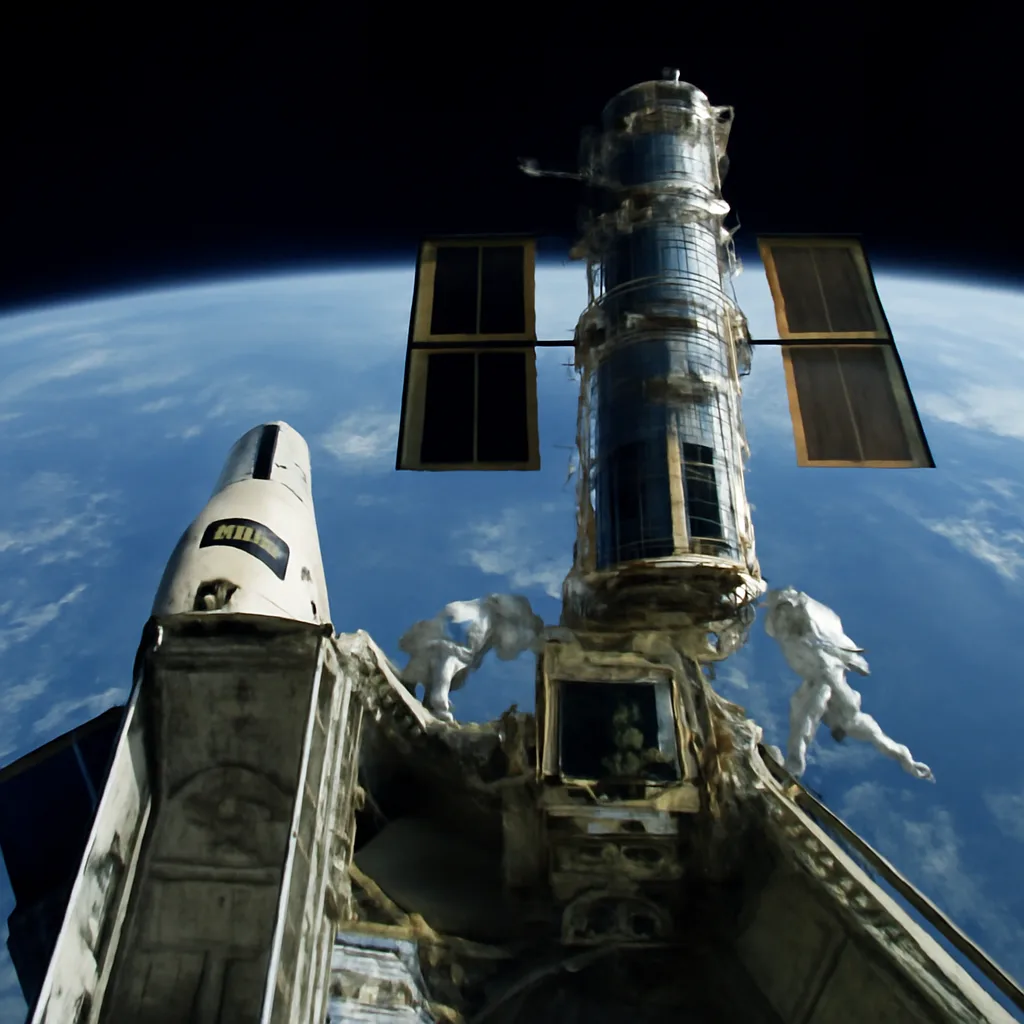
NASA conducts 1993 servicing mission to repair Hubble Space Telescope
On December 2, 1993, NASA launched a Space Shuttle mission to install corrective optics and upgraded instruments on the Hubble Space Telescope, addressing flaws discovered after its 1990 deployment and restoring the telescope's intended imaging performance.
Background
The Hubble Space Telescope (HST) was deployed by the Space Shuttle Discovery during mission STS-31 in April 1990. Soon after activation, engineers discovered that the telescope's primary mirror had been ground with a slight spherical aberration. The flaw limited Hubble's ability to deliver the sharp, high-contrast images anticipated by scientists and the public.
Mission planning and objectives
In response, NASA planned a servicing mission to correct Hubble's optics and upgrade its instruments. The mission, designated STS-61 and flown by Space Shuttle Endeavour, was scheduled for late 1993. Primary objectives included installing corrective optics for the Wide Field and Planetary Camera (WF/PC), replacing WF/PC with the Wide Field and Planetary Camera 2 (WFPC2) that incorporated a built-in corrective optical element, installing the Corrective Optics Space Telescope Axial Replacement (COSTAR) to supply corrective optics for other instruments, replacing solar arrays, and performing general maintenance and upgrades to extend Hubble's operational life.
Launch and crew
STS-61 launched on December 2, 1993. The mission carried a crew of seven astronauts, including specialists trained for multiple spacewalks (extravehicular activities, or EVAs). The timeline called for five EVAs to accomplish the complex installation and repair tasks.
Key repairs and upgrades
A central accomplishment of the mission was the installation of WFPC2, which corrected the aberration for its own imaging channel by incorporating small corrective mirrors. For instruments not replaced, COSTAR provided deployable corrective mirrors that intercepted the telescope's light path and redirected corrected light into the affected instruments' detectors. Crew members also replaced the telescope's solar arrays with more stable units and upgraded other hardware to improve pointing stability and electrical performance.
Spacewalks and technical challenges
The mission included five EVAs spread over several days. Astronauts performed delicate removal and installation work in Hubble's accessible instrument bay while contending with the challenges of working in pressurized suits, limited toolsets, and the need for extreme precision when aligning optical components. The complexity of some tasks required careful in-orbit problem solving and choreography between the crew and Mission Control.
Outcomes and significance
After the servicing mission, Hubble's imaging performance improved markedly. The corrective optics restored the telescope's intended angular resolution and contrast, enabling the instrument suite to produce far sharper astronomical images. The upgrades extended Hubble's scientific productivity for decades; subsequent discoveries and observations using the repaired telescope had major impacts across astrophysics, from refining the Hubble constant to detailed studies of distant galaxies, star formation, and planetary atmospheres.
Legacy
STS-61 is widely regarded as a pivotal moment in the Hubble program and human spaceflight operations. It demonstrated the feasibility and value of on-orbit servicing for complex scientific observatories, setting a precedent for later Hubble servicing missions and influencing designs for future serviceable space assets. The mission also helped restore public confidence in the telescope and in NASA's capacity to address challenging technical problems in space.
Notes on sources and accuracy
This summary reflects well-documented historical events surrounding Hubble's 1993 servicing mission (STS-61). Specific operational details, crew lists, and EVA counts are recorded in NASA mission archives and contemporary reporting. Where fine operational or scheduling details varied during planning and execution, those nuances are not elaborated here but are available in mission transcripts and NASA technical reports.