
09/23/1999 • 5 views
NASA Confirms Loss of Mars Climate Orbiter After Navigation Failure
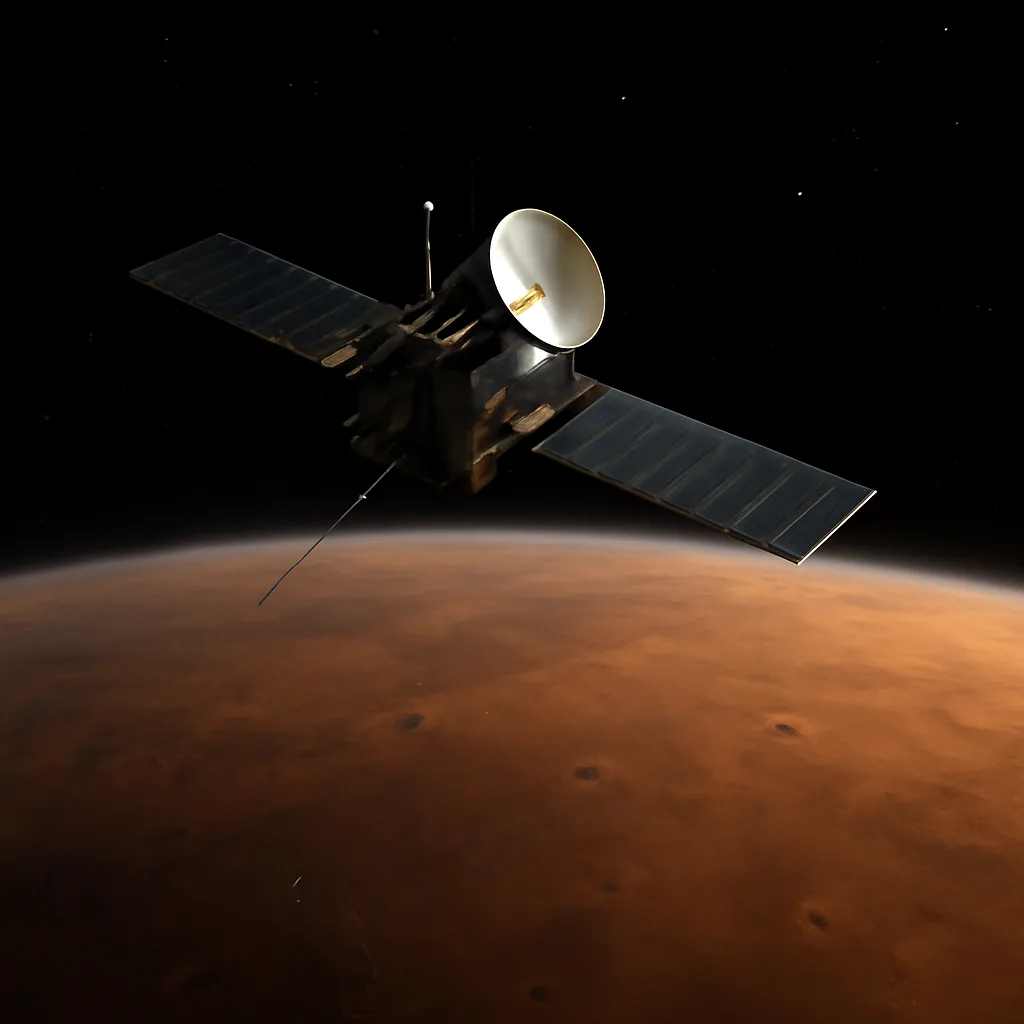
NASA announced on September 23, 1999, that the Mars Climate Orbiter was lost during orbital insertion, likely due to a metric-imperial units navigation error that caused the spacecraft to enter Mars’ atmosphere at a destructive trajectory.
Events and timeline
- Cruise and approach: Mars Climate Orbiter completed its interplanetary cruise and began the approach phase in September 1999, preparing for a burn to place it into the planned polar, sun-synchronous orbit.
- Orbital insertion attempt: During the planned Mars orbit insertion on September 23, the spacecraft performed a burn, but telemetry indicated that the resulting trajectory was inconsistent with a safe insertion.
- Loss of contact and assessment: Shortly after the burn, NASA lost communications. Analysis of tracking data and planning timelines led investigators to conclude that the orbiter likely flew too low over the Martian atmosphere, where aerodynamic forces and heating caused its destruction.
Cause and investigation
An independent investigation led by an internal NASA team and external reviewers identified a navigation error rooted in a units mismatch between two ground-based software systems. One piece of navigation software produced results in pound-seconds (imperial units) while the rest of the navigation team expected the data in newton-seconds (metric units). That discrepancy caused mission planners to underestimate the force applied during course corrections and resulted in incorrect trajectory calculations.
The mismatch was not detected in time to correct the approach. The final report emphasized procedural and organizational failures: inadequate end-to-end testing, insufficient verification of software interfaces, communication gaps between teams, and shortcomings in oversight. The report recommended stronger standards for unit consistency, improved verification and validation of flight software and ground tools, and organizational changes to reduce risk for future missions.
Consequences and legacy
The loss of Mars Climate Orbiter and the later failure of the Mars Polar Lander in the same program prompted NASA to suspend similar missions temporarily and to revamp its project management and engineering practices for interplanetary missions. The agency implemented stricter systems engineering protocols, enhanced independent reviews, and mandated more rigorous cross-checks of software interfaces and units.
Although the orbiter was lost, the lessons learned contributed to later successes in Mars exploration. Revised processes and heightened attention to verification helped improve reliability for subsequent missions, including the Mars Global Surveyor, Mars Odyssey, and later rovers and orbiters that have returned extensive scientific data.
Uncertainties and disputes
The broad cause—a units conversion error leading to navigation miscalculations—is well documented in NASA’s investigation reports from 1999 and 2000. Details about internal communications and the precise sequence of human and software contributions to the failure are described in those reports; while the units mismatch is widely accepted as the proximate technical cause, investigators also highlighted systemic management and procedural shortcomings as contributing factors.
Context
The Mars Climate Orbiter was a high-profile loss for NASA at the end of the 1990s, a period when the agency was refining its approach to frequent interplanetary missions. The incident remains a commonly cited case study in engineering and project management courses for the importance of consistent units, thorough testing, and clear organizational responsibilities.
Sources
This summary is based on contemporaneous NASA announcements and the subsequent investigation reports and reviews published by NASA and independent panels following the loss in September 1999.