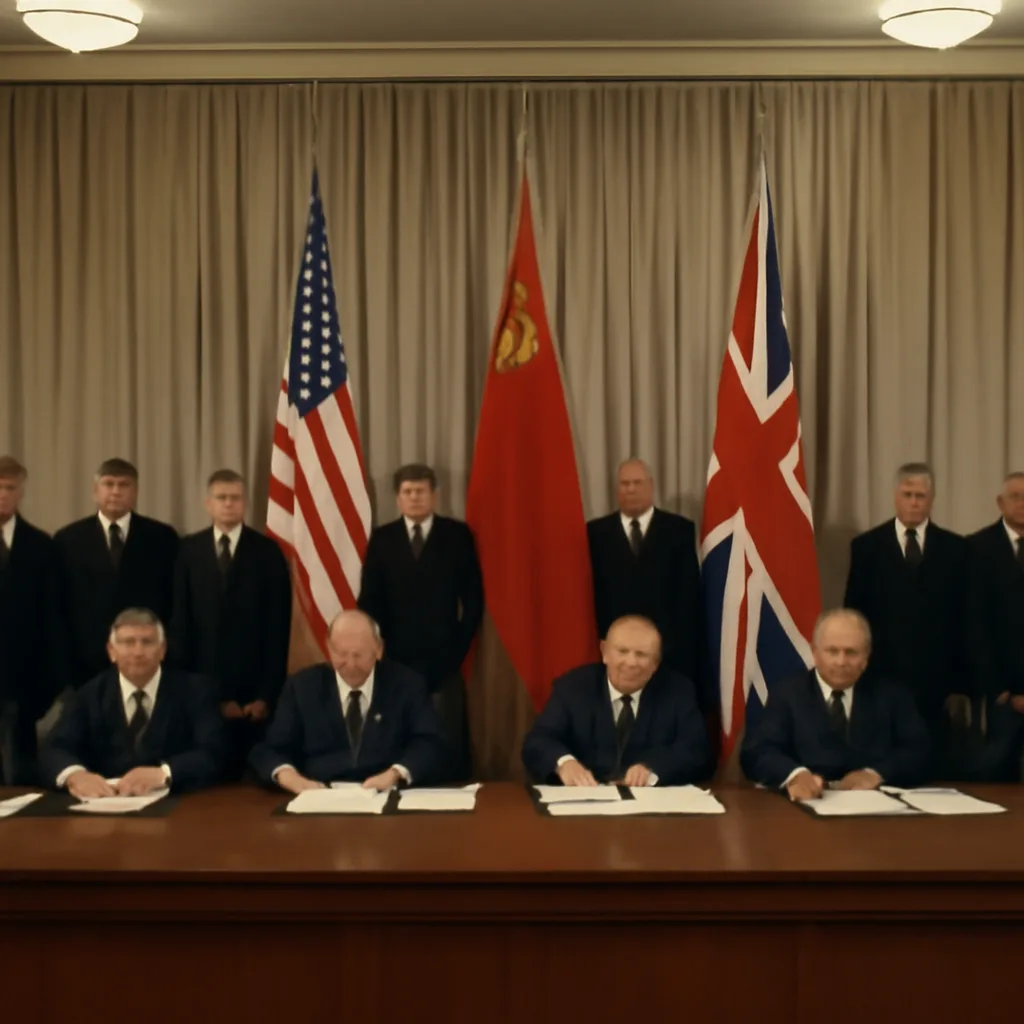
United States and Soviet Union Sign Limited Nuclear Test Ban Treaty
On September 23, 1963, the United States and the Soviet Union joined 100 other nations in signing the Limited (Partial) Test Ban Treaty, agreeing to prohibit nuclear tests in the atmosphere, outer space, and underwater while allowing underground tests.
On September 23, 1963, representatives of the United States and the Soviet Union signed the Limited Test Ban Treaty (commonly called the Partial Test Ban Treaty) in Moscow, marking a significant step in Cold War arms-control diplomacy. The accord prohibited nuclear weapons tests in the atmosphere, in outer space and under water, while permitting underground tests so long as no radioactive debris fell outside the boundaries of the test state. The treaty was opened for signature by the three principal initiators—the United States, the Soviet Union and the United Kingdom—and ultimately accrued the signatures of more than 100 states.
Background: The early Cold War era saw a rapid expansion of nuclear weapons testing, including atmospheric detonations that dispersed radioactive fallout globally. Growing public concern about health and environmental effects—intensified by visible tests and scientific studies of fallout—combined with geopolitical risks of unconstrained testing, pushed both superpowers toward negotiation. The Cuban Missile Crisis of 1962, which brought the world close to nuclear confrontation, increased political will in Washington and Moscow to find measures that would reduce nuclear danger and stabilize strategic relations.
Negotiations and scope: Negotiations toward a test-ban had been intermittent for years and involved scientific, political and verification challenges. The 1963 treaty addressed the most politically urgent forms of testing by banning detonations that released radioactive material into the environment. It did not attempt to ban underground testing entirely, in part because monitoring technology of the era was limited and because each nuclear power insisted on retaining some test capability for weapons development and safety. The treaty contained provisions for consultation and cooperation on verification and for ongoing scientific exchange related to the peaceful uses of nuclear energy.
Significance and limits: The treaty was significant both symbolically and practically. Symbolically, it represented cooperation between rivals and delivered a visible policy response to global public concern about fallout. Practically, it reduced the amount of radioactive material released into the atmosphere and created an early multilateral arms-control precedent. However, the agreement had clear limitations: it did not stop the qualitative or quantitative buildup of nuclear arsenals conducted through underground tests, nor did it constrain delivery systems, doctrines, or stockpiling directly. Some states—notably France and the People’s Republic of China—did not sign the 1963 treaty and continued atmospheric testing for several years thereafter.
Implementation and legacy: The treaty entered into force in October 1963 after ratification by the three depositary states (United States, Soviet Union and United Kingdom). It paved the way for later arms-control measures by establishing that negotiated limits on nuclear activities were politically achievable. Advances in seismic and other detection technologies over subsequent decades improved verification of underground tests and helped enable later agreements, such as the Threshold Test Ban Treaty (1994) and the Comprehensive Nuclear-Test-Ban Treaty (opened for signature in 1996, not yet in force as of this writing). The 1963 treaty remains a landmark in Cold War diplomacy and in international efforts to curb the environmental and humanitarian harms of nuclear testing.
Historical note: Different sources use varying names—“Limited Test Ban Treaty” and “Partial Test Ban Treaty” are both widely used. While the treaty curtailed many forms of nuclear testing, it did not establish a universal ban; that continuing effort has been a long-term component of international arms-control work.