
← Back
02/16/1540 • 7 views

Public autopsy demonstration astonishes 1540 crowd
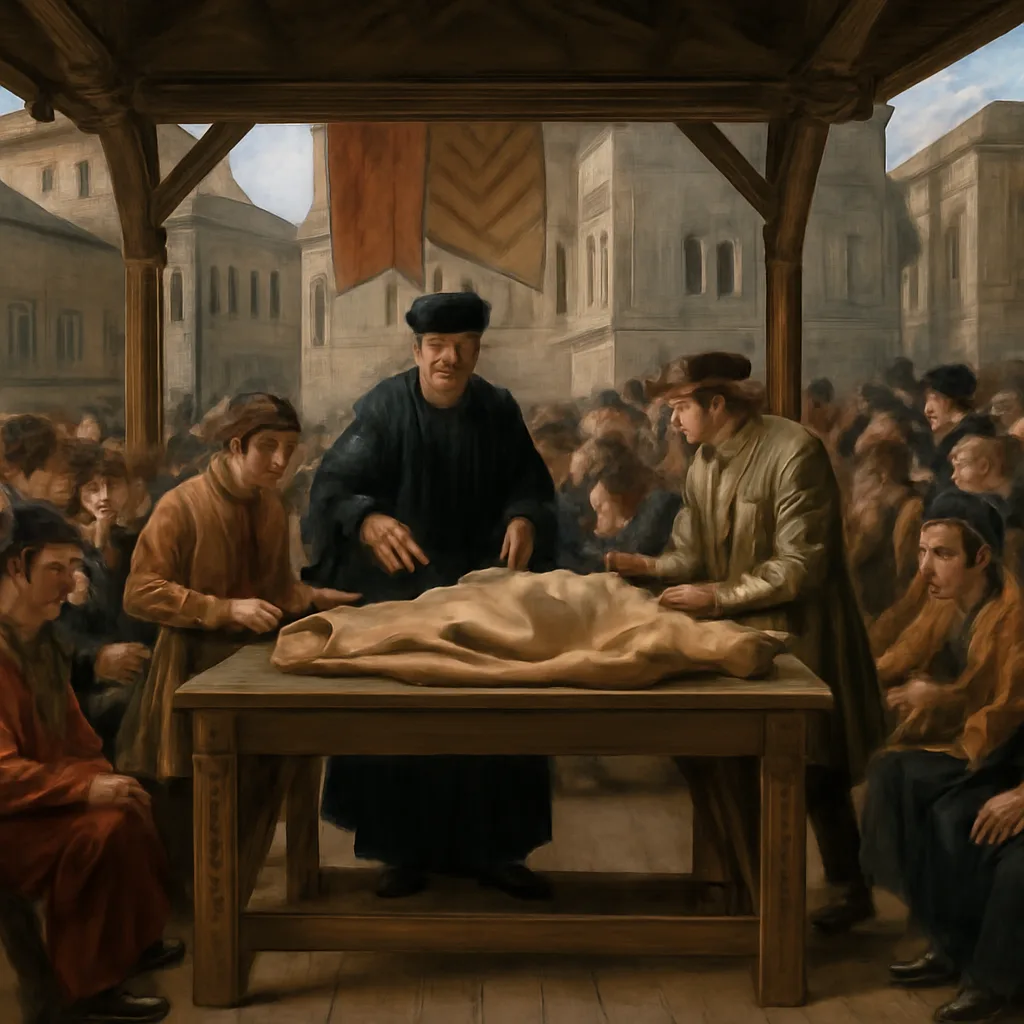
A 16th‑century public anatomical dissection in a courtyard or anatomical theatre with an anatomist attending a corpse while students and onlookers stand around; period clothing, surgical instruments and wooden benches visible.

On February 16, 1540, a public anatomical dissection drew large numbers of onlookers, marking a moment when examination of the human body began to move from private practice into a more public and instructional sphere in Renaissance Europe.


On 16 February 1540 a public anatomical dissection attracted notable attention, reflecting shifting attitudes toward hands‑on study of the human body in Renaissance Europe. Though exact details of this particular event vary by source, the practice of holding dissections for students, physicians and sometimes the wider public had become established in several Italian and northern European cities by the early 16th century. These demonstrations served educational, legal and scientific purposes: they trained surgeons and physicians, provided material for medical teaching, and in some cases helped clarify causes of death for legal authorities.

Public dissections in this period typically took place in a hospital courtyard, a university anatomical theatre or another civic space. A master anatomist—often affiliated with a university or a guild of surgeons—would perform the dissection, sometimes with assistants who handled instruments and removed tissues. A lecturer read from classical authorities like Galen and compared those texts with the findings before the audience. Because post‑mortem anatomy was still constrained by religious and civic norms, dissections were often performed on executed criminals or unclaimed bodies, and permissions varied by locality.

The spectatorship around dissections could be diverse. Medical students and practicing surgeons made up the core audience, but magistrates, clergy, and educated laypeople sometimes attended. The demonstrations were considered both educational and, by some contemporaries, morally or aesthetically challenging. Writers of the era described attendees’ mixture of curiosity and discomfort; visual records and later accounts show that dissections could draw substantial crowds when announced publicly.

The 1540 demonstration sits within a broader context of anatomical progress. Earlier in the century, anatomists such as Andreas Vesalius began to challenge received Galenic doctrine by insisting on direct observation of human bodies. Vesalius’s De humani corporis fabrica (1543) synthesized these empirical approaches and helped popularize the idea that anatomy should be based on dissection rather than unquestioning reliance on ancient texts. Public dissections reinforced the cultural shift toward observation-based medicine and helped institutionalize anatomical teaching in universities and hospitals.

At the same time, dissections remained regulated and sometimes controversial. Church teaching did not uniformly prohibit anatomical study, but local ecclesiastical authorities and civic magistrates often had a say in whether and how dissections were conducted. Practices such as the public display of bodies or the timing of burials could provoke debate. The use of criminal corpses, in particular, linked anatomy to the penal system and raised questions about dignity and the social status of the dead.

Accounts of public dissections from this period are uneven: surviving letters, university records, guild registers and later printed accounts provide fragments rather than comprehensive documentation. That makes precise reconstruction of any single 1540 event difficult without referencing a specific archival source. Nevertheless, the occurrence of an attention‑grabbing public autopsy demonstration on 16 February 1540 is consistent with known patterns of anatomical teaching and public curiosity in mid‑16th‑century Europe.

The legacy of such demonstrations is mixed. They advanced medical knowledge by encouraging direct observation and training, laying groundwork for later anatomical science. They also reflected social hierarchies and ethical tensions about the treatment of the dead. As dissection moved into institutional settings, it helped transform anatomy from a marginal practice into a central component of medical education, even as debates about propriety and consent persisted for centuries.

Share this

Email Share on X Facebook Reddit

Did this surprise you?