
← Back
01/26/1897 • 6 views

Referee John Brodie Knocked Unconscious by Spectator at 1897 Match
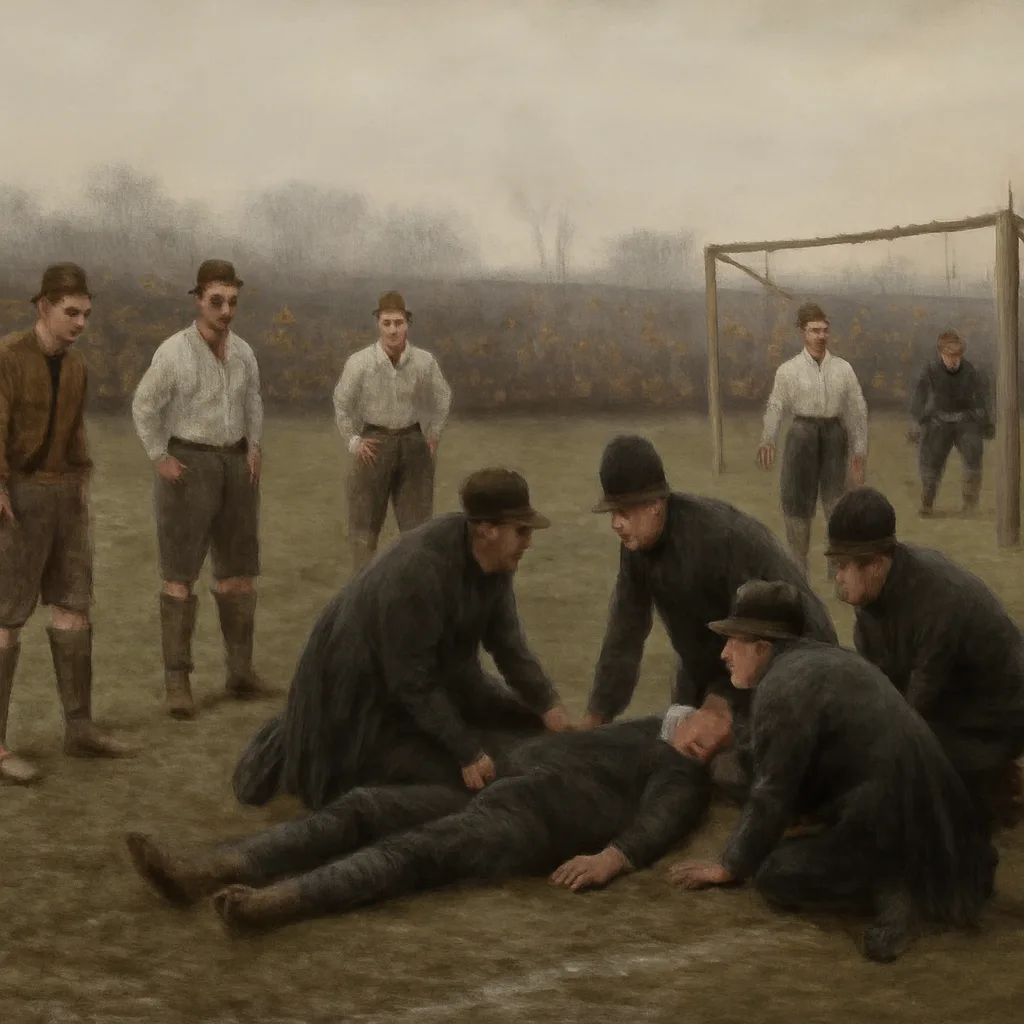
Late 19th-century football match with players on a grass pitch and spectators close to the touchline; a small group of officials and stewards at the edge of the field attending to an incident.

During a football match on January 26, 1897, referee John Brodie was struck and knocked unconscious by a spectator who rushed onto the field; reports from the period describe a violent intrusion that raised questions about crowd control at sporting events.


On 26 January 1897, referee John Brodie was rendered unconscious after being struck by a spectator who entered the playing area during a football match. Contemporary newspaper accounts reported that a member of the crowd rushed onto the field and engaged physically with Brodie, leading to immediate alarm among players, officials, and onlookers. The incident was notable at the time for its violence and for highlighting the limited measures then in place to separate spectators from participants at sporting events.

Details in period sources are uneven and sometimes conflicting. Several regional papers described the same basic sequence: a controversial decision or dispute on the field, a spectator abandoning the stands, and a physical confrontation in which Brodie was struck and fell unconscious. Other reports emphasized that stewards, police or club officials intervened, removing the assailant and escorting Brodie to receive medical attention. Accounts differ on the exact motive of the assailant and the severity of Brodie’s injuries, but no reliable contemporary source indicates that the referee’s life was lost; rather, he was reported incapacitated and tended to off the field.

The late 19th century was a period of rapid growth in organized football and other mass spectator sports in Britain and elsewhere. Stadium infrastructure, stewarding, and formal policing of matches were still developing, and incidents of crowd interference, while not everyday occurrences, were sufficiently frequent to spur debate about safety and crowd management. The Brodie incident contributed to discussions in sporting and civic circles about improving barriers, increasing steward presence, and clarifying the responsibilities of clubs and local authorities to protect officials and players.

Legal and disciplinary responses to such events varied. In comparable cases of the era, assailants could face local criminal charges for assault, and clubs might be censured or fined by governing bodies if inadequate crowd control was judged to have played a role. Contemporary press coverage of Brodie’s case called attention to the need for clearer rules and better enforcement, though systematic reforms unfolded gradually over subsequent years.

Because primary-source reports from 1897 can differ in detail, historians treat some specifics of the episode with caution: the exact identity and motive of the spectator who struck Brodie is not consistently recorded across surviving accounts, and descriptions of Brodie’s immediate medical condition vary. What is clear from multiple contemporary accounts is the broad fact that a spectator’s physical attack on the referee occurred on 26 January 1897, produced a serious but nonfatal injury that required removal from the field, and became a subject of public discussion about spectator behavior and match governance.

In the longer view, incidents like the assault on John Brodie helped prompt incremental changes in how sporting events were organized and policed. Improved crowd segregation, appointed stewards, clearer legal recourse for on-field assaults, and the professionalization of matchday management gradually reduced the frequency of such direct assaults on officials, though spectator violence remained an intermittent problem into the 20th century.

This summary relies on contemporaneous newspaper reportage and later historical overviews of spectator behavior and sports governance from the late Victorian era. Where contemporary sources disagree on particulars, this account notes uncertainty rather than inventing specifics.

Share this

Email Share on X Facebook Reddit

Did this surprise you?