
05/08/1667 • 9 views
Restoration London: The Great Fire Officially Declared Extinguished
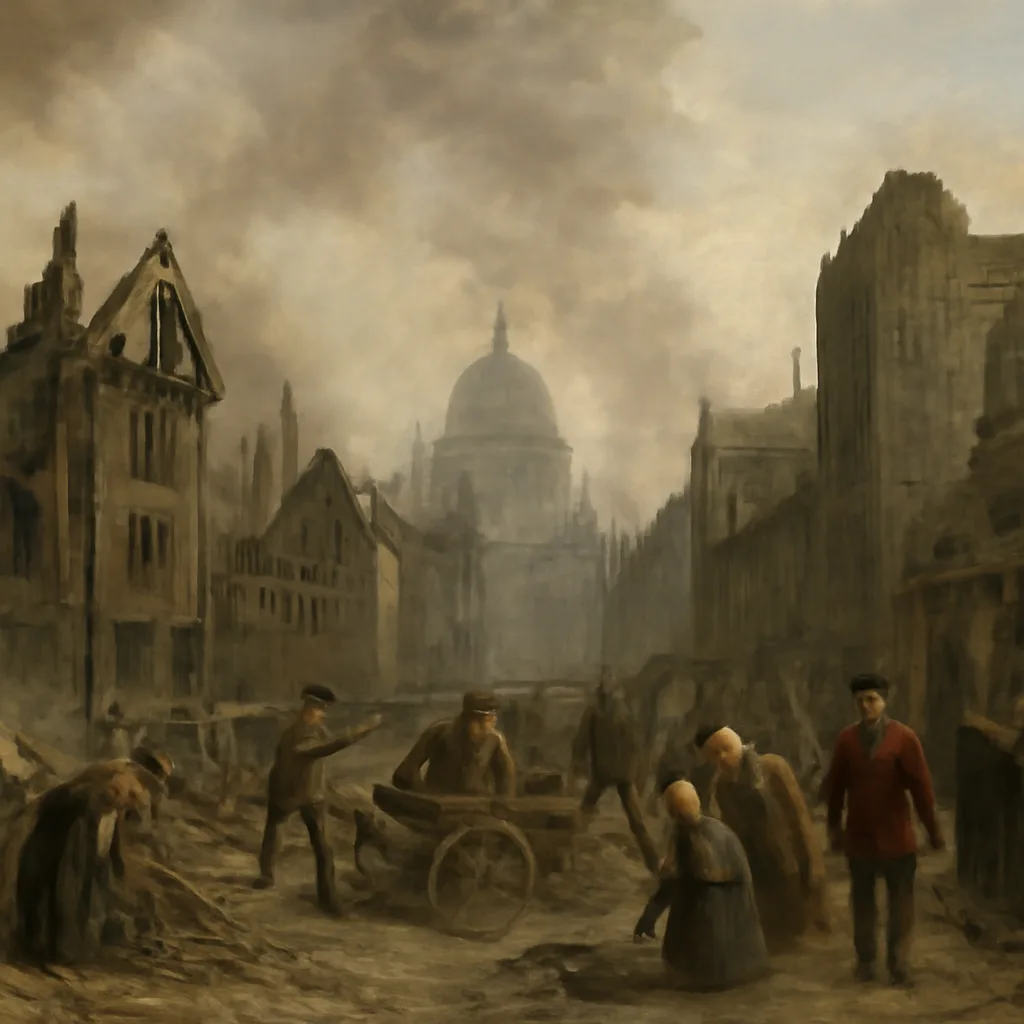
On 8 May 1667 authorities declared the Great Fire of London extinguished, ending the immediate danger though leaving much of the city in ruins and beginning a long period of rebuilding and legal dispute over property and responsibility.
Physical damage and human impact
The blaze consumed an estimated 13,200 houses, 87 parish churches, the old St Paul’s Cathedral, the Royal Exchange, and most civic buildings within the walls. Contemporary accounts disagree on exact casualty numbers; authorities recorded relatively few deaths compared with the scale of property loss, but modern historians caution that records undercounted poorer residents and that displacement and secondary suffering were substantial. Tens of thousands of inhabitants were rendered homeless and transported many parishes and neighbourhoods into protracted destitution.
Immediate response and the spring declaration
After firefighters, soldiers and labourers finally contained the flames in early September 1666, the winter and spring that followed involved clearing debris, securing scorched buildings, and preventing outbreaks of disease. The 8 May 1667 statement that the fire was extinguished was administrative as much as factual: it signalled that the city had moved from emergency response to civic recovery. The declaration allowed rebuilding contracts to proceed, legal processes about property boundaries and ownership to resume, and Parliament and the Crown to coordinate relief, taxation and reconstruction efforts.
Rebuilding, planning and controversy
Reconstruction presented both opportunity and conflict. Proposals for comprehensive redesigns—most famously by Christopher Wren, John Evelyn and others—sought to widen streets, create formal public squares and replace timber with stone. Those plans were largely unrealised because of entrenched property rights, the sheer scale and cost of demolition and rebuilding, and resistance from owners who preferred to reclaim previous plots. Instead, the city was rebuilt largely on its old street plan but with new regulations: brick and stone were mandated for new houses, wooden projections were restricted, and building codes were introduced to reduce future fire risk.
Legal and economic consequences
The aftermath produced extended legal disputes. Determinations about who would pay for rebuilding, where property boundaries lay, and how ancien regime rents and leases should be honoured filled courts and commissions for years. Insurance as an organised industry began to develop in response to the catastrophe and the economic shock. The fire also altered trade and finance temporarily: warehouses and merchants’ records were lost, but the city’s role as a commercial hub recovered over subsequent decades.
Cultural memory and long-term effects
The Great Fire left lasting marks on London’s urban fabric, governance and culture. The rebuilding prompted improvements in public health and infrastructure, a shift toward fire-resistant materials, and an architectural renaissance—most visibly in the new St Paul’s Cathedral completed by Wren. The event entered popular and political memory as both disaster and a catalyst for modernization. Historians continue to debate aspects of the event, including casualty figures and the degree to which long-term reforms were direct consequences of the fire rather than of broader economic and political trends.
Conclusion
The 8 May 1667 declaration that the Great Fire was extinguished closed the chapter of active crisis and opened decades of rehabilitation and conflict over the city’s future. Although the immediate flames had been put out, the social, economic and legal reverberations shaped London’s recovery and transformation through the late 17th century and beyond.