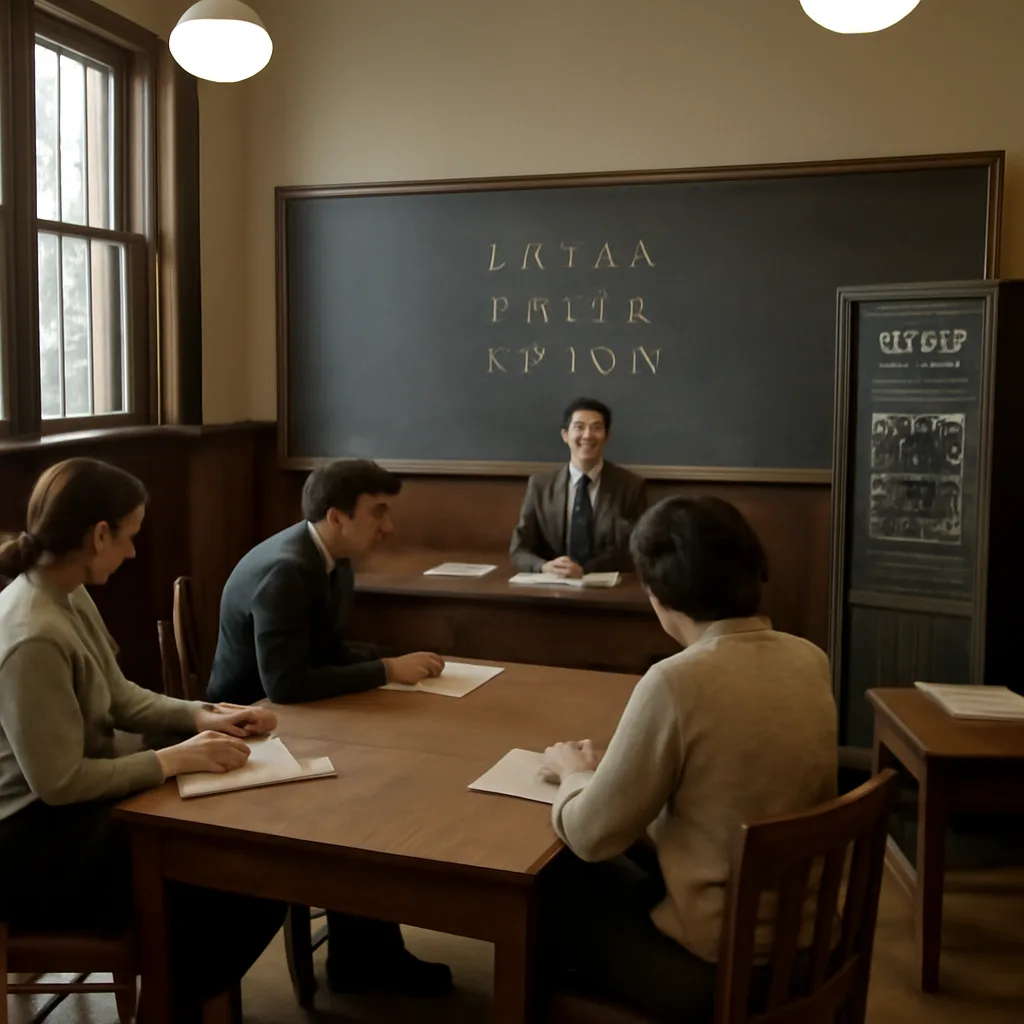
The 1956 Dartmouth Workshop: First Public Demonstration of AI Concepts
On April 18, 1956, researchers at Dartmouth College convened a workshop that articulated the formal research program for “artificial intelligence,” presenting early demonstrations of symbolic problem solving and proposing research directions that shaped the field.
On April 18, 1956, a group of researchers gathered at Dartmouth College for a summer workshop that marked the first organized public articulation and demonstration of ideas later grouped under “artificial intelligence” (AI). Proposed by John McCarthy, Marvin Minsky, Nathaniel Rochester, and Claude Shannon, the Dartmouth Conference was framed as an exploratory research meeting to investigate whether “every aspect of learning or any other feature of intelligence can in principle be so precisely described that a machine can be made to simulate it.”
Context and participants
The workshop convened a small, interdisciplinary set of attendees, including mathematicians, computer scientists, and cognitive theorists. John McCarthy, who coined the term “artificial intelligence” for the proposal, organized the event at Dartmouth College in Hanover, New Hampshire. Other notable participants included Marvin Minsky, Allen Newell, Herbert A. Simon, Arthur Samuel, and participants from IBM such as Nathaniel Rochester. The meeting was modest in scale but influential because it gathered key thinkers who were already experimenting with symbolic problem-solving approaches.
What was demonstrated
The Dartmouth Workshop did not feature a single spectacular machine unveiling; rather, it combined formal proposals, short presentations, and informal demonstrations of early programs and ideas. Prior work by Allen Newell and Herbert A. Simon—such as the Logic Theorist (1955), a program that proved certain theorems in symbolic logic—was discussed and shown to participants, serving as an early, tangible example of machine-based symbolic reasoning. Arthur Samuel’s work on machine learning for checkers and other computational experiments were also part of the broader milieu influencing attendees. These demonstrations emphasized symbolic representations, rules, and search procedures as practical ways to model reasoning.
Intellectual outcomes
The Dartmouth proposal set an explicit research agenda: to explore the possibility of creating machines that could simulate facets of human intelligence by manipulating symbols, learning rules, and search methods. While the organizers may have been optimistic about rapid progress, the workshop’s durable contribution was its establishment of AI as a coherent field of inquiry. It encouraged collaborations, seeded research programs at universities and industry labs, and helped popularize the term “artificial intelligence.”
Limitations and later reassessment
Contemporary accounts and later histories stress that Dartmouth did not produce immediate, wide-ranging demonstrations of human-level intelligence; rather, it formalized a research program and highlighted promising early results. Some participants later recalled the event as loosely organized and modest in scope. The early focus on symbolic methods proved powerful in some domains (theorem proving, formal logic, rule-based systems) but encountered limits when faced with perceptual tasks and real-world uncertainty—issues that drove later shifts toward statistical and subsymbolic methods.
Legacy
Despite its limited scale, the Dartmouth Workshop of 1956 is widely cited as the founding moment of AI research. It gave a name to the field, gathered influential researchers, and established problem frameworks and methods—symbolic representation, search, and formal reasoning—that dominated early AI research and informed subsequent phases of development. Over time, AI’s goals, methods, and definitions have evolved, but the Dartmouth meeting remains a key historical marker for the discipline’s origins.
Sources and verification
This summary is based on historical records of the Dartmouth proposal and subsequent scholarly histories of computing and AI. Participant lists, the original proposal text (authored by McCarthy, Minsky, Rochester, and Shannon), and retrospective accounts by attendees and historians document the workshop’s date, attendees, and its role in shaping research priorities. Where recollections vary—about the event’s organization, scale, or immediate outcomes—histories note those differences rather than asserting uncertain specifics.