
← Back
01/04/1896 • 6 views

Utah Grants Women the Right to Vote (Again)
voting

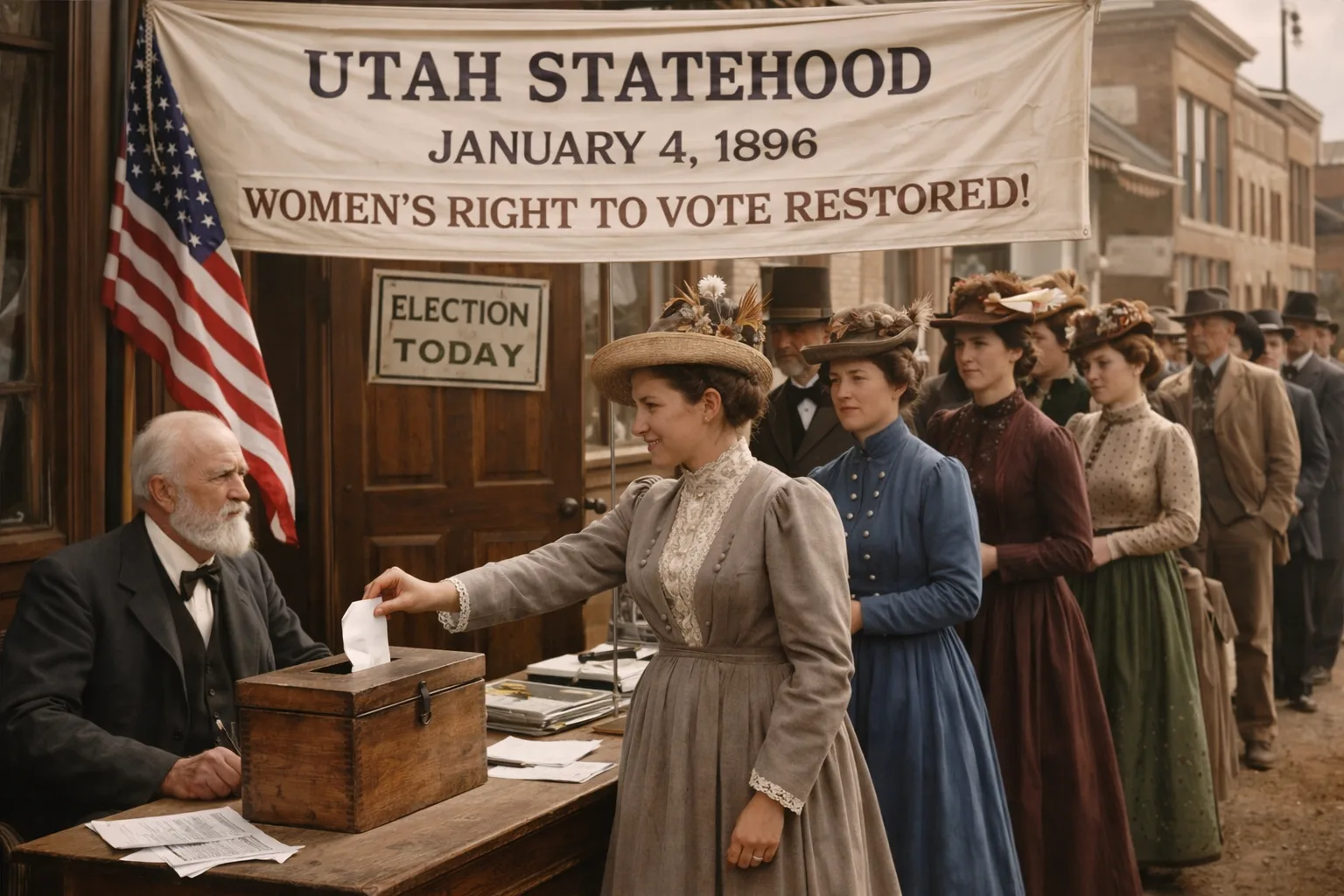
On January 4, 1896, Utah entered the Union as the 45th U.S. state. Tucked into its new state constitution was a clause that quietly restored a right women there had already tasted—and lost: the right to vote.


On January 4, 1896, Utah entered the Union as the 45th U.S. state. Tucked into its new state constitution was a clause that quietly restored a right women there had already tasted—and lost: the right to vote.

The word again is doing a lot of work here.

Utah didn’t pioneer women’s suffrage once.
It did it twice—and the first time, Congress took it away.

The First Time: Radical by Accident

Utah women were first granted the right to vote in 1870, making Utah one of the earliest places in the world to allow women’s suffrage—decades before the 19th Amendment.

But this wasn’t pure progressivism.

The territory was dominated by members of the Church of Jesus Christ of Latter-day Saints, and Congress viewed Mormon polygamy as a national moral crisis. Critics claimed Mormon women were oppressed, coerced, and voiceless.

So Utah leaders did something unexpected: they let women vote.

The logic was confrontational:

If Mormon women were enslaved, voting would expose it

If they weren’t, it would undercut anti-Mormon arguments

When Utah women voted—and voted overwhelmingly in support of their communities—it infuriated Congress.

The narrative collapsed.

Punishment Disguised as Reform

In 1887, Congress passed the Edmunds–Tucker Act, aimed squarely at dismantling Mormon political power.

Among its provisions:

Disenfranchising Utah women

Seizing church property

Dissolving the LDS Church as a legal entity

Women lost their voting rights not because they misused them, but because they used them correctly—in a way Congress didn’t like.

Their rights were not revoked for incompetence.
They were revoked for political inconvenience.

January 4, 1896: Rights Repackaged as Statehood

When Utah sought statehood in the 1890s, Congress set conditions:

Official renunciation of polygamy

Rewriting of territorial laws

Compliance with federal authority

Utah complied—and then did something quietly defiant.

In its state constitution, Utah reinstated women’s suffrage in full.

Not as a reward.
Not as a gift.
But as a declaration.

When Utah officially became a state on January 4, 1896, women once again gained the right to vote—24 years before the rest of the United States would follow.

Congress allowed it this time, perhaps hoping history wouldn’t notice the contradiction.

The Dark Irony

Utah women were trusted with the vote:

Before most of the world

Then deemed unfit

Then trusted again

All without their consent ever being the deciding factor.

Their rights were:

Granted to make a point

Revoked to make an example

Restored to close a deal

This wasn’t moral progress.
It was political bargaining.

Why This Moment Matters

The story of Utah women’s suffrage exposes an uncomfortable truth about American rights:
they are often treated less like principles and more like levers of control.

January 4, 1896, stands as:

A victory for women

An indictment of federal hypocrisy

Proof that progress is rarely linear

Utah didn’t just grant women the right to vote that day.

It reclaimed a right that had already been proven—then punished.

The Quiet Lesson

When history celebrates milestones, it often forgets the reversals.

Utah’s women didn’t win suffrage once.
They survived losing it.

And on January 4, 1896, they proved something even more unsettling than progress:

That rights can be taken away—not because they’re wrong,
but because they’re effective.

Share this

Email Share on X Facebook Reddit

Did this surprise you?