
← Back
01/28/1986 • 6 views

Challenger’s Final Launch: STS-51-L Departs on January 28, 1986
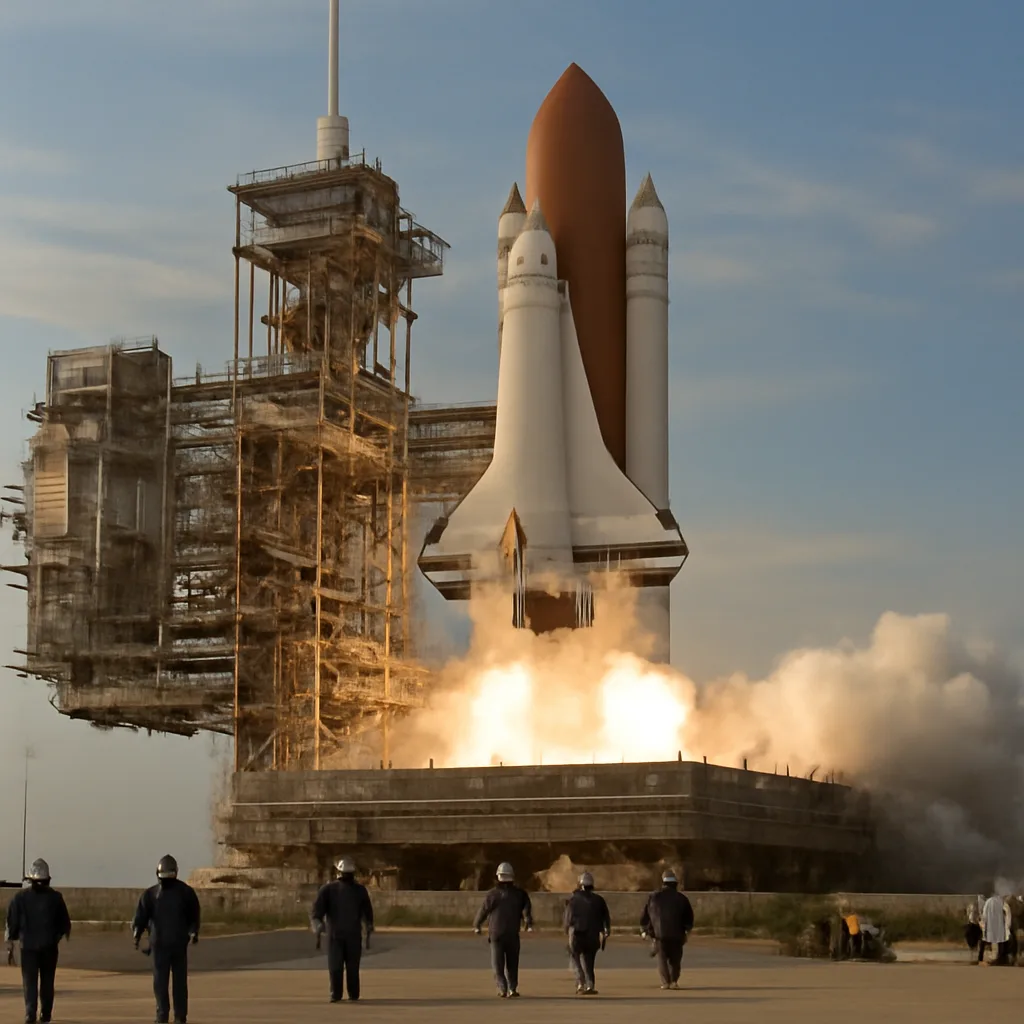
Space Shuttle Challenger on the launch pad at Kennedy Space Center moments before liftoff on January 28, 1986, with service structures and clouds in the sky.

Space Shuttle Challenger lifted from Launch Complex 39B on January 28, 1986 for mission STS-51-L, the vehicle’s tenth flight and the program’s 25th mission; 73 seconds after liftoff the shuttle broke apart, killing all seven crew members aboard.


On January 28, 1986, Space Shuttle Challenger (OV-099) launched from NASA’s Kennedy Space Center, beginning mission STS-51-L. The flight carried seven crew members: Commander Francis R. “Dick” Scobee, Pilot Michael J. Smith, Mission Specialists Ronald McNair, Ellison Onizuka, and Judith Resnik, Payload Specialist Gregory Jarvis, and Payload Specialist Christa McAuliffe, a schoolteacher selected for NASA’s Teacher in Space Project. The launch had been delayed several times in preceding days because of weather and technical checks.

At 11:38 a.m. Eastern Standard Time Challenger lifted off from Launch Complex 39B. About 73 seconds into the ascent, while passing through an area of maximum dynamic pressure (max q), the vehicle experienced a structural failure leading to breakup of the stack. Videotape and telemetry showed the aft field joint on the right Solid Rocket Booster (SRB) had leaked hot gases, a condition linked to O-ring erosion in cold temperatures. The resulting breach allowed hot plume gases to impinge on the external tank structure. The orbiter separated from the SRBs and the external tank broke apart; the crew cabin ultimately impacted the Atlantic Ocean. All seven astronauts were killed.

The immediate aftermath produced conflicting statements and widespread shock. NASA suspended Shuttle flights and established the Presidential Commission on the Space Shuttle Challenger Accident (the Rogers Commission) to investigate. The commission conducted an extensive review of telemetry, recovered hardware, documents, and testimony from engineers and managers. Its findings, released in June 1986, concluded the probable cause was the failure of the right SRB aft field joint O-ring to seal properly at liftoff temperatures, allowing hot gas leakage and structural failure. The commission also identified organizational and decision-making flaws within NASA and its contractor Morton-Thiokol that contributed to the accident, including inadequate communication of engineering concerns and schedule pressure.

The accident had immediate and long-term consequences for the U.S. human spaceflight program. Shuttle flights were halted for nearly three years while technical changes were developed and implemented. Design modifications included a redesigned SRB joint, improved inspection and testing procedures, and enhancements to management and safety oversight. The Shuttle returned to flight with STS-26 in September 1988.

Beyond technical and programmatic changes, the Challenger disaster affected public perception of NASA and raised questions about risk, culture, and oversight in complex engineering programs. The loss of Christa McAuliffe, the first civilian selected to fly as part of a teacher outreach initiative, made the tragedy especially resonant with schoolchildren and educators nationwide. Memorials, scholarships, and educational programs were established in the crew members’ names. NASA also increased emphasis on safety, transparency, and independent review in its operations.

Historical analyses of the Challenger accident rely on the Rogers Commission report, NASA documentation, and retrospective studies by engineers and historians. While the technical root cause (O-ring failure exacerbated by low temperature) and the commission’s management critiques are well established, subsequent scholarship has continued to examine how organizational culture, communication failures, and external pressures combined to allow the flight to proceed under risky conditions.

Challenger’s loss remains a pivotal moment in U.S. spaceflight history, shaping safety practices and institutional attitudes toward risk for decades that followed.

Share this

Email Share on X Facebook Reddit

Did this surprise you?