
← Back
03/14/1863 • 5 views

Demonstration of a Successful Artificial Limb, 14 March 1863
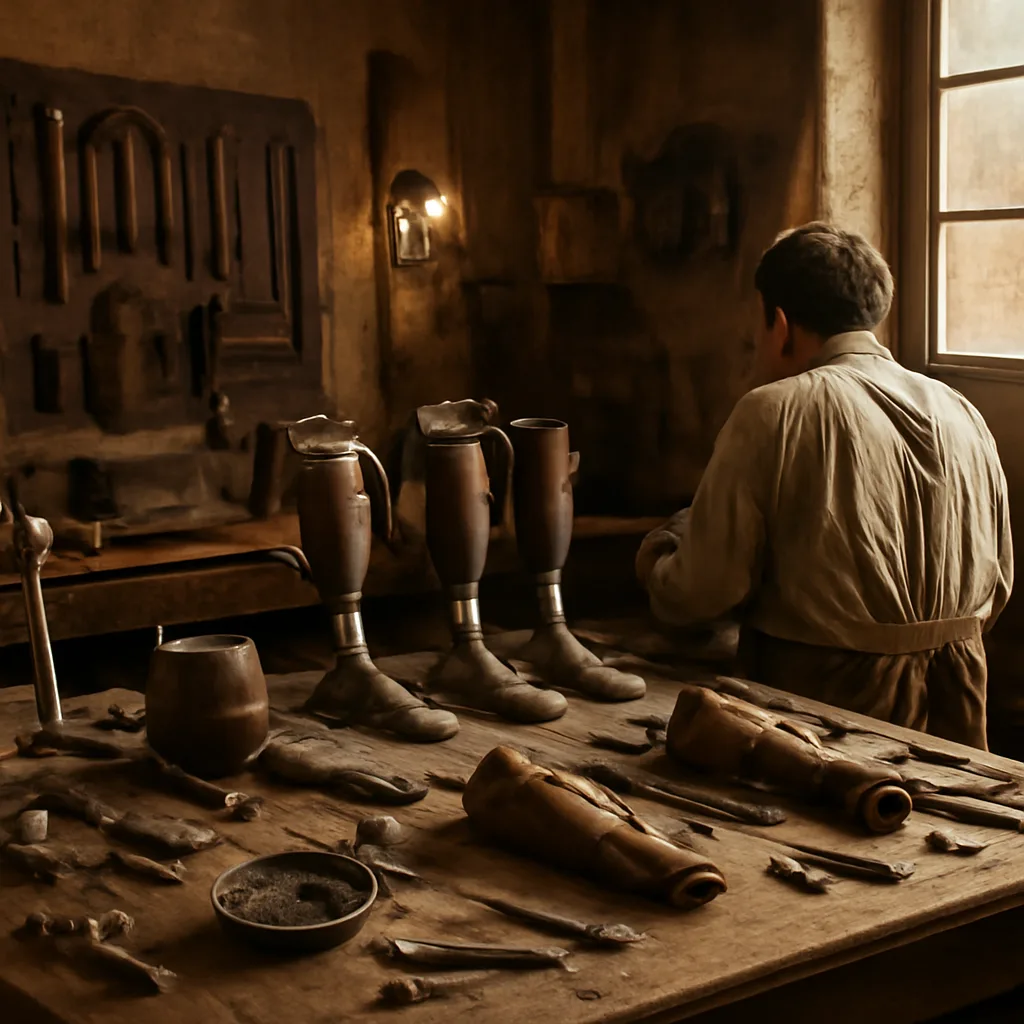
A 19th-century workshop scene showing a table with a jointed artificial limb made of metal, wood and leather; tools and fittings nearby; a partially visible craftsman in period work clothes without a clear face.

On 14 March 1863 a mechanically articulated prosthetic limb was publicly demonstrated, marking a milestone in 19th-century efforts to restore mobility to amputees through engineered artificial limbs.


In mid-19th-century Europe and North America, high rates of limb loss from warfare, industrial accidents and disease drove renewed interest in prosthetic devices. On 14 March 1863 a notable public demonstration showcased an articulated artificial limb that combined jointed metal components with leather and wooden fittings—an advance that illustrated both practical improvements in prosthesis design and the growing role of industrial manufacturing techniques in medical aids.

Prosthetics had existed in rudimentary forms for centuries, from carved wooden peg legs and simple hand hooks to more elaborate hinged designs. The 19th century brought incremental innovations: lighter materials, improved socket fitting, articulated joints with springs or ratchets, and attention to cosmetic covers. Treatises, patent filings and workshop catalogs from the period show inventors and surgeons collaborating to make limbs that were more functional and more comfortable than earlier models.

The 1863 demonstration reflected these cumulative advances rather than the single sudden invention of a complete technology. Contemporary accounts describe a limb that allowed controlled flexion at an artificial elbow or knee and a more natural gait for lower-limb devices. Such demonstrations were often staged by prosthetic makers or displayed at exhibitions and medical meetings to attract clients and professional endorsement. They emphasized mobility, durability and adjustability—characteristics increasingly achievable with factory-produced metal fittings, standardized joints and improved methods for attaching sockets to stumps.

Medical journals, patent records and exhibition reports from the era document the growing professionalism of prosthetics manufacture. Surgeons contributed clinical knowledge about stump shaping and end-bearing sockets, while mechanical engineers and artisans refined locking mechanisms and ankle or wrist articulations. The result was a class of artificial limbs better suited to daily activities: walking on varied terrain, grasping objects, and maintaining posture—though none matched biological limbs in sensation or full range of motion.

It is important to note that attributions of “first” successes in prosthetics are often contested. Multiple inventors across different countries pursued similar improvements around the same time, and public demonstrations were part promotional, part technical proof. Records from 1863 should be read in context: the device demonstrated that year was a significant and practical improvement, but it was one step in a continuum of innovation rather than an isolated origin point for modern prosthetics.

The social impact of such demonstrations was substantial. They offered amputees—many of them veterans of recent conflicts—visible hope of restored function and work capacity. They also influenced public and professional perceptions of disability, framing artificial limbs as technological solutions that could reintegrate individuals into civilian and economic life. Nevertheless, access to advanced prosthetics remained uneven: cost, availability and the need for skilled fitting and maintenance limited widespread adoption.

Technically, later decades would build on the mechanisms and materials shown in 1863, incorporating lighter alloys, improved socket designs and eventually electrical components in the 20th century. The 1863 demonstration is therefore best understood as a milestone that showcased practical, mechanically articulated prosthetic limbs emerging from a blend of surgical insight and industrial manufacturing—an incremental but meaningful advance in the long history of artificial limbs.

Share this

Email Share on X Facebook Reddit

Did this surprise you?