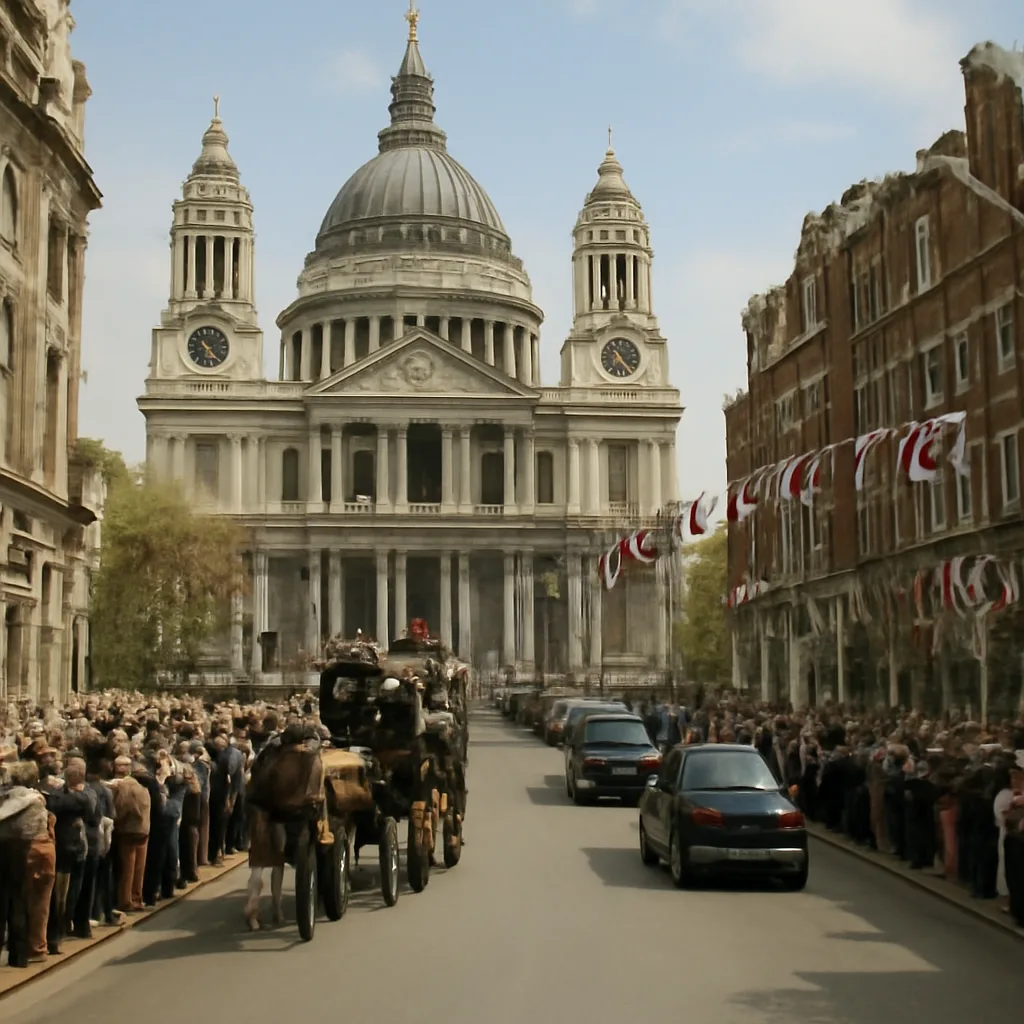
Diana Spencer Marries Prince Charles at St. Paul's Cathedral
On 29 May 1981, Lady Diana Spencer married Charles, Prince of Wales, in a globally watched ceremony at St. Paul’s Cathedral, marking one of the late 20th century’s most prominent royal weddings.
On 29 May 1981, Lady Diana Spencer and Charles, Prince of Wales, were married in a state wedding at St. Paul’s Cathedral in London. The ceremony followed a civil service of marriage earlier the same day at the register office in the City of Westminster, required under British law for legal recognition before the public religious service. The day drew enormous global attention: hundreds of thousands lined processional routes in London and an estimated global television audience of several hundred million watched the televised ceremony.
Background
Charles and Diana’s engagement was announced in February 1981 after a brief courtship. Diana, then 19, was a member of the British aristocracy and a former nursery school teacher; Charles, at 32, was heir apparent to the British throne. Their relationship and forthcoming marriage became a major focus of media and public interest in the United Kingdom and abroad.
Ceremony and pageantry
The public religious service was held in St. Paul’s Cathedral rather than Westminster Abbey; the cathedral was chosen for its capacity to accommodate a large congregation and for logistical reasons connected to the concurrent civil marriage. The service featured traditional elements of Anglican wedding liturgy and included representatives of many nations and figures from public life. Diana wore a silk taffeta and antique lace gown designed by David and Elizabeth Emanuel, notable for its wide skirt and long train. Charles wore the uniform of a naval officer.
The wedding procession traveled from Buckingham Palace to St. Paul’s Cathedral and back, passing crowds gathered along The Mall and other central London thoroughfares. The route, the ceremonial carriage, and the visible pageantry were intended both to honor royal tradition and to allow public participation in the occasion.
Public reaction and media
The wedding was a focal point for intense media coverage. Television broadcasts and international news reporting framed the event as a global royal spectacle, and public celebrations took place across the United Kingdom and in British overseas territories. The combination of ancient ceremony and modern mass media contributed to the couple’s immediate celebrity and shaped public perceptions of the monarchy during the early 1980s.
Aftermath and historical significance
The marriage initially strengthened public interest in the monarchy and elevated Diana’s public profile; she became one of the most recognized figures worldwide. Over subsequent years, aspects of the marriage—its personal difficulties and eventual dissolution—would reshape public and historical assessments of the period. At the time of the wedding, however, the event was widely portrayed as a major state occasion and a defining media moment for the British royal family.
Notes on sources and accuracy
This summary is based on contemporaneous reporting and historical accounts of the 1981 royal wedding. Some details—such as crowd estimates and television audience figures—vary between sources; where precise figures are contested, this account uses general descriptions rather than single disputed numbers.