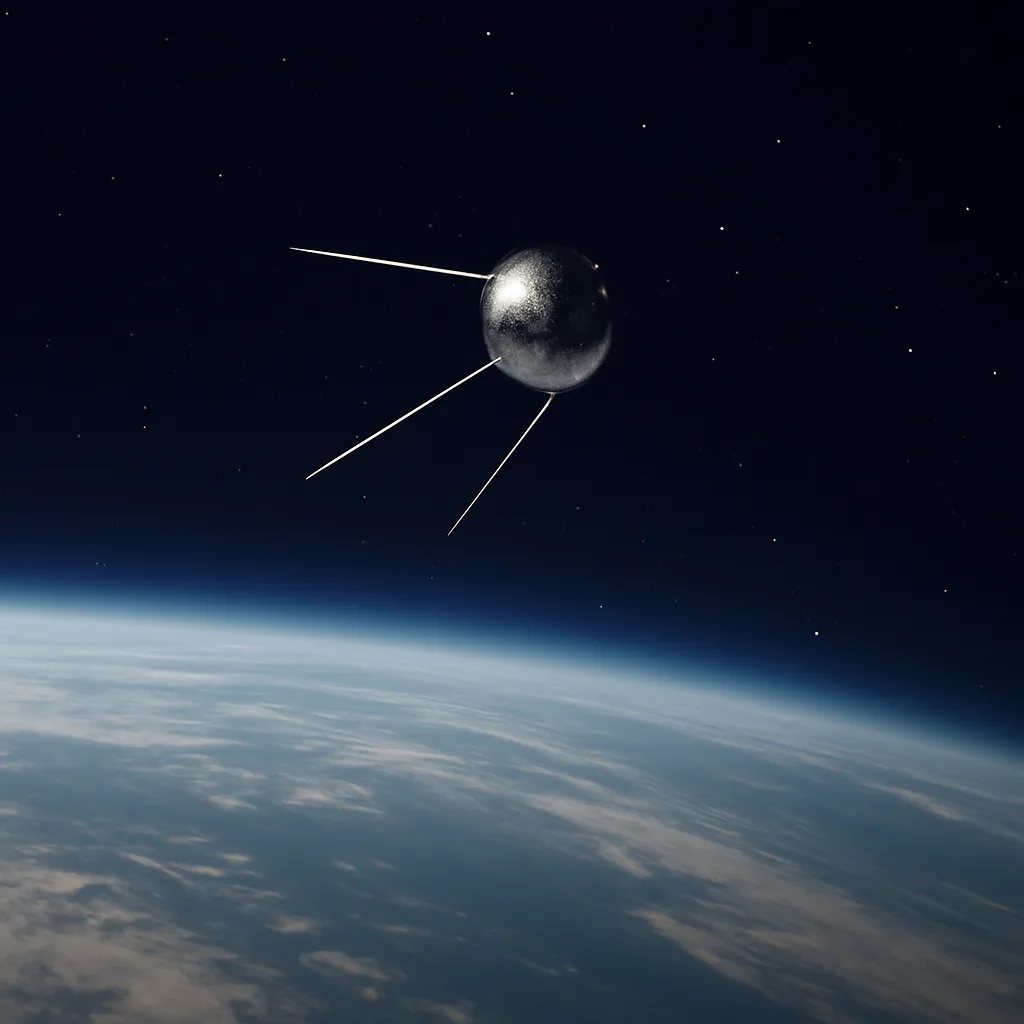
First Artificial Satellite Unexpectedly Reenters Earth’s Atmosphere
On June 3, 1958, the United States’ Vanguard 1 (first launched March 17, 1958) experienced an unexpected orbital decay and reentered Earth's atmosphere, marking one of the earliest unplanned satellite losses and underscoring the challenges of early spaceflight.
On June 3, 1958, one of the earliest American artificial satellites, Vanguard 1, experienced an unplanned orbital decay that led to its return to Earth’s atmosphere. Vanguard 1 was launched on March 17, 1958, by the U.S. Naval Research Laboratory as part of the Vanguard program, itself a response to the International Geophysical Year and the nascent space race. The mission aimed to test launch vehicle capabilities and to obtain geophysical data, including measurements of atmospheric density via orbital perturbations.
Vanguard 1 was a small, 1.47-kilogram aluminum sphere with two long antennae, and its initial orbit was highly elliptical. In the months following launch engineers tracked the satellite and used its radio transmissions to refine models of the upper atmosphere and to study orbital decay. Early satellites routinely faced unpredictable forces — atmospheric drag, solar activity, and tracking uncertainties — that could alter orbits faster than planners anticipated.
By early June 1958, observations indicated that Vanguard 1’s orbit had degraded more rapidly than expected. On June 3 the satellite’s perigee had dropped sufficiently that atmospheric drag increased markedly and it subsequently reentered the denser layers of the atmosphere. The reentry destroyed the satellite; no return of hardware or controlled landing was possible for such early, lightweight probes. Vanguard 1’s loss was one of the first demonstrations of how tenuous low Earth orbits could be and highlighted limits in predicting long-term orbital lifetimes with the period’s observational and modeling tools.
The unplanned reentry had several immediate and longer-term implications. Practically, it curtailed some of Vanguard 1’s planned long-term observations. More broadly, the episode spurred improvements in atmospheric modeling, tracking networks, and design margins for future satellites. Engineers and scientists used the available tracking data from Vanguard 1’s decay to improve understanding of atmospheric drag at high altitudes and to refine orbital prediction methods — lessons that proved valuable as satellite launches accelerated.
Historical records from the time note that early satellite missions often encountered uncertainties that are rare in the modern era of precise tracking and propulsion. While later satellites received design enhancements to prolong orbital lifetimes and to provide controlled reentry options when necessary, the unexpected return of Vanguard 1 remains an instructive example of the experimental nature of the first decade of spaceflight.
Because contemporaneous reporting and technical documents sometimes differ in exact phrasing or emphasis, accounts vary slightly on particulars such as the precise timing of the final tracking contact and the sequence of decay observations. What is clear and well-documented is that Vanguard 1, launched in March 1958 as one of the very first U.S. satellites, ceased to be an active orbital asset after its uncontrolled reentry on or about June 3, 1958, underscoring the fragility and novelty of early artificial satellites.