
← Back
04/30/1939 • 8 views

First Mass‑Produced Television Goes on Sale at 1939 World's Fair
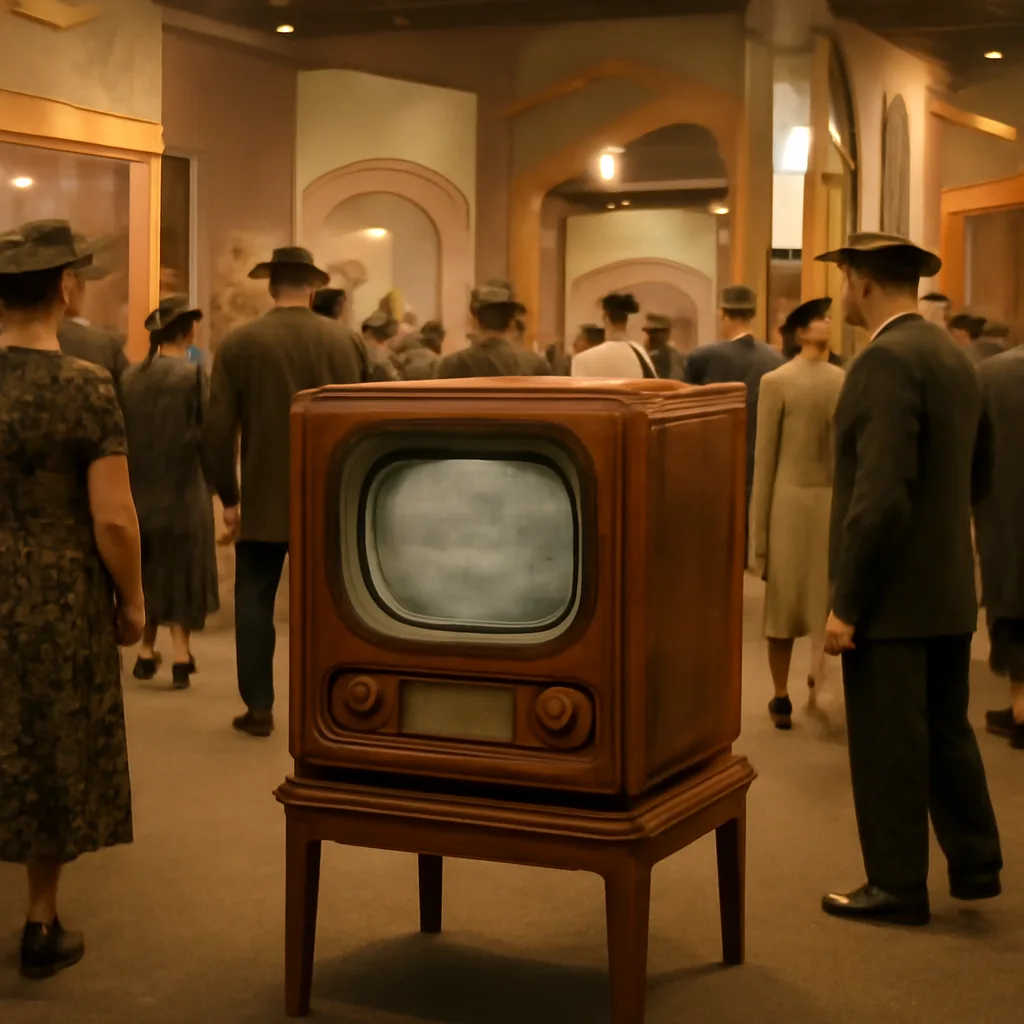
A late 1930s living room display showing a wooden cabinet cathode‑ray television receiver on a stand at a World's Fair exhibition area, with period visitors in 1930s dress nearby and exhibition signage in the background.

On April 30, 1939, RCA began selling the first mass‑produced television sets to the public—marking a turning point from experimental broadcasts to consumer television, introduced at the New York World's Fair and timed with the burgeoning broadcast service.


On April 30, 1939, amid the fanfare of the New York World’s Fair, the Radio Corporation of America (RCA) introduced the first commercially produced, mass‑market television receivers to the American public. The debut was closely tied to RCA’s broader effort to demonstrate television as a viable consumer technology: RCA had a major exhibit at the fair’s Westinghouse Building and used the event—and NBC, which RCA owned—to showcase live and filmed television programming to visitors.

The sets offered in 1939 were cathode‑ray tube televisions, a technology that had been refined through the 1920s and 1930s by a succession of inventors and companies. Earlier mechanical television experiments and small‑scale electronic receivers had been demonstrated during the 1920s and early 1930s, but the 1939 models reflected advances in electronic imaging, improved picture tubes, and more reliable radio‑frequency receivers. RCA and other firms were now able to produce sets in greater numbers and with a design and finish intended for living‑room use.

RCA’s retail launch followed its public demonstrations and the inauguration of regular television broadcasts in New York. NBC launched a regular broadcast schedule in April 1939, timed to coincide with the World’s Fair and the opening ceremonies that April. The interplay between available sets and programming mattered: consumers could buy a receiver, but useful television required a compatible broadcast service. In 1939 broadcasts were limited in schedule, geographic reach, and content compared with later decades; early programming included special events, short dramatic pieces, newsreel material, and variety segments produced specifically for television or adapted from radio and film.

Pricing and availability limited adoption. Early television sets were relatively expensive compared with radios and household appliances, and broadcast coverage was confined to a few urban areas where stations operated. The number of sets sold in 1939 was modest by later standards, and the outbreak of World War II in Europe curtailed international commercial expansion and diverted industrial capacity in the United States toward wartime needs in the early 1940s. After the war, mass production resumed on a much larger scale and television ownership expanded rapidly in the late 1940s and 1950s.

The 1939 launch is often cited as a watershed moment because it marked the transition from experimental demonstration to ad‑supported consumer electronics—with manufacturers, broadcasters, and exhibitors coordinating to present television as an integrated system of hardware, programming, and commercial potential. RCA’s role as both equipment manufacturer and broadcaster (via NBC) shaped early standards and promoted a model in which manufacturers and networks worked closely to grow the medium.

Historians note some ambiguity about claims that any single date or model represents the definitive "first" mass‑produced television. Several firms produced sets in limited quantities before 1939, and mechanical television experiments continued in parallel. Nevertheless, the April 1939 introductions associated with the New York World’s Fair and RCA’s marketing and broadcast launch represent the moment when television was presented deliberately as a consumer product to a mass audience, setting the stage for the medium’s postwar expansion.

Share this

Email Share on X Facebook Reddit

Did this surprise you?