
← Back
04/12/1921 • 6 views

First Modern Lie Detector Test Administered Using Pneumograph and Cardiodynamic Recording
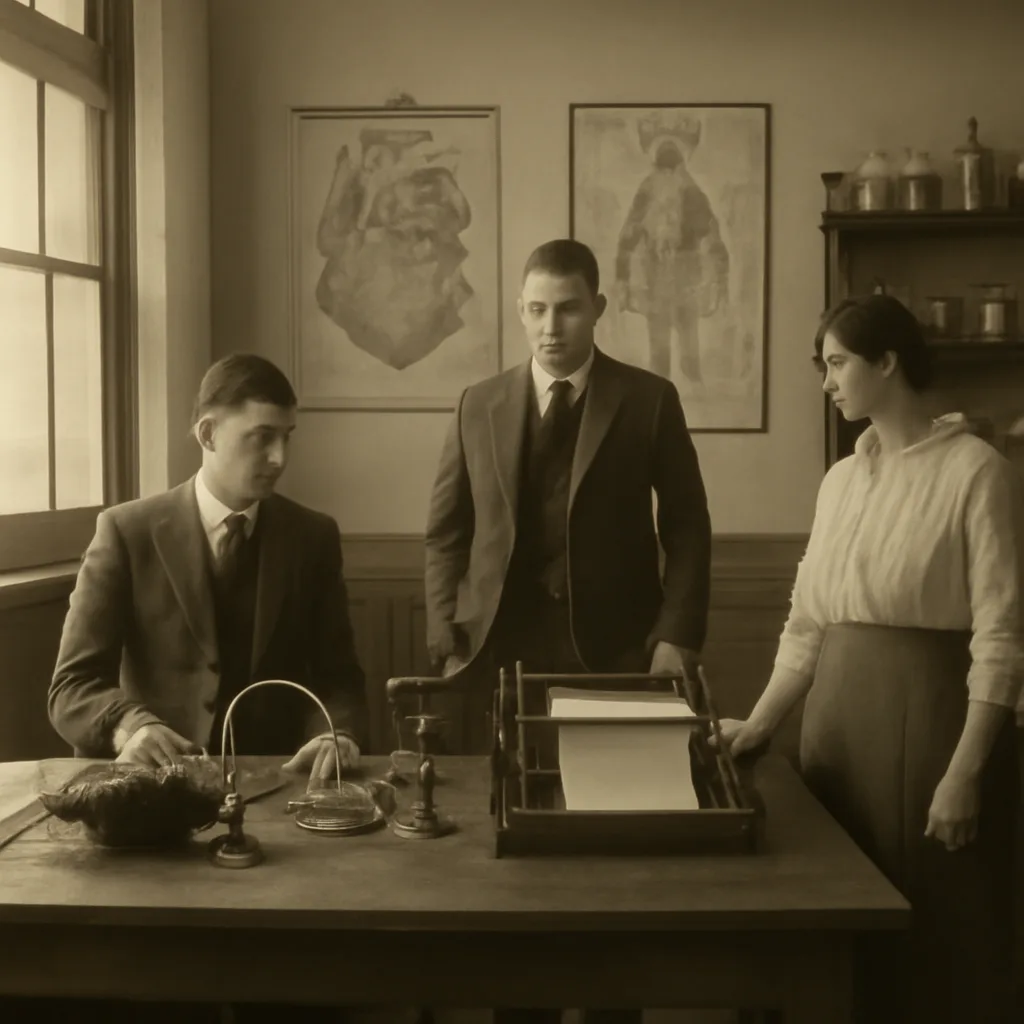
Early 20th-century laboratory room with a table holding a pneumograph and wired cardiograph, paper recording charts, and researchers in period clothing observing instrumentation.

On April 12, 1921, University of Missouri researchers conducted what is commonly cited as the first modern lie detector test, combining respiratory and cardiovascular recordings to assess truthfulness in a criminal investigation.


On April 12, 1921, investigators at the University of Missouri carried out an experiment that has since been described as the first modern lie detector test. The procedure arose from growing interest in physiological methods for assessing veracity in the late 19th and early 20th centuries. Researchers combined measurements of respiration and cardiac activity—recorded with a pneumograph and a cardiograph—to observe physiological changes while a suspect answered questions. The test took place in the context of criminal investigation and scientific exploration of the links between emotion, stress and bodily responses.

Background

Before the 1921 test, several researchers had attempted to correlate physiological signals with deception. In the late 19th century, Italian physician Angelo Mosso and English physiologist Ernest Jones, among others, explored blood flow and vascular changes associated with emotional states. In the United States, psychologist William Moulton Marston in the 1910s proposed systems for measuring blood pressure changes during questioning. These precedents laid groundwork for combining multiple physiological channels to seek patterns that might indicate deception.

The 1921 Test

The April 12 procedure at the University of Missouri used apparatus that recorded breathing patterns (a pneumograph) and heart-related tracings (a cardiograph). Subjects were asked a series of questions while technicians recorded the tracings; investigators looked for consistent changes—such as shifts in respiration or heart rhythm—when the subject gave deceptive answers versus truthful ones. The approach marked a shift from single-measure observations toward polygraph-style reasoning: the idea that combining multiple physiological indicators could increase confidence in judgments about veracity.

Contemporary reception and impact

Contemporaries treated the experiment as an important step in applying physiological measurement to legal and forensic problems. The test helped popularize the notion that objective instruments could assist in distinguishing truth from falsehood. Over subsequent decades, refinements—such as adding galvanic skin response and standardizing questioning techniques—led to the development of the polygraph instruments widely associated with lie detection by mid-20th century practitioners.

Limitations and later assessment

Modern scholars caution that early demonstrations, including the 1921 test, do not establish error rates or prove reliability under varied conditions. Physiological measures can reflect anxiety, fear, or other emotional states unrelated to deliberate deception, and experimental settings, questioning styles, and interpretation methods influence outcomes. As a result, the scientific and legal communities have long debated the validity and admissibility of polygraph evidence. The 1921 Missouri experiment remains important historically as an early, systematic attempt to record physiological responses during interrogations, even as questions about the method’s specificity and accuracy persist.

Legacy

The April 1921 test is often cited in histories of psychophysiology and forensic science as a formative moment in the emergence of instrument-assisted lie detection. It illustrates both the early promise of physiological measurement and the methodological challenges that would shape decades of research and legal debate. Whether regarded as a scientific milestone or a tentative step, the test occupies a clear place in the timeline of efforts to make questions of truth and deception amenable to empirical observation.

Share this

Email Share on X Facebook Reddit

Did this surprise you?