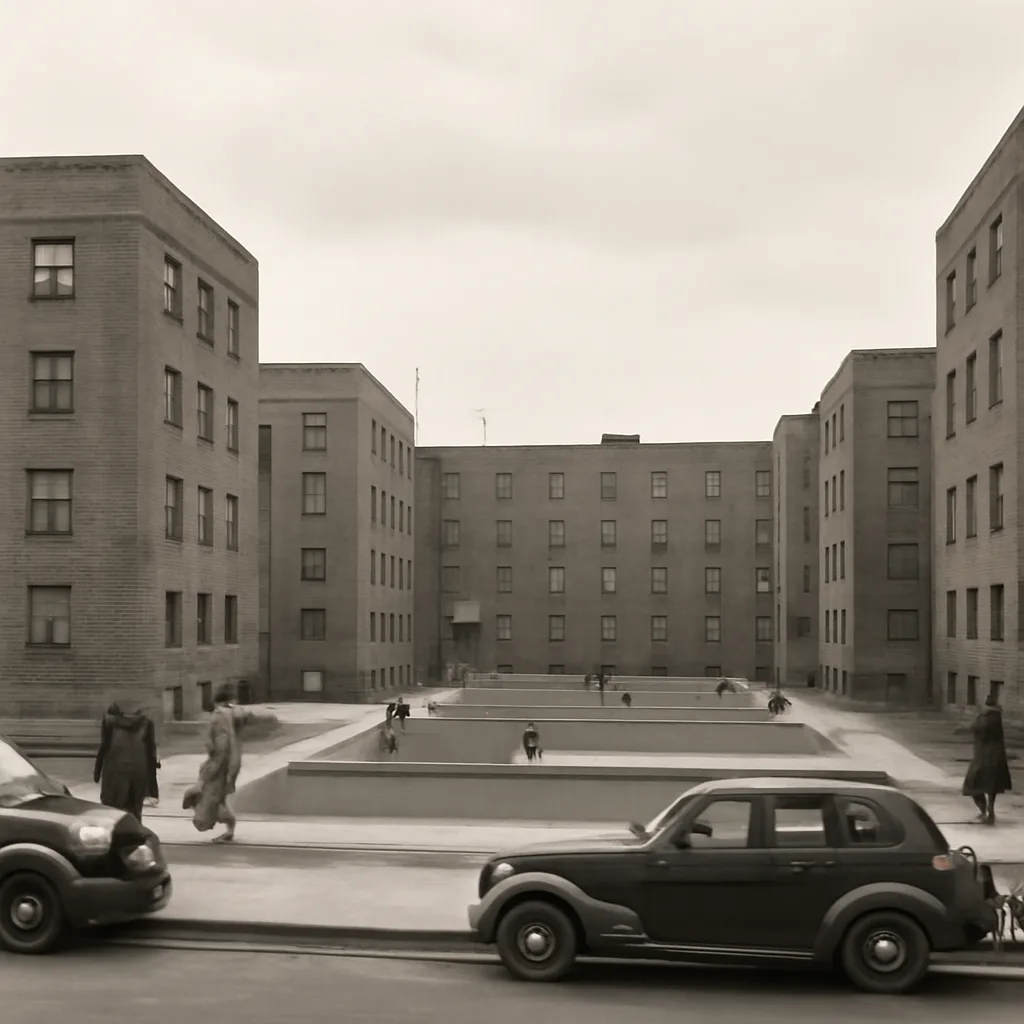
First Modern Public Housing Development Opens in 1936
On May 3, 1936, the first large-scale modern public housing development in the United States opened, marking a shift toward federally supported, planned housing for low-income urban residents amid New Deal reforms.
On May 3, 1936, the nation saw the opening of what is widely recognized as the first modern public housing development under a federal program instituted during the New Deal era. The project emerged from a growing consensus in the 1920s and 1930s that slum clearance and the construction of decent, affordable housing were matters of public policy, not solely private philanthropy or market forces.
Background and policy context
The Great Depression intensified housing insecurity and renewed calls for government intervention. In 1934 Congress created the United States Housing Authority (USHA) as part of the National Housing Act, authorizing federal loans and subsidies to local public housing agencies for slum clearance and the construction of “low-rent” housing. The USHA sought to replace deteriorated housing stock with planned developments that incorporated basic modern utilities, open space, and centralized management—features that distinguished them from earlier philanthropic or employer-built housing.
Design and features
Early modern public housing projects were planned to provide light, ventilation, indoor plumbing, and common open space—improvements over the cramped, unsanitary conditions in many inner-city tenements. Architects and planners working with local agencies often adopted simple, utilitarian building forms influenced by contemporary municipal housing models in Europe, but adapted them to local contexts and budgets. Developments typically consisted of low- to mid-rise brick or masonry buildings arranged around courtyards or lawns, with attention to circulation, daylighting, and shared facilities.
Social aims and limitations
Public housing was promoted as a means to improve public health, reduce overcrowding, and stabilize communities. Proponents argued that federal financing and local oversight could produce durable, affordable homes for working-class families. However, early projects also reflected the racial, economic, and political compromises of their time. Local authorities controlled allocation policies, and segregationist practices persisted in many jurisdictions. Moreover, funding constraints and local opposition sometimes limited scale and amenities.
Reception and legacy
The opening of the first modern federally supported public housing project symbolized a new role for the federal government in urban housing and set precedents for subsequent programs. Over the following decades, public housing expanded in many American cities, evolving through periods of praise for providing stable homes for millions and critique for design shortcomings, underfunding, and management challenges. The 1936 project is thus an important milestone in the long, contested history of government housing policy—one that illustrates both the ambitions and the limits of reform efforts in the New Deal era.
Notes on historical claims
Historians identify multiple early projects associated with the USHA and local agencies; dating and designation as the “first” modern public housing development can vary depending on criteria (federal funding, scale, completed occupancy). The date given corresponds to the known opening of an early federally supported development in 1936 tied to the initial USHA program. Specific local details (site, architect, and occupancy figures) vary by city and should be cited from local archival sources for precision.