
03/23/1896 • 5 views
First Public Demonstration of X‑Ray Technology, March 23, 1896
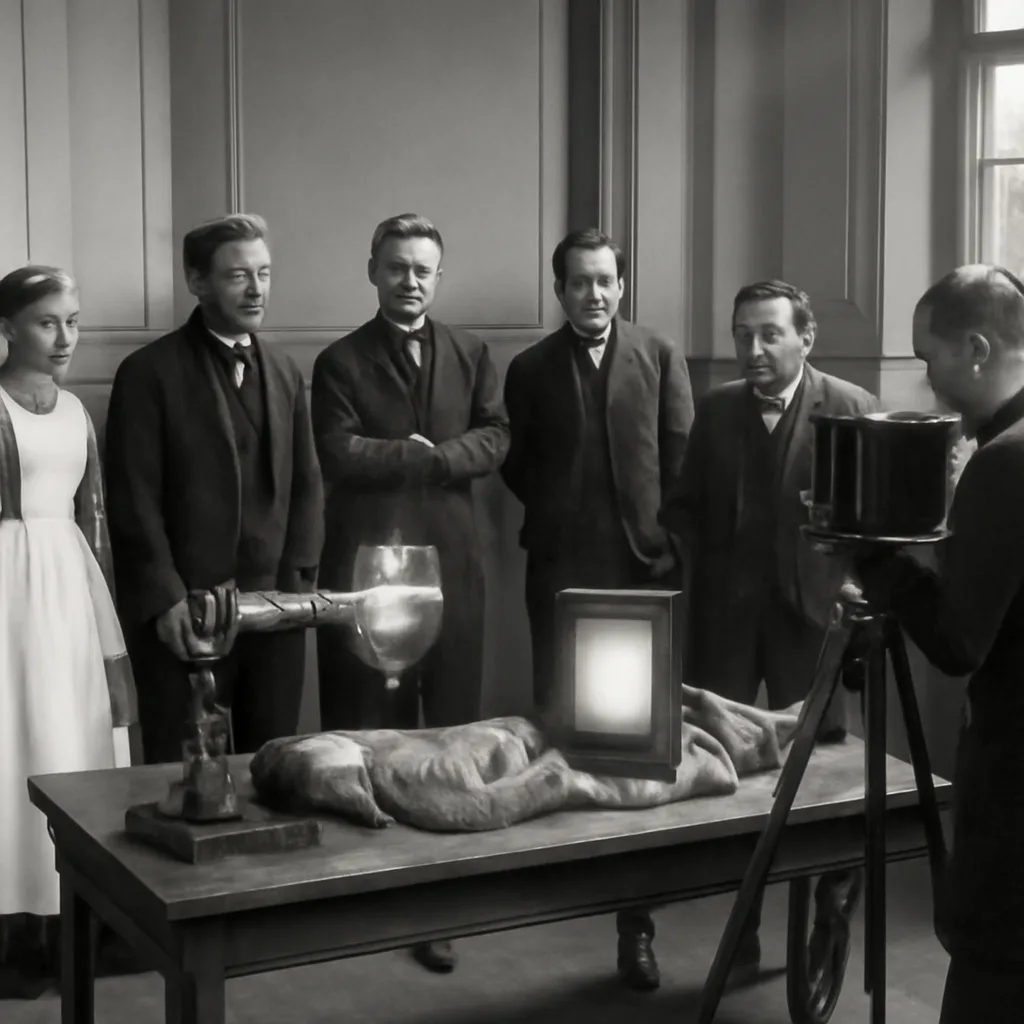
On 23 March 1896, shortly after Wilhelm Röntgen’s discovery, the first widely publicized public demonstration of X‑rays was held, showcasing the new rays’ ability to reveal bones and hidden objects and triggering rapid public and scientific interest.
Context and participants
By March 1896, multiple laboratories had replicated Röntgen’s results. Public demonstrations were arranged by hospital staff, university professors, photographers and instrument makers to display the practical and sensational potential of the rays. Contemporary press accounts describe clinicians and experimenters placing parts of the body or objects between an X‑ray source and a photographic plate to produce images for curious audiences. These events brought together physicians, scientists, journalists and members of the general public eager to witness the new phenomenon.
What was shown
Demonstrations typically displayed radiographs (then often called "skiagraphs" or "shadowgraphs") of hands, skulls, and objects such as coins, keys or sewing needles hidden in clothing. The resulting images made bones and dense materials appear vividly against the softer tissues, illustrating both medical promise and novelty. Early operators used Crookes tubes or similar vacuum discharge tubes with fluorescent screens and photographic plates, often requiring long exposure times by modern standards. Operators emphasized diagnostic applications—locating fractures, foreign bodies and bullets—and some demonstrations included comparisons with ordinary photography to highlight the difference.
Reactions and immediate impact
Reports of the March 23 demonstration and others like it generated excitement and a mixture of wonder and apprehension. Medical professionals recognized possible clinical uses, leading to rapid adoption in hospitals and clinics. Newspapers conveyed astonishment to broader publics; many articles mixed scientific explanation with sensational description, contributing to public fascination. At the same time, early practitioners had limited understanding of radiation’s biological effects; safety measures were minimal or absent in these first months.
Legacy and significance
The March 1896 public demonstration exemplifies how quickly Röntgen’s discovery moved from laboratory observation to public spectacle and medical practice. Within a year, radiography had become an established diagnostic tool in many countries, and Röntgen’s contribution was acknowledged with the first Nobel Prize in Physics in 1901. However, the early enthusiasm also delayed appreciation of the hazards of ionizing radiation, leading to later efforts to define safe practices.
Historiographical notes
Precise attributions for who organized or attended each early demonstration can vary across contemporary reports; newspaper accounts and institutional records sometimes conflict on dates and participants. The March 23, 1896 demonstration is representative of numerous similar events held that spring in Europe and North America. Where specific archival citations are required, researchers should consult contemporary newspapers, hospital archives and scientific society minutes for local details.
In short, the public demonstration on 23 March 1896 was a key moment in the rapid public and clinical adoption of X‑rays: a display of scientific novelty that quickly reshaped diagnostic medicine and public imagination, while also foreshadowing later concerns about radiation safety.