Princess Diana’s Funeral Broadcast to a Global Audience
On September 6, 1997, the funeral of Diana, Princess of Wales was televised worldwide, attracting millions of viewers as nations observed a day of mourning following her death in late August.
On September 6, 1997, the funeral service for Diana, Princess of Wales took place at Westminster Abbey and was broadcast live to a global television audience. Diana had died on August 31, 1997, after a car crash in Paris; the week that followed saw an unprecedented outpouring of public grief in the United Kingdom and around the world. Her funeral became both a national moment of mourning and an international media event.
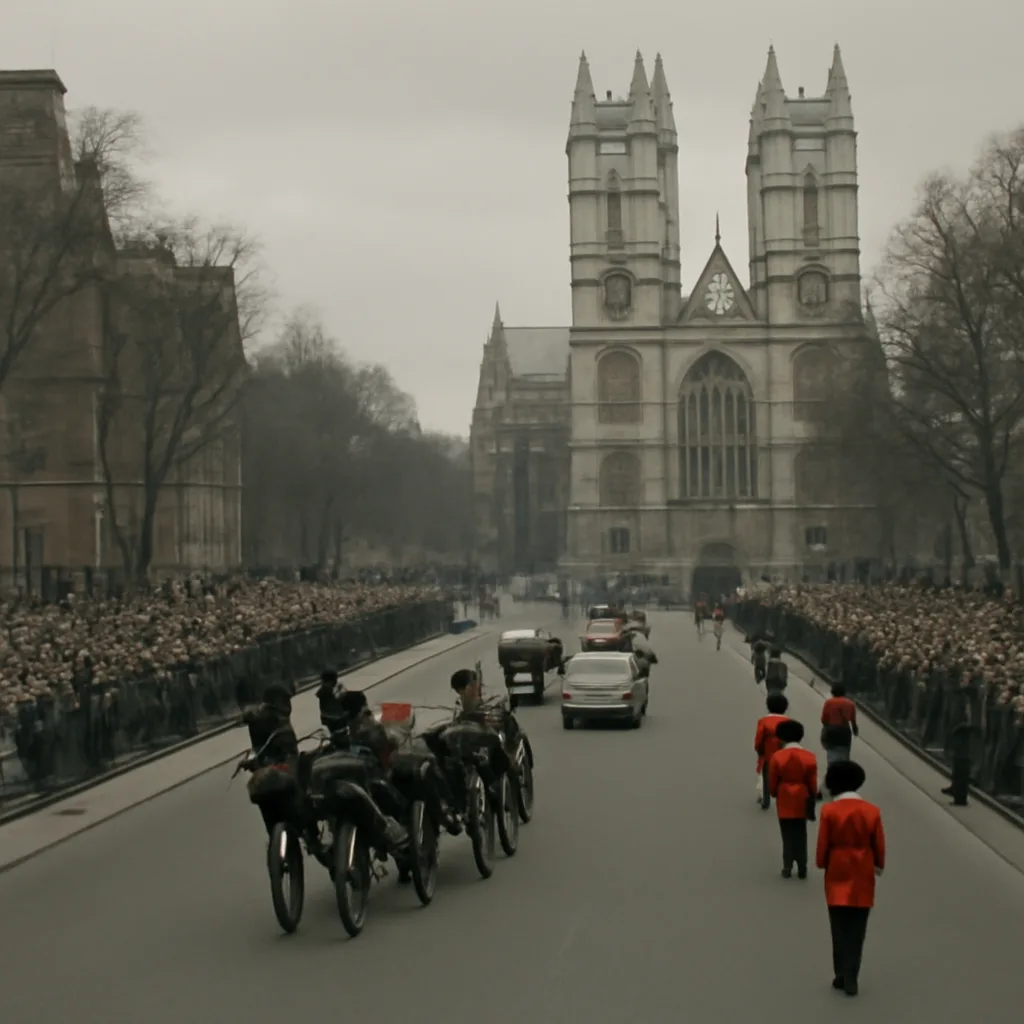
The service at Westminster Abbey was attended by members of the British royal family, world leaders, celebrities, and thousands of members of the public who lined the procession route from Kensington Palace to Westminster. The route passed along Hyde Park Corner and down Whitehall to the abbey, providing opportunities for public remembrance. The coffin, draped in the royal standard and carrying a wreath, was followed by mourners in a procession watched by crowds along the route.
Broadcasters in Britain and abroad carried extensive live coverage. In the United Kingdom, major television channels provided continuous coverage before, during, and after the service; news outlets extended programming to include background pieces on Diana’s life, archival footage, and reports from correspondents. International networks also carried the service and produced special programming to contextualize Diana’s life and the public reaction. Estimates put the global television audience in the hundreds of millions, reflecting Diana’s high international profile.
The public reaction to the funeral and the manner of its coverage prompted discussion and, at times, criticism. Some commentators and royal watchers debated the scale and tone of television coverage, the role of the media in Diana’s life and death, and the royal family’s response to the public’s grief. Others noted the technical and logistical challenges of broadcasting from Westminster Abbey and of coordinating international feeds for a live event of such magnitude.
Beyond live television, the funeral was extensively documented in newspapers, radio, and in subsequent documentary coverage. Photographs and footage from the day became part of ongoing public and historical conversations about Diana’s influence on public life, monarchy-media relations, and late-20th-century celebrity culture.
The September 6 broadcast remains a notable example of global live television coverage of a state and public funeral. It illustrated the capacity of television and international news media to shape shared public experiences across borders, and it marked a pivotal moment in how the world observed bereavement for a public figure whose life had been intensely covered by the press.