
← Back
04/05/1914 • 6 views

First Electric Traffic Signal Installed in Cleveland, 1914
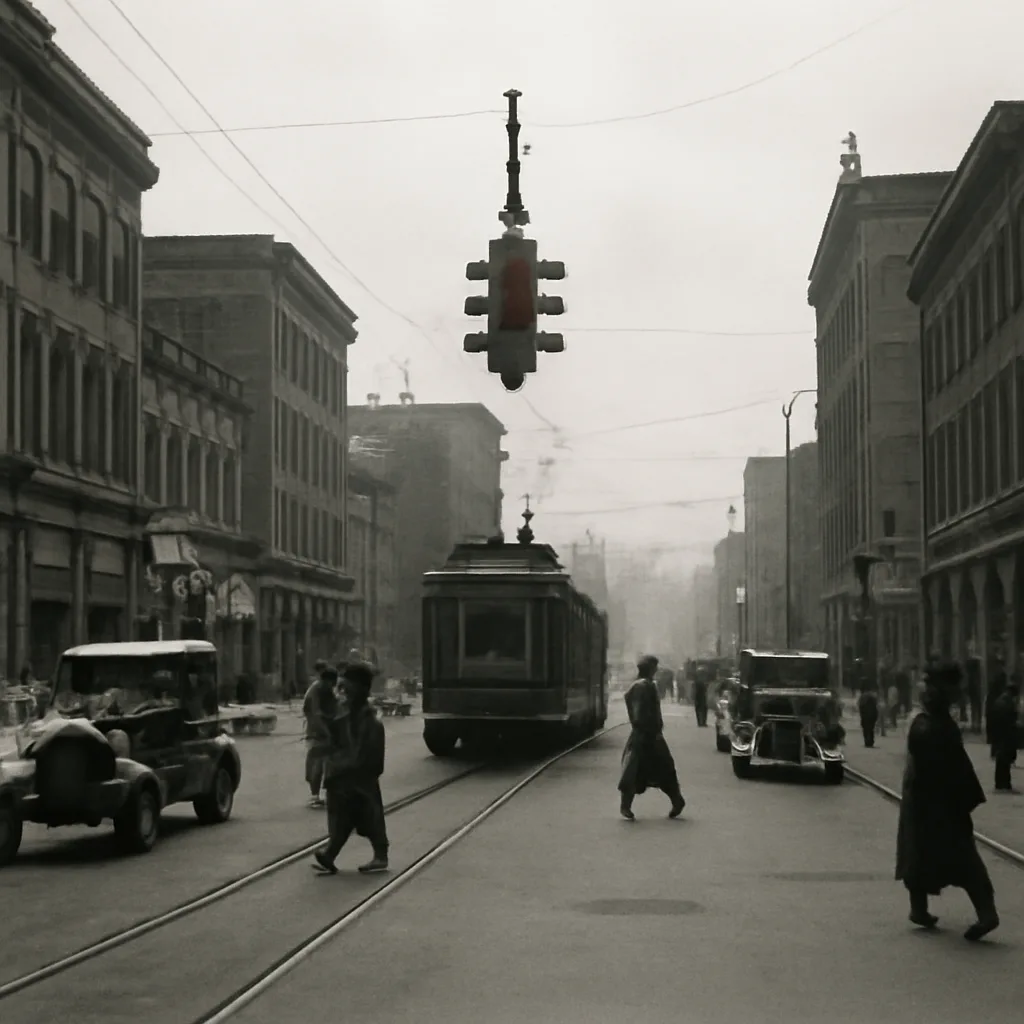
Early 20th-century street intersection in Cleveland with a tall pole-mounted traffic signal and automobiles, streetcars, and pedestrians from the era.

On April 5, 1914, the first electric traffic signal in the United States began operation in Cleveland, Ohio, marking a shift from manual traffic control and early experimentation with electrically controlled intersections.


On April 5, 1914, city engineers in Cleveland, Ohio, activated what is widely recognized as the first electric traffic signal in the United States. The device, placed at the intersection of Euclid Avenue and East 105th Street, represented a step in the evolution of traffic control from manual flagging and semaphore-like devices to electrically powered signaling intended to manage increasing urban automobile traffic.

Background
By the early 20th century, American cities were grappling with rapidly growing numbers of automobiles, streetcars, bicycles, and pedestrians sharing limited street space. Early attempts to manage traffic included police officers directing flows from elevated platforms and various mechanical or manually operated semaphore signals. The need for automated, reliable control at busy intersections became more acute as speeds and traffic volumes rose.

The Cleveland installation
The Cleveland signal of April 1914 was developed by the American Engineering Company in collaboration with Cleveland city engineers. Contemporary accounts describe it as an electrically operated traffic light that used red and green lights to indicate stop and go; some versions included a buzzer or other auditory element to alert drivers and pedestrians to changes. The device was mounted on a pole and controlled by an electric mechanism rather than by a police officer. Its installation was reported in local newspapers and trade publications at the time, and the event is commonly cited in histories of traffic control.

Impact and context
The Cleveland signal did not instantly standardize traffic control nationwide, but it demonstrated the practical potential of electrically operated signals. Other cities experimented with similar devices in the following years, and inventors continued to refine signaling technology—introducing timed cycles, multiple aspects (including amber/yellow), and later, coordinated systems for linking signals along corridors.

It is important to note that there were earlier and parallel experiments with electrically or mechanically operated signals elsewhere. For example, in London a mechanically operated signal with semaphore arms and gas-lit lamps was installed outside Parliament in the 1860s; in the United States, various electric and mechanical signaling experiments occurred in the late 19th and early 20th centuries. Historians therefore treat the Cleveland 1914 installation as the first widely recognized electric traffic signal in the U.S. context, rather than the singular origin of all traffic-signal technology.

Legacy
The Cleveland signal helped spur municipal interest in adopting electrically controlled intersections. Over subsequent decades, traffic-signal design became standardized in the U.S., adding yellow lights, standardized color conventions, and timing methods to improve safety and traffic flow. The 1914 installation is often cited in museum exhibits and transportation histories as an early milestone in the transition to electrically managed urban traffic.

Sources and reliability
The details above derive from contemporaneous newspaper reports, municipal engineering records, and secondary histories of transportation and traffic control. Some elements—such as exact technical specifications of the original device—are variably described across sources. Where claims conflict, historians generally present the Cleveland 1914 installation as the first recognized electric traffic signal in the United States while acknowledging earlier or parallel signaling experiments elsewhere.

Share this

Email Share on X Facebook Reddit

Did this surprise you?