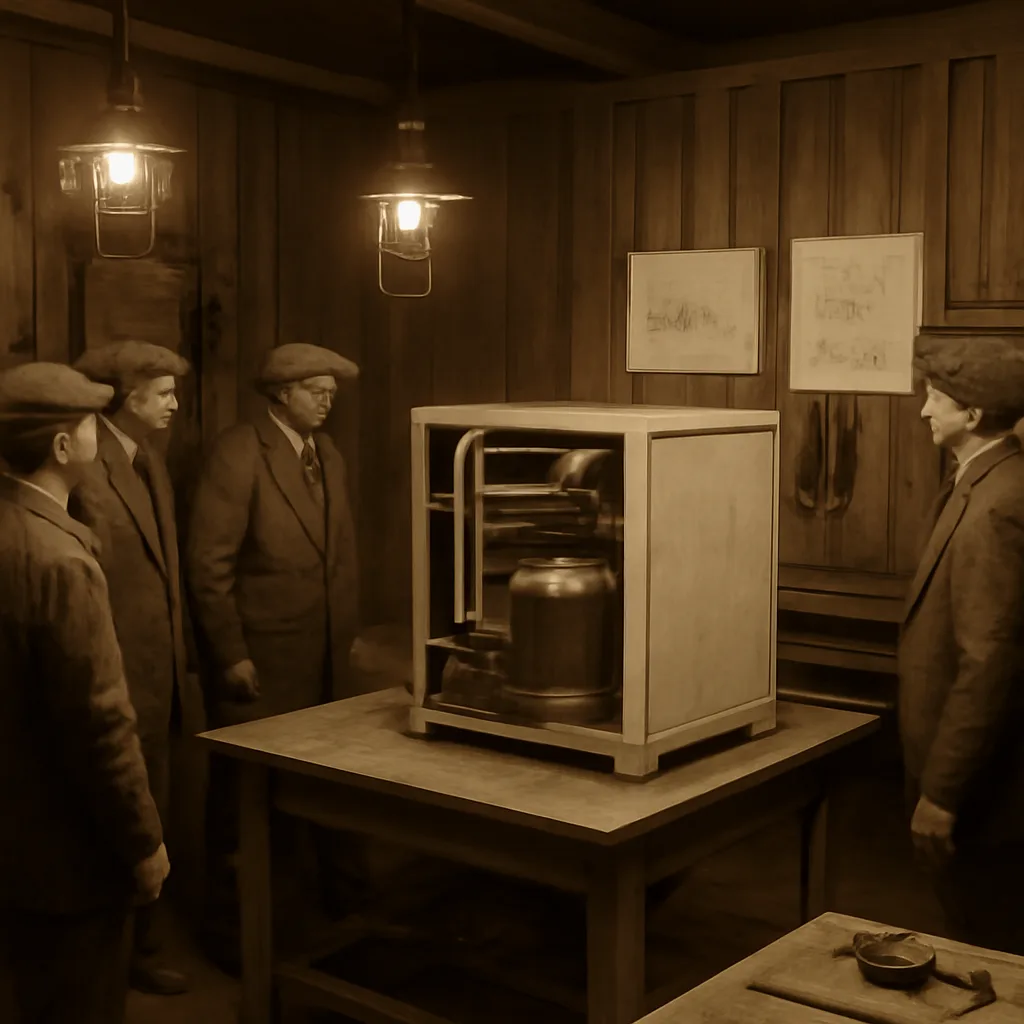
On April 5, 1913, an early practical mechanical refrigerator was demonstrated, marking a key step toward household refrigeration by showing reliable, controlled mechanical cooling using compressed refrigerant rather than large ice delivery systems.
By the early 20th century, ice delivery and insulated iceboxes dominated food preservation in many parts of the industrialized world. Mechanical refrigeration had been developing for decades, but on April 5, 1913, inventors and manufacturers demonstrated an apparatus widely regarded as one of the first practical refrigerators suitable for continuous use. The demonstration showcased a compact, mechanically driven system that used a compressor to circulate a volatile refrigerant through coils, condense it to a liquid, expand it to produce cooling, and then return it to the compressor in a closed cycle.
This machine drew on prior advances: the vapor-compression refrigeration cycle first put in practical form by pioneers such as Jacob Perkins (early 19th century) and later improved by James Harrison, Carl von Linde, and others. What distinguished the 1913 demonstration was the emphasis on reliability, manufacturability, and suitability for regular service in commercial and, increasingly, domestic contexts. Previous systems had been large, hazardous, or inefficient; this design reduced size and improved safety and control, making continuous operation more feasible.
The demonstration was part of a broader commercial and technological movement. By the 1910s, electric motors and improved metallurgy made compact compressors and heat exchangers more viable. Refrigeration companies presented their systems to hotel operators, grocers, and patent examiners to prove that mechanical cooling could replace reliance on seasonal or imported ice. Practical refrigeration promised major changes for food supply chains: fewer spoilage losses, expanded markets for perishable goods, and new possibilities for urban living and food retail.
Safety and refrigerant choice remained contentious. Early refrigerants included ammonia, sulfur dioxide, and various chlorinated hydrocarbons; each presented trade-offs in toxicity, flammability, and performance. The 1913 demonstration emphasized containment and control to mitigate risks, but debates about the best working fluids and safeguards continued for decades.
Adoption proceeded unevenly. Large-scale commercial refrigeration—meatpacking, brewing, and ice production—transitioned first, while domestic uptake accelerated later as costs fell and designs simplified. The 1913 demonstration is therefore best understood as a milestone in demonstrating that a compact, continuous mechanical refrigerator was technically and commercially credible, not as the sole origin of household refrigerators. It contributed to the cascade of engineering refinements, standardization, and mass production that would eventually make refrigerators common in homes by the mid-20th century.
Historians note that credit for “the first practical refrigerator” can vary depending on criteria (commercial availability, continuous operation, domestic suitability, or specific refrigerant used). This event on April 5, 1913, stands among several linked developments that collectively transformed refrigeration from experimental apparatus to everyday technology.
Legacy: The practical demonstration helped shift industry and public perception toward trust in mechanical cooling. Over ensuing decades, continued innovation in compressors, refrigerants, insulation, and manufacturing would make refrigeration safer, cheaper, and ubiquitous—reshaping diets, supply chains, and domestic life worldwide.