
02/18/1909 • 7 views
First recorded automobile bank robbery, February 18, 1909
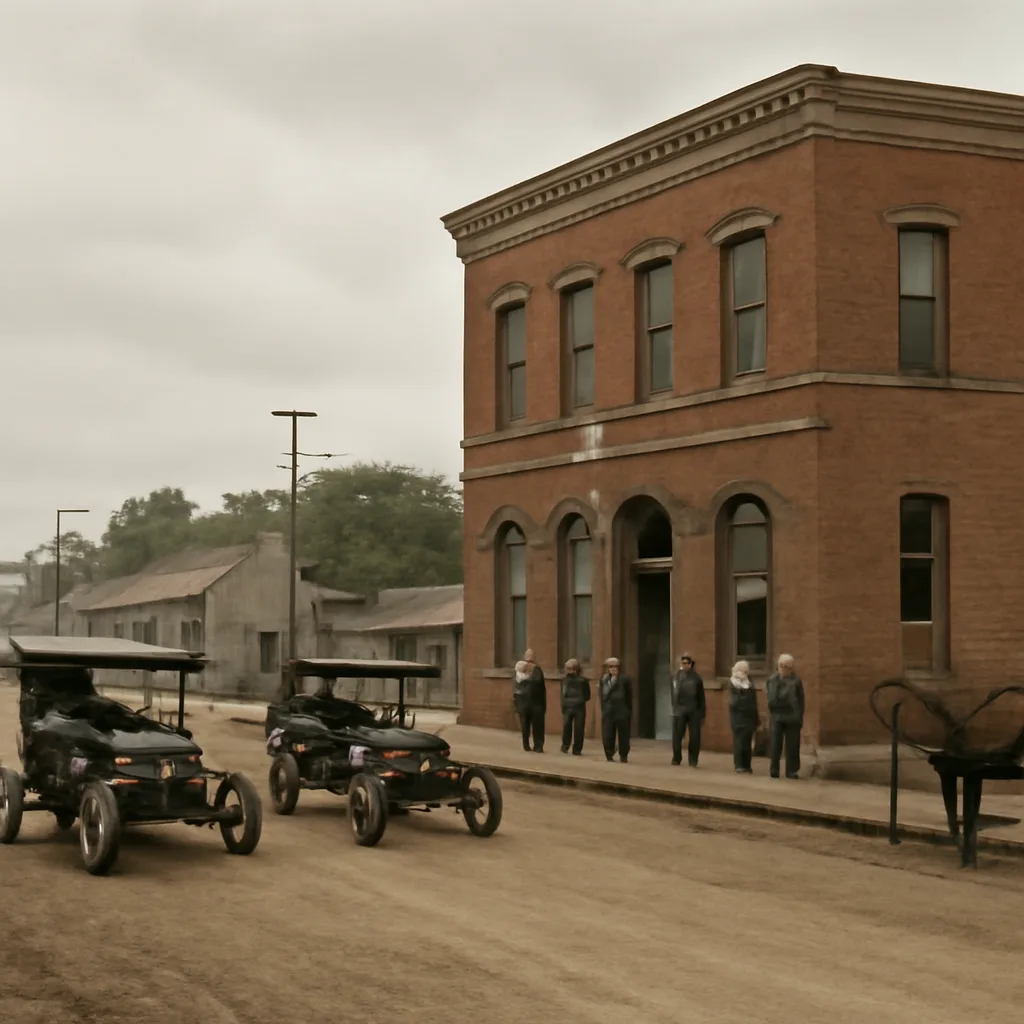
On February 18, 1909, a gang used multiple automobiles to rob a bank in Russell, Kansas—an early documented instance where motor vehicles enabled a getaway, marking a shift in criminal tactics as cars spread across the United States.
The robbery took place during an era of rapid change: the first decade of the 20th century saw automobiles transition from novelty to practical conveyance for business and personal travel. Criminals quickly recognized the tactical advantage offered by cars—speed, relative durability over rough rural roads, and capacity to transport multiple people or large sums of money. Prior bank robberies relied on horses, bicycles, or local knowledge to flee; the 1909 Russell incident illustrated how motor vehicles could enable swifter, longer-distance escapes and complicate police pursuit.
Details reported at the time indicate that the robbers arrived in two automobiles, entered the bank, took cash and valuables, and departed rapidly. Authorities pursued but were hindered by limited road infrastructure and the scarcity of motor vehicles among pursuing forces. Newspaper descriptions emphasized the novelty and audacity of using automobiles, and the story was reprinted in several outlets, contributing to its recognition in later historical surveys of crime and transportation.
Historians treating early automobile crime note that while the 1909 Russell robbery is frequently cited as a first recorded example, documentation from the period can be uneven. Small-town newspapers and law-enforcement records varied in detail and preservation. Some earlier incidents involving motor vehicles and theft may not have been widely reported or archived, so the claim rests on surviving contemporary reports rather than an absolute certainty that no prior automobile-assisted bank robbery occurred.
The broader significance lies in how this and similar early cases influenced policing and public perception. Law-enforcement agencies began to consider automobiles in both criminal strategy and police response. Over the following decades, police adoption of motorized patrols and improvements in intercity communication and road networks changed the dynamics of pursuit and deterrence. By the 1920s and 1930s, automobiles were a common feature in many high-profile robberies, and policing methods continued to adapt.
Primary-source coverage of the Russell robbery appears in period newspapers; researchers rely on archived press reports, court records where available, and local historical societies for verification. Because contemporary reporting can contain inconsistencies, historians who summarize the event typically note the limits of the record rather than presenting every detail as incontestable fact.
In short, the February 18, 1909 robbery in Russell, Kansas, stands in historical accounts as an early documented case of criminals using automobiles to facilitate a bank robbery. It exemplifies how the spread of new technology quickly reshaped both criminal methods and law-enforcement practices, even as the exact precedence of such incidents remains subject to the availability and reliability of surviving records.