
← Back
04/23/1939 • 6 views

First Successful Night-Vision Demonstration, April 23, 1939
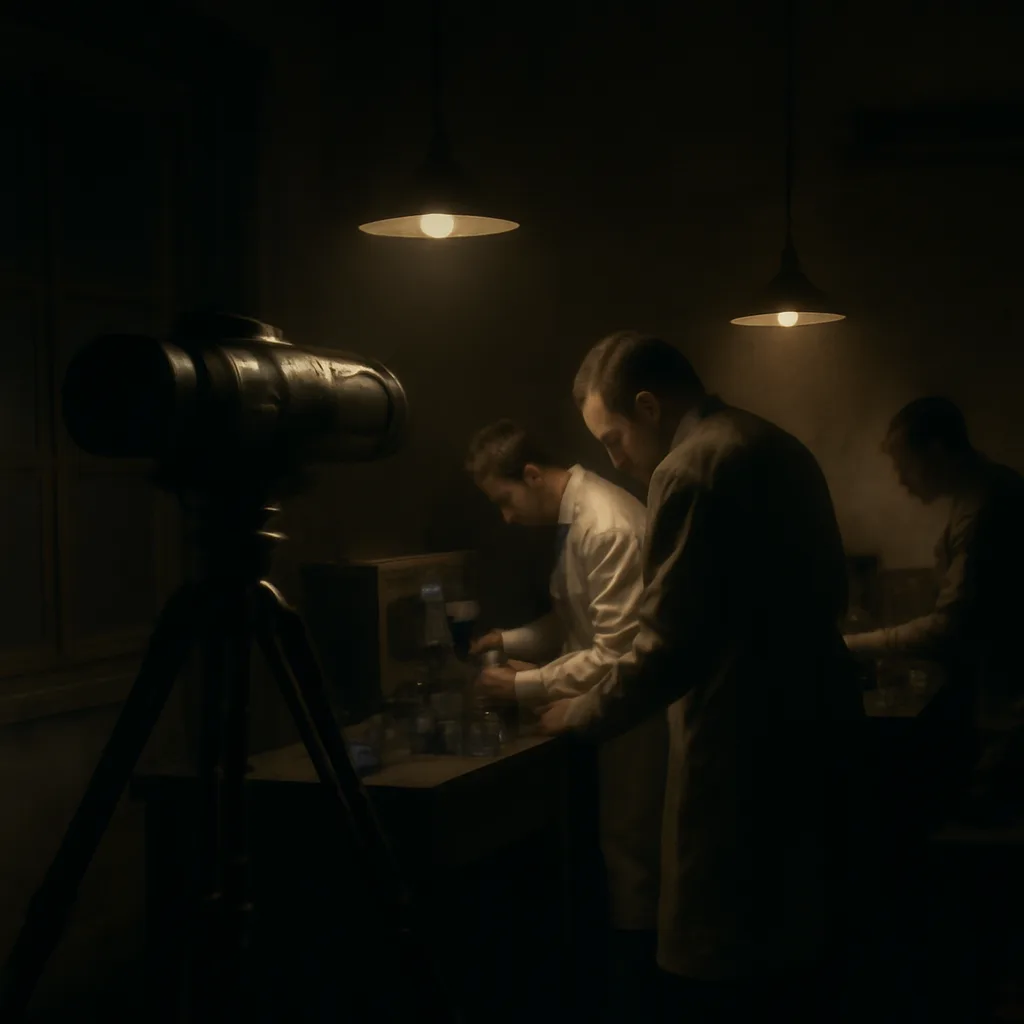
A 1930s laboratory room with a bulky, tripod-mounted optical instrument and technicians in period workwear adjusting cables and control boxes under dim light.

On April 23, 1939, an early infrared-based night-vision device was successfully demonstrated in the United States, marking a key step toward practical battlefield night observation and later widespread military use.


Background
Night-vision technology developed through parallel scientific and military efforts in the interwar period. Researchers explored infrared radiation, image intensification, and thermal detection as means to improve visibility after dark. By the late 1930s, several laboratories and companies in the United States and Europe had produced prototype devices that converted infrared radiation or amplified low-light images to make nighttime observation possible.
The demonstration on April 23, 1939
On April 23, 1939, a documented demonstration of an infrared-sensitive imaging device took place in the United States. The apparatus used photoelectric and infrared principles—collecting near-infrared illumination and producing a visible image, or otherwise amplifying dim light—to enable operators to see targets at night. Contemporary accounts identify this event as an early successful public or military test that showed the practical potential of night vision for reconnaissance and targeting.
Technical context
The devices of this era were bulky, required powerful illumination in the infrared portion of the spectrum or relied on early image intensifier tubes, and delivered limited resolution and range compared with later systems. They often used incandescent lamps filtered to emit infrared, lead sulfide detectors, or active infrared searchlights paired with receiver tubes. Power requirements, cooling needs, and fragile components restricted immediate frontline deployment, but the demonstration highlighted a viable path forward.
Impact and subsequent development
The 1939 demonstration accelerated military interest and funding for night-vision research. During World War II and in the decades following, engineers refined image intensifiers, developed passive infrared detectors, and miniaturized components for vehicle-mounted and handheld applications. The technologies that began with early demonstrations like the one on April 23, 1939, eventually led to the widely used image-intensifier goggles and thermal imagers of the late 20th century.
Notes on sources and uncertainty
Multiple institutions and manufacturers contributed to early night-vision work, and separate demonstrations occurred in different countries around the same period. While April 23, 1939, is recorded in U.S. historical summaries as the date of a successful test of an infrared-based night-observation device, other contemporaneous experiments in Europe and elsewhere complicate claims of a single “first” global test. Where records disagree, historians typically treat April 1939 as an important early successful demonstration in the U.S. lineage of night-vision development rather than the unequivocal world-first occurrence.

Share this

Email Share on X Facebook Reddit

Did this surprise you?