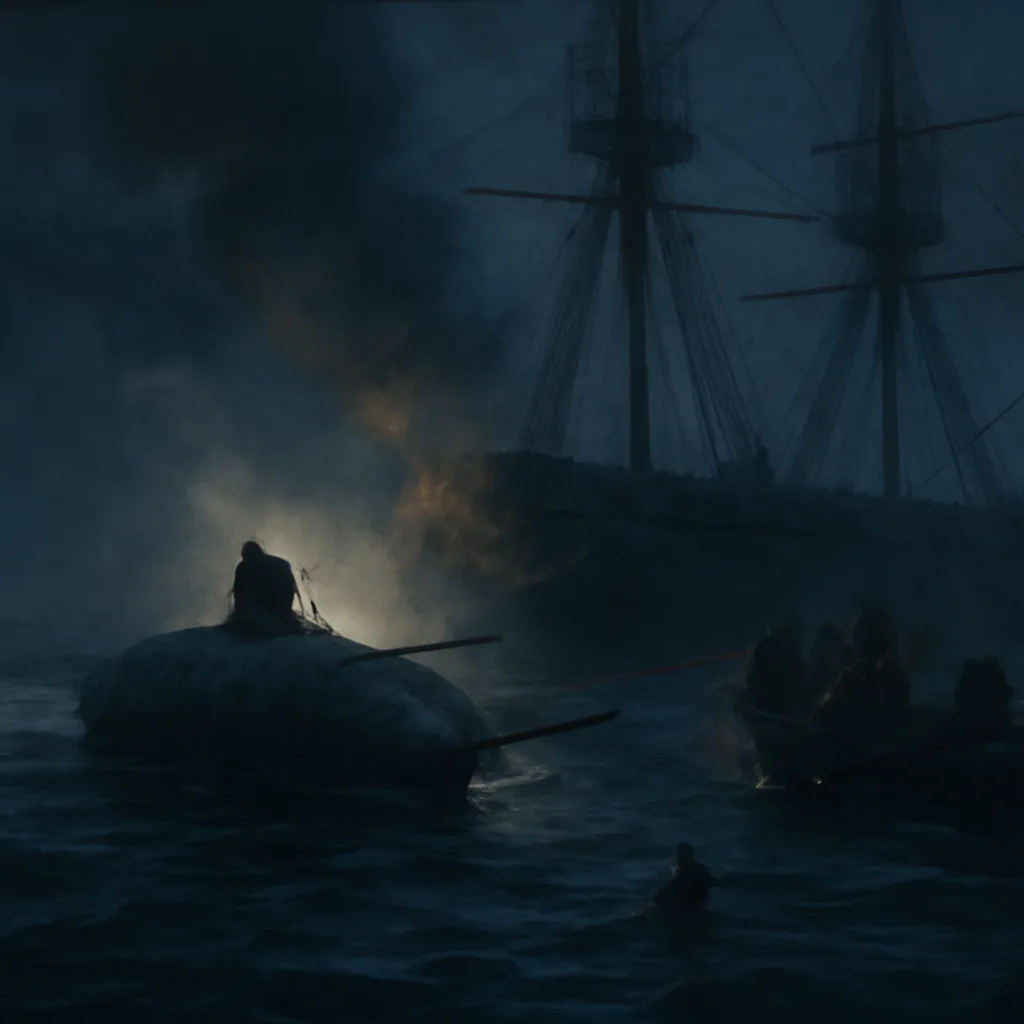
First successful submarine attack sinks a ship in 1864
On March 17, 1864, during the U.S. Civil War, the Confederate submarine H. L. Hunley successfully attacked and sank the Union sloop USS Housatonic off Charleston harbor — the first time a submarine sank an enemy warship in combat, though the Hunley itself was lost soon after.
On the evening of March 17, 1864, Confederate forces deployed the hand-cranked submarine H. L. Hunley in an attack against the Union blockade off Charleston, South Carolina. The submarine approached the Union sloop-of-war USS Housatonic and detonated an explosive charge against the ship’s hull. The Housatonic sank rapidly with minimal loss to the blockade squadron, marking the first time in naval history that a submarine successfully sank an enemy warship in action.
The Hunley was a privately built Confederate vessel funded and supported by the Confederate Navy and local backers. It measured roughly 40 feet in length and was operated by a crew who turned cranks to power the single propeller. Its offensive device was a spar-mounted torpedo: an iron tank or canister filled with black powder affixed to the end of a long pole that projected from the submarine’s bow. The plan was to ram or place the spar charge against an enemy hull and detonate it, causing catastrophic flooding.
On the night of the attack, the Housatonic was on blockade duty outside Charleston Harbor. Accounts from the Union side indicate that lookouts spotted a small object in the water at short range, and before the crew could fully react, an explosion struck the Housatonic’s starboard side near the waterline. The sloop sank in shallow water within minutes; five sailors were killed and others rescued. The effectiveness of the attack shocked both sides, demonstrating that submarines could pose a lethal threat to surface warships.
The fate of the Hunley itself has been the subject of historical attention and investigation. Shortly after the attack, the submarine failed to return to its point of origin and was lost with its crew of eight. Contemporary Confederate reports and later historical research debated whether the Hunley was damaged by the blast, swamped by the sea, or suffered some other malfunction. The Hunley remained missing until it was located in 1995 and raised in 2000. Examination of the hull and artifacts has provided insights but has not produced a single definitive cause for the loss; hypotheses include damage from the explosion, crew incapacitation, flooding, or a combination of factors.
The attack on the Housatonic had several consequences. It demonstrated the tactical potential of submarines and underwater explosives, accelerating interest in submersible warfare and countermeasures. For the Union blockade, the sinking highlighted vulnerabilities in anchoring and watch procedures, prompting adjustments in patrol patterns and defensive precautions around harbors. For the Confederacy, the action was a rare tactical success in a theater where material shortages and industrial limitations constrained naval capabilities.
Historians consider the Hunley’s action significant both technologically and symbolically. Technologically, it marked the first recorded sinking of an enemy warship by a submarine — an important milestone in naval warfare that foreshadowed the growing role of subsurface craft in the 20th century. Symbolically, the episode has been remembered and studied as a dramatic example of innovation under resource constraints and the human costs associated with experimental weapons. The raised Hunley and the artifacts recovered from it continue to inform scholarly work and public exhibits about Civil War naval history and early submarine design.
While the broad facts of March 17, 1864 — the sinking of USS Housatonic by the Confederate submarine H. L. Hunley and the subsequent loss of the Hunley — are well established, details about the precise mechanics of the sinking and the submarine’s final moments remain debated among historians and researchers. Ongoing forensic study of the recovered Hunley and archival research into contemporary reports continue to refine understanding of this landmark event in naval history.