
← Back
04/27/1912 • 9 views

How the Piltdown Forgery Was First Challenged (April 27, 1912)
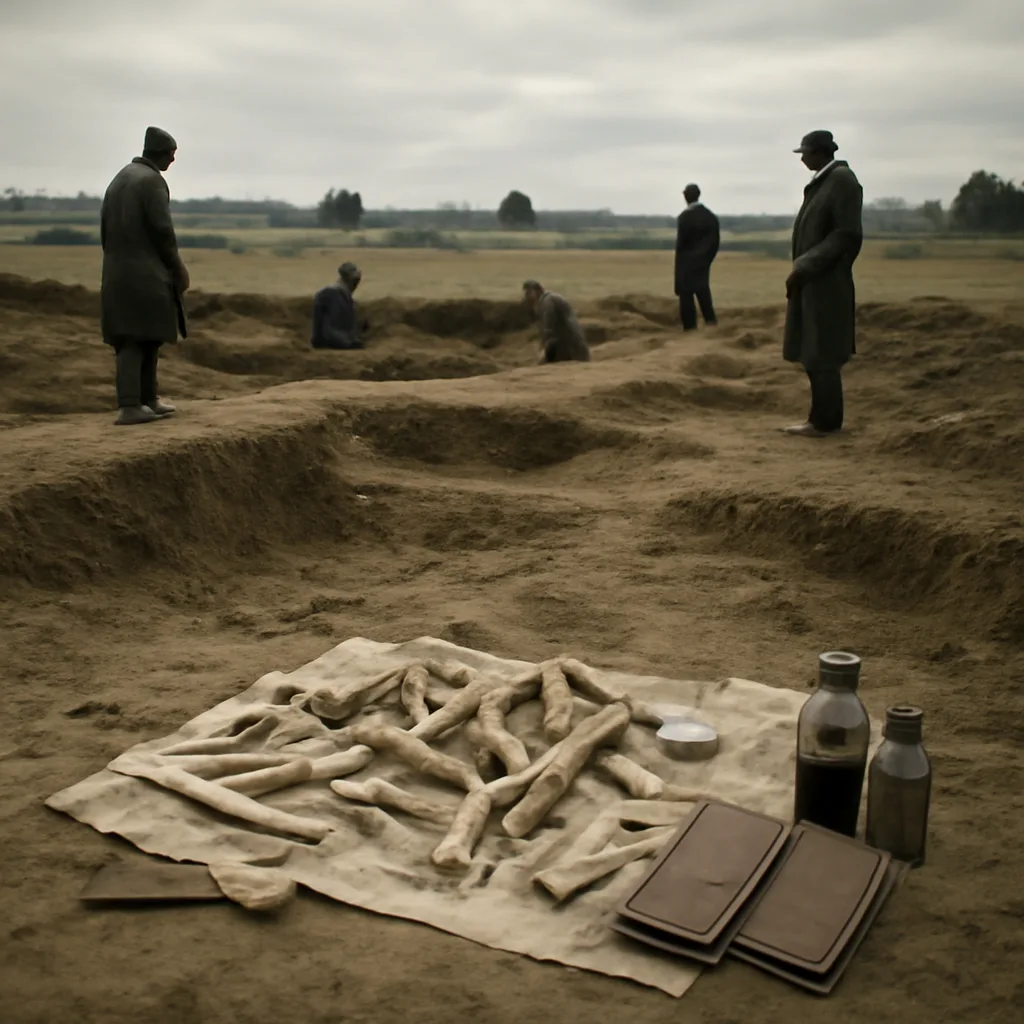
A wide view of an early 20th-century archaeological dig near Piltdown, Sussex, showing excavation pits, scattered bone fragments on cloth, wooden tools and field notebooks on the ground, and researchers in period dress examining finds from a distance.

On April 27, 1912, scientists publicly questioned the authenticity of the Piltdown skull fragments—an early, documented challenge to a staged scientific fraud that would later be exposed as deliberate forgery.


On April 27, 1912, the Piltdown remains—fragments of a skull and jaw reportedly discovered in Sussex, England, and presented as a missing link between apes and humans—came under early scientific scrutiny. The Piltdown material, first announced in 1912 by amateur archaeologist Charles Dawson and supported by prominent figures such as Arthur Smith Woodward of the Natural History Museum, was initially received with great interest. The finds were framed as evidence of an ancient British hominid, dubbed Eoanthropus dawsoni (Piltdown Man).

The initial presentation combined cranial fragments resembling modern Homo with a jawbone that appeared more apelike. Contemporary accounts record that specialists at the time debated the age and significance of the specimens. On April 27, 1912, questions began to surface in scientific correspondence and meetings as anatomists and geologists noted inconsistencies between the skull and jaw and between the material and other fossil evidence from Europe and Africa. These early challenges did not immediately unseat the Piltdown interpretation but marked the first documented moment when scientists publicly expressed doubt about the find’s coherence and provenance.

Skepticism in 1912 focused on anatomical mismatches and the absence of corroborating fossils from the same strata or locale. Some anatomists pointed out that the cranial fragments and the jaw displayed differing morphological characteristics that were difficult to reconcile in a single individual. Geological observations also raised questions about how the bones had been deposited and whether the stratigraphic context offered secure dating. At that stage, the criticisms were cautious: many researchers accepted the possibility that new or unusual fossils could alter existing frameworks, while others urged more thorough analysis.

Over the following decades, additional doubt accumulated. Improved analytical techniques and discoveries of more complete hominid fossils elsewhere cast increasing suspicion on Piltdown. By the mid-20th century, the case against Piltdown grew decisive. In 1953, rigorous chemical tests (including fluorine analysis, nitrogen content assessment, and later radiometric approaches) demonstrated that the skull and jaw bones were of markedly different ages and that the bones had been artificially stained to appear ancient. Also evident were deliberate modifications—teeth on the jaw had been filed down and the bones had been artificially fractured and stained to create the appearance of antiquity. These findings showed that the Piltdown assemblage was not a natural, coherent fossil but a staged forgery assembled from recent human and ape remains.

The identity and motives of the forger or forgers remain a matter of historical debate. Several candidates have been proposed in the literature—ranging from Charles Dawson himself to various colleagues and rivals—but conclusive proof naming the perpetrator has not been universally accepted. What is clear, however, is that the Piltdown affair became a landmark case in the history of science: it exposed vulnerabilities in peer review, the influence of personal reputation and national pride on scientific interpretation, and the need for multiple lines of verification, including geochemical and contextual analyses.

The early questioning on April 27, 1912, is important because it demonstrates that scientific scrutiny was present from the outset, even if it did not immediately overturn the accepted interpretation. The Piltdown episode ultimately reinforced methodological standards in paleoanthropology and archaeology, encouraging more rigorous provenance documentation, open data sharing, and application of independent tests. While the Piltdown forgery did mislead parts of the scientific community for decades, the process of challenge, retesting, and eventual correction illustrates the corrective mechanisms of science when exposed to persistent, methodical inquiry.

Sources for this account include contemporary scientific reports and later historical and forensic analyses of the Piltdown material. Because some details—especially the identity of the forger—are disputed, this summary confines itself to well-documented events and the established trajectory from initial doubt in 1912 to definitive exposure in the 1950s.

Share this

Email Share on X Facebook Reddit

Did this surprise you?