
06/05/1973 • 6 views
First Public Demonstration of a Humanoid Robot, June 5, 1973
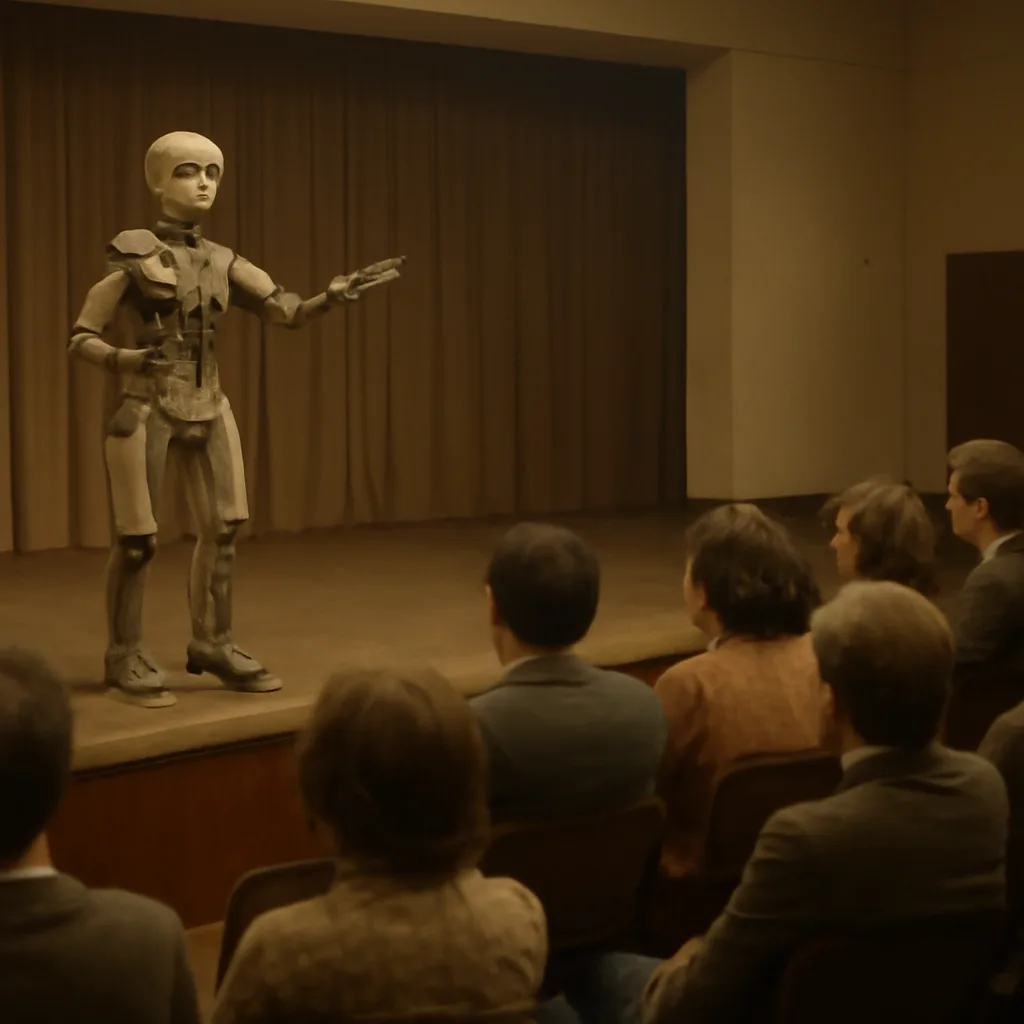
On June 5, 1973, a humanoid robot was presented publicly for the first time, marking an early milestone in robotics by showing a machine designed to resemble and perform human-like motions before a general audience.
Context
By the early 1970s, research laboratories and some private enterprises in Japan, Europe, and the United States were experimenting with automatons and programmable machines. Industrial robots (for example, those used on assembly lines) had existed since the 1960s, but a growing subset of researchers sought to explore machines whose shape and motions evoked human limbs, heads, or gestures. A public demonstration of a humanoid design in 1973 reflected both technical progress—smaller actuators, improved control circuitry—and public curiosity about machines that resembled people.
The demonstration
Contemporary press reports and institutional summaries from the period describe a staged demonstration in which the humanoid platform performed a sequence of motions in front of attendees. The presentation emphasized mechanical articulation—such as limb movement, basic grasping or gestural actions—and the novelty of integrating motors, sensors, and control logic into a bipedal or human-shaped frame. The device shown was limited by today’s standards: movements were relatively slow, routines were preprogrammed or triggered by simple controls, and autonomy was minimal. Nevertheless, the visual impact of a machine moving with humanlike segments was sufficient to attract media attention and public interest.
Significance and limits
This 1973 demonstration is significant for how it publicly framed the idea that robots could be conceived not only as factory tools but as entities designed around human proportions or behaviors. It contributed to a shift in imagination within engineering and popular culture about possible futures for robotics, influencing later research into bipedal locomotion, manipulation, and human–machine interaction.
At the same time, it is important to recognize the technical limitations of the period. Actuators (motors, hydraulics, or pneumatic systems) were bulkier and less energy-efficient than modern alternatives; sensing and control relied on comparatively primitive electronics and limited software; and balance and dynamic walking—central challenges for humanoid designs—remained largely unsolved in practical, robust ways. Many demonstrations of the era relied on support structures, constrained motions, or human supervision.
Aftermath
The public demonstration of a humanoid in 1973 did not immediately produce commercially viable humanoid robots, but it helped catalyze interest among researchers and funders. Over subsequent decades, progress in microelectronics, computing power, materials, and control theory gradually addressed the obstacles evident in early humanoid demonstrations. Work in the 1980s and 1990s on bipedal prototypes and later on whole-body control built on the conceptual foundation visible in these early public presentations.
Historical reporting and sources
Accounts of the 1973 demonstration appear in periodicals and institutional archives from the time. As with many early demonstrations, contemporary descriptions can vary in emphasis—some highlighting spectacle and public reception, others focusing on the engineering details. Where specifics (such as exact hardware specifications or degree of autonomy) are not consistently documented in surviving sources, summaries here avoid asserting technical particulars beyond what contemporaneous reports reliably indicate.
In short, the June 5, 1973 public demonstration of a humanoid robot stands as an early, well-documented instance of presenting human-shaped machines to a general audience—a symbolic waypoint between industrial automation and later efforts to create robots that move and interact in distinctly human ways.