
← Back
02/28/1953 • 8 views

Watson and Crick Reveal Structure of DNA: The Double Helix
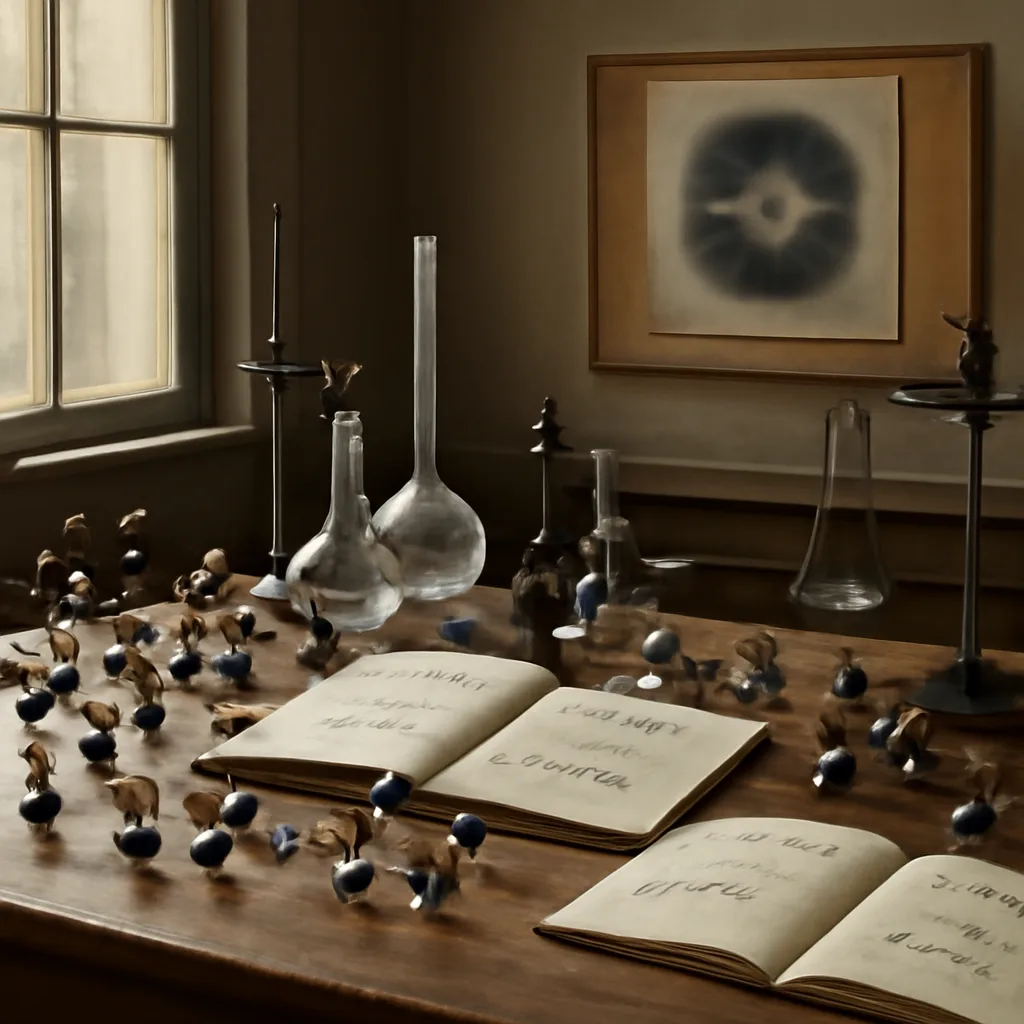
Scientists' workspace with molecular models and lab notebooks on a wooden table, 1950s laboratory setting with period equipment and glassware, no identifiable faces.

On Feb. 28, 1953, James Watson and Francis Crick announced they had determined the double-helix structure of deoxyribonucleic acid (DNA), a discovery that explained how genetic information is stored and replicated.


On 28 February 1953 James D. Watson and Francis H.C. Crick publicly disclosed that they had deduced the molecular structure of deoxyribonucleic acid (DNA) as a right-handed double helix. Their model explained how two complementary strands, paired through specific base interactions, could store genetic information and be copied during cell division. The announcement followed months of rapid progress in molecular biology and intense exchange of experimental data, chemical reasoning, and model building.

Background and context
By the early 1950s, researchers knew that DNA contained genetic information but lacked a convincing structural explanation for heredity. X-ray diffraction data produced by Rosalind Franklin and Raymond Gosling at King’s College London, chemical analyses by Erwin Chargaff showing base-pair regularities, and earlier biochemical and theoretical work created a puzzle many teams were trying to solve. Watson, an American postdoctoral researcher, and Crick, a physicist turned molecular biologist at the Cavendish Laboratory in Cambridge, approached the problem using physical models guided by available data.

The model and its significance
Watson and Crick proposed that DNA consists of two antiparallel polynucleotide strands coiled around a common axis to form a helical structure. The strands run in opposite directions and are held together by hydrogen bonds between complementary bases—adenine with thymine, guanine with cytosine—arranged in a consistent geometry that explained Chargaff’s ratios. The model implied a mechanism for replication: each strand could serve as a template for synthesizing its complement, offering a molecular basis for inheritance.

Collaboration and sources
Watson and Crick’s work was enabled by experimental results produced by others. Notably, Rosalind Franklin’s X-ray diffraction images provided critical evidence for a helical form and consistent dimensions; Chargaff’s rules constrained base-pairing possibilities; and biochemical studies established the chemical nature of nucleotides. Watson and Crick combined these lines of evidence with physical model-building to propose the double helix.

Reception and subsequent developments
The model was rapidly influential. It offered an explanatory framework that oriented subsequent research into replication, transcription, and the genetic code. Over the following decade, experiments by many investigators—molecular biologists, biochemists, and geneticists—tested and elaborated the molecular mechanisms implied by the double helix. In 1962 Watson, Crick, and Maurice Wilkins (a colleague of Franklin’s at King’s College) received the Nobel Prize in Physiology or Medicine for discoveries concerning the molecular structure of nucleic acids; Rosalind Franklin had died in 1958 and was not eligible for the prize.

Historiographical notes
Accounts of the discovery emphasize both the centrality of the double-helix model and the collaborative, sometimes contentious interactions among laboratories. The roles of Franklin and Chargaff, and the extent to which data were shared or used across groups, have been the subject of extensive historical discussion. Contemporary summaries recognize Watson and Crick’s model as a pivotal conceptual advance while also situating it within a broader, multi-laboratory effort.

Legacy
The double helix remains a foundational concept in biology. Its elucidation marked a transition to molecular explanations of heredity and propelled advances in genetics, biotechnology, medicine, and evolutionary biology. The 1953 announcement is often cited as a turning point that reshaped biological science in the twentieth century.

Share this

Email Share on X Facebook Reddit

Did this surprise you?