
← Back
06/05/1937 • 5 views

Patent for the First Practical Electric Guitar Granted, June 5, 1937
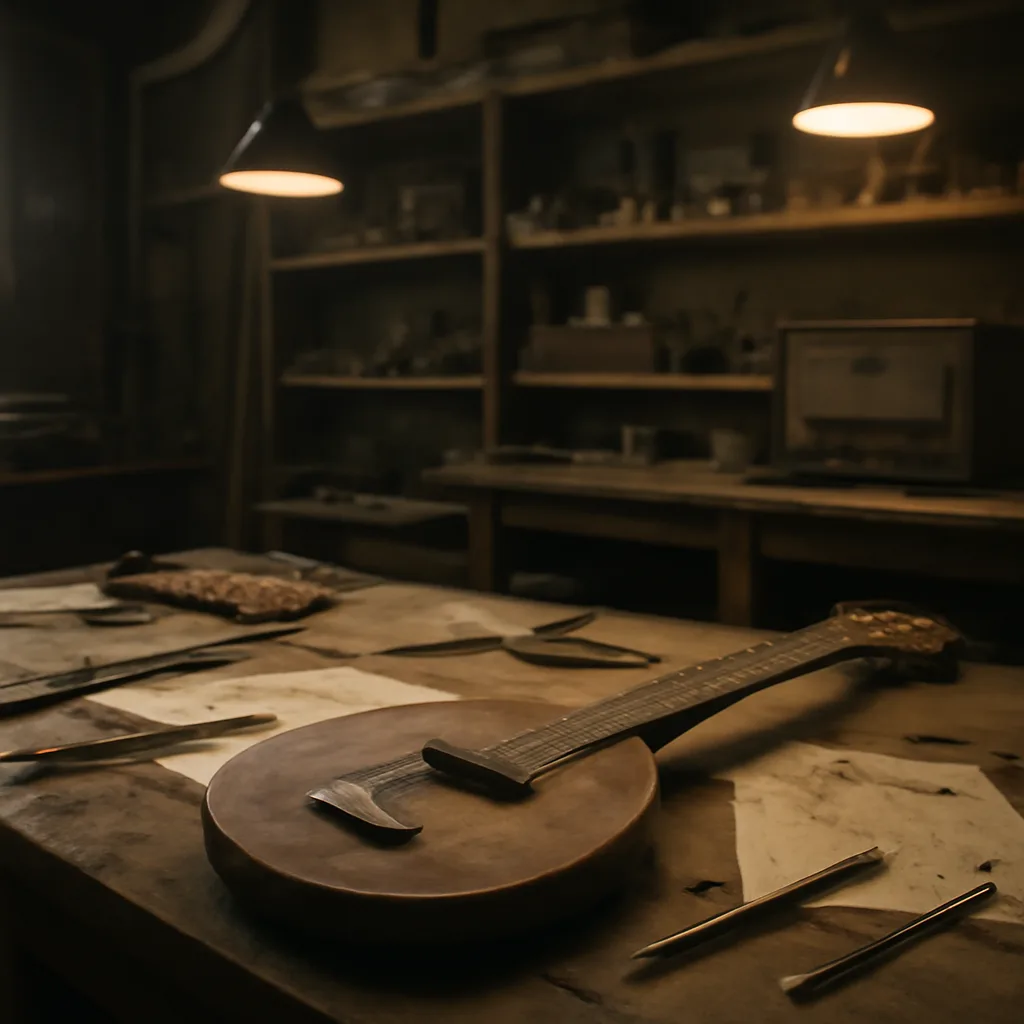
1930s workshop scene with an early lap-style electric guitar ("frying pan"), electromagnetic pickup visible beneath the strings, workbench with tools and patent drawings spread out.

On June 5, 1937, inventor and musician George Beauchamp (with colleagues) was granted U.S. Patent No. 2,089,171 for an electrically amplified stringed instrument—commonly regarded as the first practical electric guitar—marking a turning point in musical amplification.


On June 5, 1937, U.S. Patent No. 2,089,171 was granted for an electrically amplified stringed instrument—a milestone often cited as the issuance of the first patent for a practical electric guitar. The patent names George D. Beauchamp and Adolph Rickenbacker (among others associated with the National String Instrument Corporation and later the Rickenbacker company) for an instrument that used electromagnetic pickups to convert string vibration into an electrical signal for amplification.

Background and technical context
Before the 1930s, guitarists relied on acoustic projection; louder instruments for ensemble settings were limited to larger-bodied guitars, archtops, and amplified banjos. Early experiments to amplify stringed instruments included microphones and mechanical add-ons, but these solutions were prone to feedback and limited effectiveness. The key technical advance formalized in the 1937 patent was the use of a pickup—an electromagnetic transducer—positioned close to the strings, enabling more reliable, controllable electrical pickup of string vibration to feed into an amplifier and loudspeaker.

The inventors and companies involved
George D. Beauchamp, an instrument maker and player, is commonly credited as a central figure in the development. He worked with partners including Adolph Rickenbacker and Paul Barth; their efforts coalesced in companies such as the National String Instrument Corporation and later Rickenbacker. The patent and subsequent instruments were part of a collaborative, iterative effort among inventors and small manufacturers in Southern California and Chicago in the early-to-mid 1930s.

What the patent covered
The 1937 patent describes an electrically amplified stringed instrument with a magnetic pickup assembly coupled to the strings, measures to anchor and intonate strings, and means to route the electrical signal to external amplification. The documents emphasize adapting existing string-instrument forms to incorporate electromagnetic pickup technology rather than inventing a wholly new stringed body type.

Significance and immediate impact
The patent formalized the practical application of electromagnetic pickups to the guitar, enabling greater volume and new tonal possibilities. Early commercially produced instruments that followed—sometimes called "frying pan" lap steel guitars for their shape and later hollow- and solid-body electrics—allowed guitarists to be heard alongside brass, drums, and larger ensembles. This technology laid groundwork for amplified blues, jazz, country, Hawaiian steel, and, later, rock and roll.

Debates and qualifications
Historians note that multiple inventors and firms contributed to electric amplification for stringed instruments across the 1920s–1930s; patents and prototypes appeared in various forms. The 1937 patent is often described as the first practical patent for an electric guitar pickup system, but it is not the sole origin of electric amplification ideas. Some earlier experiments and patents addressed pickup concepts for other instruments or used different transduction methods. Thus, while the June 5, 1937 patent is a verifiable milestone, the broader invention of electric guitars was evolutionary and collaborative.

Legacy
The technology formalized in the 1937 patent became foundational. Electromagnetic pickups evolved in design (single-coil, humbucking, etc.), and instrument body types diversified. Manufacturers built on these early patents to create the range of electric guitars that shaped 20th-century popular music. Museums, instrument archives, and patent records preserve examples and documentation of these early instruments, enabling continued study of their technical and cultural history.

Share this

Email Share on X Facebook Reddit

Did this surprise you?