
← Back
03/01/1692 • 5 views

Interrogations Begin in Salem Witch Trials
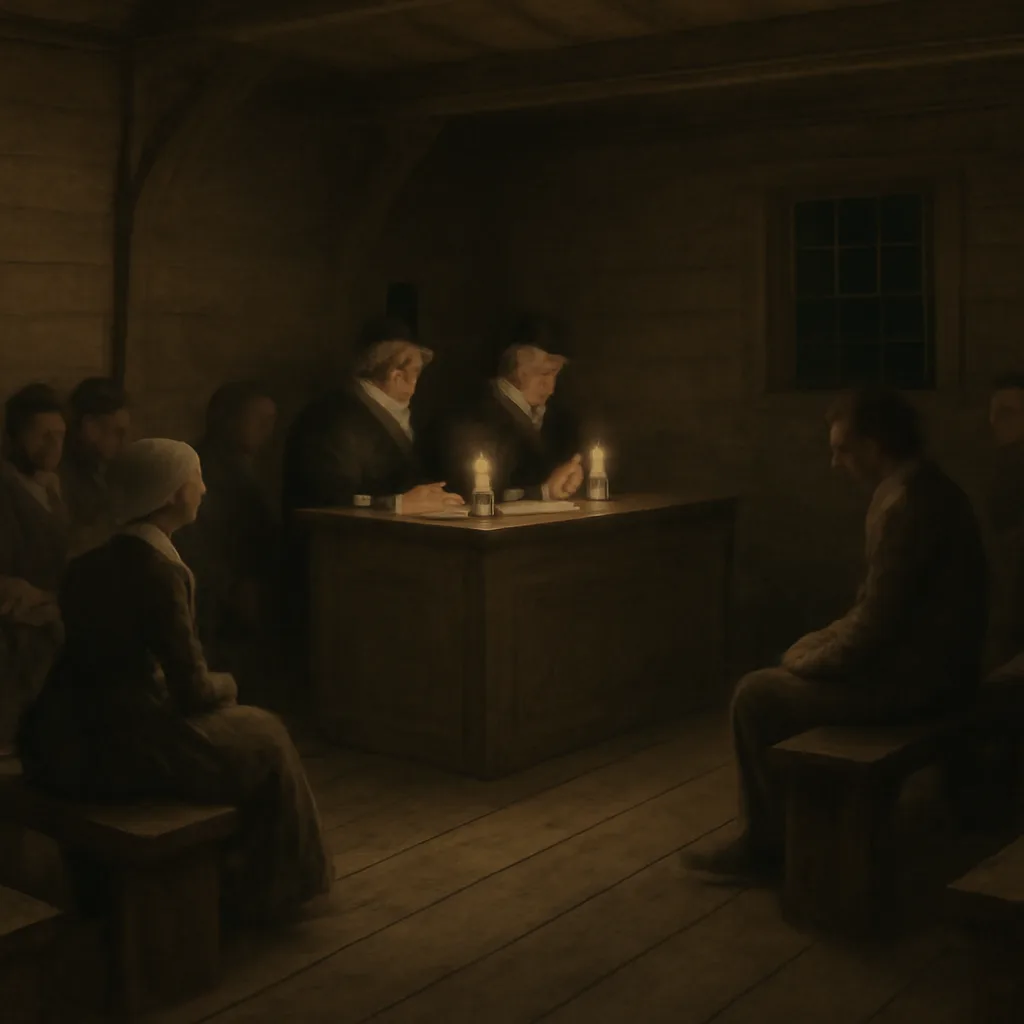
Late 17th-century New England village meeting house interior with magistrates questioning seated villagers by candlelight; plain colonial clothing and wooden benches visible.

On March 1, 1692, formal interrogations began in Salem Village as magistrates questioned accused individuals in the first official stage of the trials that would lead to widespread arrests and executions the following year.


In early 1692 tensions in Salem Village (now Danvers, Massachusetts) erupted into a series of accusations of witchcraft that would become known as the Salem witch trials. On March 1, 1692, the first formal interrogations were conducted by local magistrates who recorded the complaints and interrogated those accused. These early proceedings followed complaints by several young women in the village who reported fits and strange behavior, which some neighbors attributed to supernatural causes.

The interrogations on March 1 were part of a process that moved quickly from informal community concern to legal action. Magistrates such as Jonathan Corwin and John Hathorne played prominent roles in hearing allegations, taking sworn statements, and assessing evidence presented by the afflicted and their families. The initial suspects were questioned about relationships, recent disputes, and any odd occurrences that might be offered as signs of witchcraft. Accusers were often present or their depositions were read aloud. The proceedings relied heavily on testimony and observable behavior rather than modern forensic standards.

At this early stage, the legal framework in Massachusetts allowed for civil authorities to examine complaints of witchcraft; later events would involve county courts and, eventually, the special Court of Oyer and Terminer convened in 1692 for the trials. The interrogations helped produce the arrest warrants that led to the imprisonment of several accused persons. The reliance on spectral evidence — testimony that the accused’s spirit or apparition afflicted the complainant — and intense community fear contributed to the rapid expansion of accusations beyond the original circle.

Historical records show that the process on March 1 did not yet include the full formal trials that came later, but it marked the shift from rumor and community strife to official judicial action. The interrogations and depositions collected at this time were preserved in court records and later compilations, which historians use to trace how personal vendettas, property disputes, and religious tensions intersected with fears of the supernatural.

By mid-1692 the number of accused rose, and by 1693 the trials had resulted in numerous executions and imprisonments. Modern scholars debate the relative weight of social, economic, psychological, and environmental factors — including recent smallpox outbreaks and ergot theory hypotheses — in producing the mass accusations, but the March 1 interrogations are widely recognized as a formal starting point in the judicial sequence that became the Salem witch trials.

Because contemporary attitudes and records differ from present-day legal standards, scholars caution against reading the interrogations as impartial investigations; they were shaped by the expectations and religious worldview of a Puritan New England community. The surviving records from March 1692 and subsequent months remain primary sources for understanding how the community moved from fear and suspicion to legal prosecution.

Share this

Email Share on X Facebook Reddit

Did this surprise you?