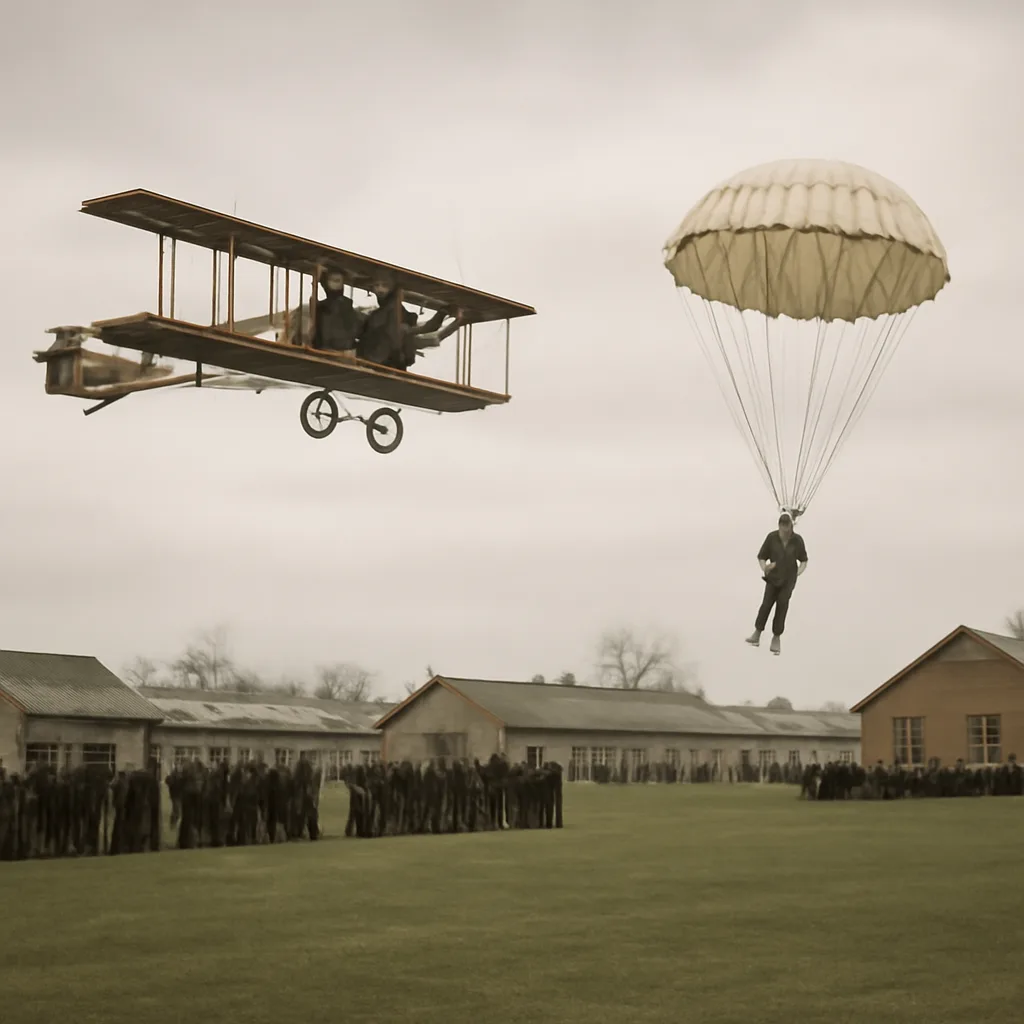
First Successful Parachute Jump From an Airplane, March 1, 1912
On March 1, 1912, parachutist Albert Berry completed the first documented successful parachute descent from a powered airplane over Jefferson Barracks, Missouri, proving the concept of aerial escape from aircraft.
On March 1, 1912, Albert (sometimes spelled Alberto) Berry made what is widely recognized as the first successful parachute jump from a powered airplane. The flight took place at Jefferson Barracks, a military installation near St. Louis, Missouri. The airplane was a Benoist-type biplane flown by pilot Tony Jannus. From an altitude reported in contemporary accounts as roughly 1,500 feet (estimates vary), Berry exited the aircraft while suspended in a harness connected to a parachute that was stowed in a metal canister attached beneath the airplane. When Berry fell clear of the plane and the parachute deployed, he descended safely to the ground, demonstrating that a person could survive an intentional parachute jump from a powered aircraft.
Context and significance
The early 1910s were a period of rapid experimentation in aviation. While parachutes had been used from balloons and for demonstrations earlier, jumping from heavier-than-air powered aircraft posed new technical and procedural challenges, including how to stow and deploy a parachute without fouling the airplane or its controls. Berry’s jump provided a practical proof of concept that influenced military and civilian thinking about pilot safety and emergency escape, and it accelerated further development of parachute designs and deployment methods.
Details and sources
Contemporary newspaper reports and later historical accounts identify Albert Berry as the parachutist and place the event at Jefferson Barracks on March 1, 1912. The airplane is commonly described as being piloted by Tony Jannus in a Benoist biplane. Precise technical details—such as the exact altitude, the exact configuration of the harness and canister, and whether Berry’s descent was the first attempt globally—are reported with some variation across sources. Some earlier experiments from balloons and dirigibles, and a few contested claims from other countries or dates, mean historians sometimes distinguish Berry’s jump specifically as the first documented successful parachute jump from a powered, heavier-than-air airplane rather than the first person ever to descend by parachute from any airborne craft.
Aftermath
Berry’s successful descent did not immediately standardize parachute use in aircraft, but it drew attention from both aviation enthusiasts and military planners. Over the following decade, parachute design and training evolved, and by World War I and particularly World War II, parachutes became standard equipment for many pilots and airborne troops. Berry’s jump remains a milestone cited in histories of aviation safety and parachuting.
Notes on disputed or uncertain points
Some historical sources use slightly different spellings of Berry’s name and give varying altitudes and technical descriptions. Earlier parachute descents from balloons and dirigibles occurred and are distinct from the specific claim of a jump from a powered airplane. Where accounts differ, this summary identifies the widely accepted elements—Albert Berry, Jefferson Barracks, March 1, 1912, and a Benoist-type biplane piloted by Tony Jannus—while noting that some particulars are reported differently in primary and secondary sources.