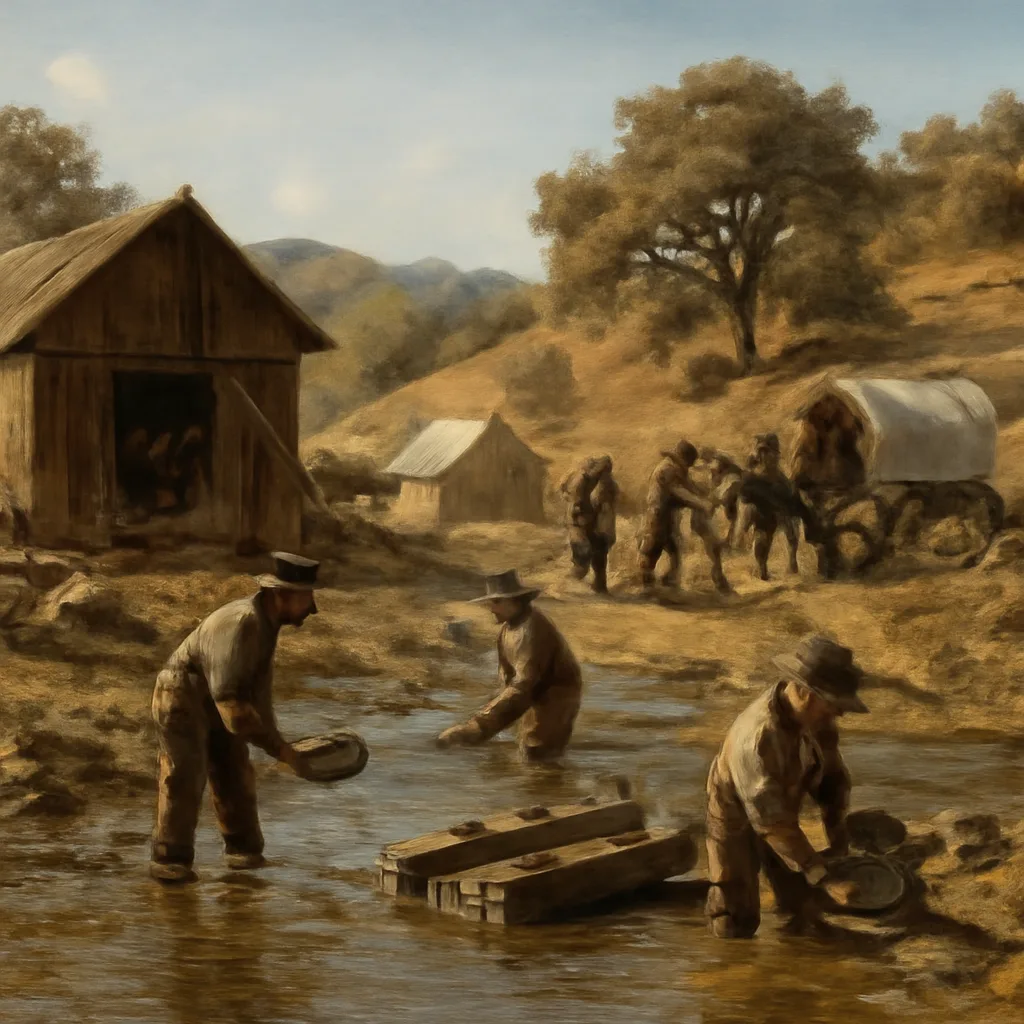
July 19, 1848: News of California gold sends thousands westward
On July 19, 1848, reports of gold discovered at Sutter’s Mill in California began to spread widely, triggering a mass movement of prospectors, settlers, and entrepreneurs toward the West that reshaped the United States.
On January 24, 1848, James W. Marshall found gold at John Sutter’s sawmill on the American River near Coloma, California. News of the discovery moved slowly at first within California’s dispersed communities. By spring and early summer of 1848 the discovery reached the wider United States, and the date July 19, 1848 is commonly cited as a moment when reports circulating in eastern newspapers and letters helped accelerate the flow of migrants.
The initial wave of people who moved to California after word of the find included local miners, sailors, soldiers, European immigrants already in the region, and laborers from nearby Mexican and Native American communities. As accounts of easy finds and the promise of quick wealth spread—often exaggerated—thousands more made the long journey overland across the continent, by sea around Cape Horn, or via the Isthmus of Panama. Those who traveled in 1848 began what became known as the California Gold Rush, a sustained migration that peaked in the early 1850s.
The movement had immediate demographic and economic effects. San Francisco, a small settlement before 1848, grew rapidly as a provisioning and transportation hub. Mining camps and boomtowns proliferated across the Sierra Nevada and the Sacramento Valley. Merchants, outfitters, and service providers often profited more reliably than individual prospectors. The influx accelerated California’s population growth, hastened its admission to the Union as a state in 1850, and intensified conflicts over land, resources, and sovereignty.
The Gold Rush’s impacts were not uniformly beneficial. Native American tribes experienced devastating loss of life, land, and livelihood due to disease, dispossession, violence, and calamitous environmental changes. Californian and federal authorities frequently failed to protect Indigenous populations; settlers, vigilante groups, and militias often carried out expulsions and attacks. The arrival of miners and settlers also increased tensions with the Mexican Californio population; property and legal claims were contested, and many Californios lost lands through litigation, debt, or coercion.
Environmental transformations were profound. Hydraulic mining, which expanded later in the 1850s and 1860s, released massive amounts of sediment into rivers, altered landscapes, and damaged farmland downstream. Timber cutting for mine supports and fuel, along with the sudden demand for construction and firewood, reduced forested areas in many regions.
The Gold Rush reshaped national politics and economics. California’s rapid population growth and economic importance helped prompt its relatively swift path to statehood, which in turn upset political balances over slavery and regional power in the United States. Internationally, the rush attracted migrants from Latin America, Europe, Australia, China, and other parts of the Pacific, contributing to California’s ethnically diverse population—but also to nativist reactions and discriminatory laws and practices, notably against Chinese immigrants in the 1850s and beyond.
Not all who traveled in hope of riches found success. Many miners returned home or moved on after failing to strike it rich; some settled in California and built businesses, farms, or professional careers. Others endured debt, illness, and hardship. Contemporary newspaper reports and personal letters often amplified tales of large gold finds, creating a feedback loop that encouraged further migration even as stories of disappointment circulated.
Historians continue to study the Gold Rush’s complex legacies: rapid economic development and urban growth on one hand, and dispossession, environmental damage, and social strife on the other. While July 19, 1848 marks a moment when wider public awareness and migration accelerated, the broader Gold Rush unfolded over several years and involved millions of people whose experiences varied widely.
Sources for this summary include primary accounts from the period (newspapers, letters, government records) and extensive secondary historical scholarship on the California Gold Rush’s causes, course, and consequences. Where precise attributions or contested dates exist, historians note variation in timelines and interpretations.