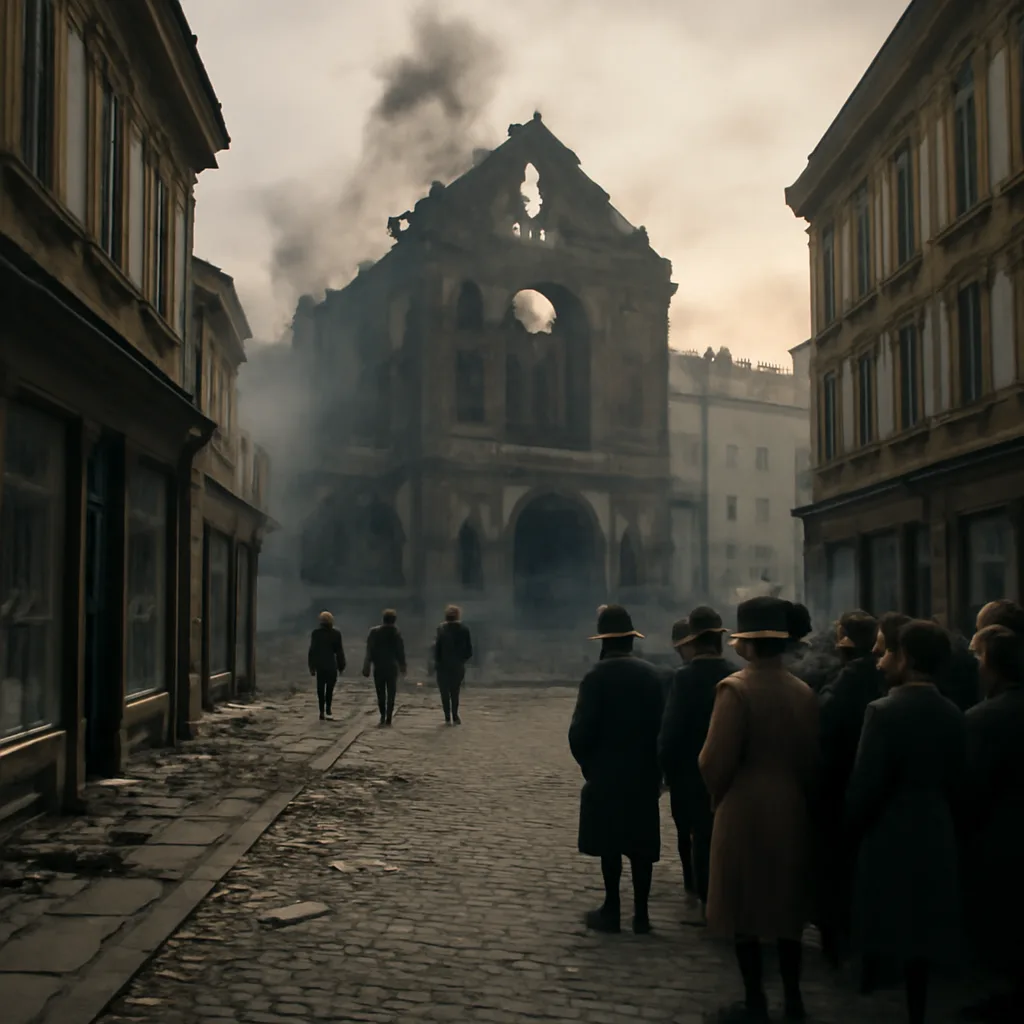
Kristallnacht: Widespread pogroms shatter Jewish lives across Nazi Germany
On the night of November 9–10, 1938, state-sanctioned violence against Jewish people and property swept across Germany and annexed territories, leaving synagogues burned, businesses shattered, and thousands arrested — a decisive escalation in Nazi persecution.
On the evening of November 9 and into November 10, 1938, a coordinated wave of violent attacks against Jewish communities took place across Germany, Austria and the Sudetenland. Often called Kristallnacht (the "Night of Broken Glass"), the pogrom combined organized vandalism and arson with arbitrary arrests and beatings. It marked a turning point from discriminatory laws and economic pressure to overt physical terror endorsed and facilitated by the Nazi state.
Background
Antisemitic policy in Nazi Germany had been escalating since Hitler came to power in 1933. Legal restrictions, social exclusion and economic boycotts had marginalized Jewish citizens for years. The immediate pretext for the November pogrom was the assassination on November 7, 1938, in Paris of German diplomat Ernst vom Rath by Herschel Grynszpan, a 17-year-old Polish Jew. The Nazi leadership used the assassination as justification for mass reprisals.
Course of events
During the night and following days, SA (Sturmabteilung) and SS units, alongside Hitler Youth and civilian rioters with clear encouragement from senior officials, carried out coordinated attacks. Synagogues and prayer halls were set alight or destroyed in many cities; Jewish homes and businesses were looted and smashed; cemeteries were desecrated. Windows of thousands of Jewish-owned shops were broken — an image that gave the event its popular name. Local police and fire brigades frequently stood aside or intervened selectively; in many instances, fires were extinguished only to preserve neighboring non-Jewish property.
Casualties and arrests
Estimates vary but contemporary and subsequent research indicates that at least 91 Jewish people were killed during the violence, with many more wounded. Approximately 30,000 Jewish men were arrested and sent to concentration camps such as Dachau, Buchenwald and Sachsenhausen; most were released weeks to months later, often after their families had paid heavy ransoms or arranged emigration. The material and social damage was vast: hundreds of synagogues were destroyed or severely damaged, and thousands of businesses and homes were ruined.
Economic and legal consequences
The Nazi regime framed the pogrom as a spontaneous public outburst, but evidence shows it was planned and directed at high levels. In the aftermath, the state intensified the expropriation of Jewish property. The German government fined the Jewish community a collective payment for the cost of "restoring order" (an indemnity imposed as punishment) and enacted additional regulations that accelerated Aryanization — the transfer of Jewish businesses to non-Jewish ownership. Insurance claims for damage were largely denied or expropriated by the state.
International reaction and significance
News of the pogroms provoked widespread international condemnation and increased the urgency among many Jews to seek emigration, though barriers remained high. For the Nazi regime, Kristallnacht served both as a domestic signal of intensified persecution and as a step in the regime’s evolving policies that culminated in the Holocaust. Historians view the events of November 1938 as a clear escalation from discrimination to organized, state-enabled violence that put Jewish communities in Germany and annexed territories in immediate and mortal danger.
Memory and commemoration
Kristallnacht has been the subject of extensive historical study and is commemorated in many countries as a warning about state-sponsored hatred and violence. Scholarly estimates and archival records continue to refine our understanding of the exact numbers of victims and assets lost, but the central facts — that synagogues were burned, Jewish businesses and homes were destroyed or looted, and thousands of Jewish men were arrested and deported to concentration camps — are well documented.
Sources and limitations
This summary is based on established historical scholarship and contemporary records. Exact casualty figures and detailed local accounts vary among sources; where numbers differ in the historical record, historians note uncertainty and ongoing research.