
← Back
11/09/1989 • 5 views

Unexpected Opening of the Berlin Wall, 9 November 1989
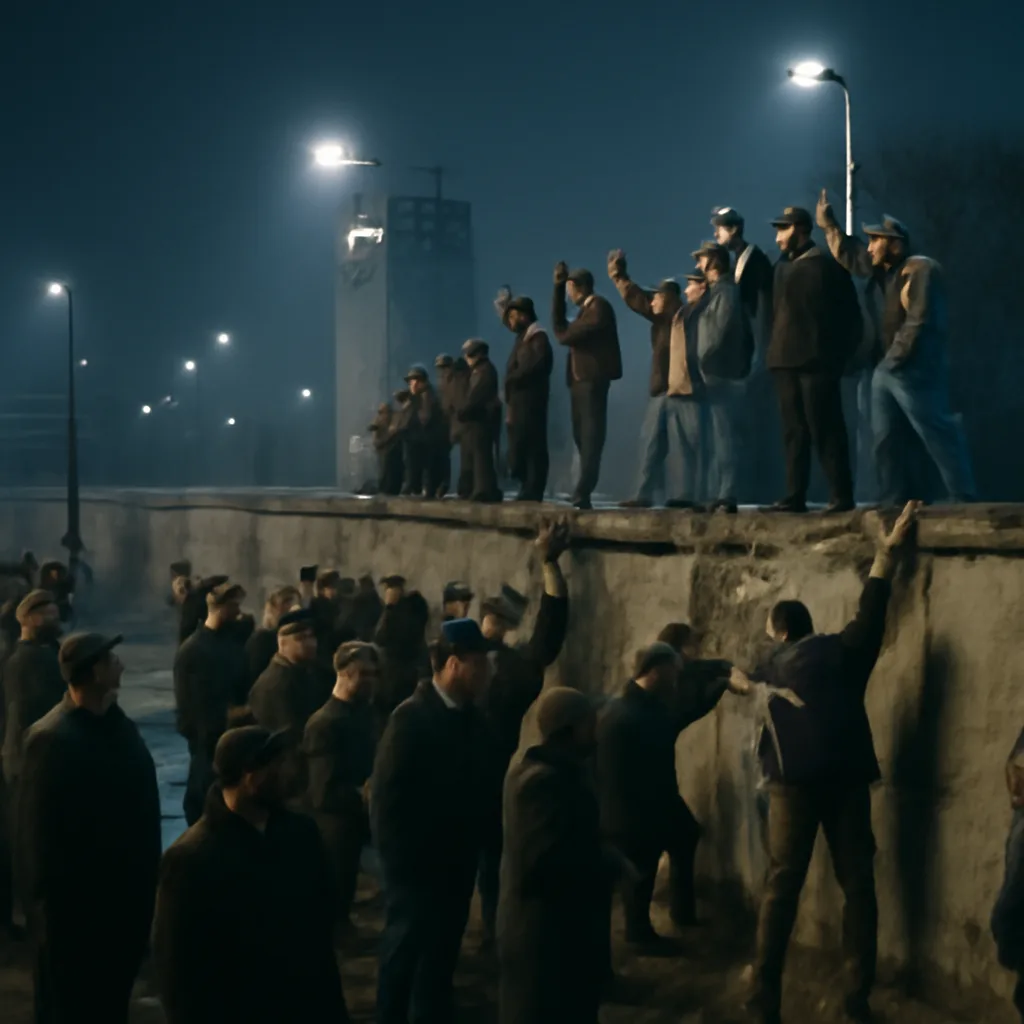
Crowds gathered at a Berlin Wall crossing at night on 9 November 1989, with people on and near the concrete barrier celebrating and some removing pieces.

On 9 November 1989 East German authorities announced relaxed travel rules and a mistaken briefing led border guards to allow crossing immediately, triggering spontaneous celebrations as thousands flowed between East and West Berlin and began dismantling the Wall.


On the evening of 9 November 1989 the Berlin Wall—erected in 1961 to stop East Germans leaving to the West—was effectively opened, allowing free movement between East and West Berlin. The opening followed a chaotic press briefing by the East German Politburo that announced new, looser travel regulations and mistakenly implied immediate implementation. Unclear instructions to border posts, combined with mounting public pressure and large crowds gathering at crossing points, prompted border guards to permit passage rather than use force.

By the time the first crossings occurred, thousands of East Berliners had gathered at checkpoints such as Bornholmer Straße, Potsdamer Platz and the Brandenburg Gate. Scenes that night included jubilant reunions, cheering crowds, and people crossing without routine passport controls. Some climbed onto the Wall and began chipping away at the concrete with hammers and chisels; others celebrated by exchanging gifts or simply embracing family and friends who for decades had been inaccessible except by special permission.

The opening was not the result of a single premeditated decision to dismantle the barrier. It was the culmination of political changes across Eastern Europe in 1989, growing emigration through neighboring countries, sustained civil protests in the German Democratic Republic (GDR), and a reform-minded atmosphere within parts of the GDR leadership. A new travel regulation had been drafted to ease travel for ordinary citizens, but an official presentation to the press by Politburo member Günter Schabowski contained ambiguous phrasing and when asked when the rules would take effect he replied, after consulting notes, that they were "immediately, without delay." This answer circulated rapidly through West and East German media and helped precipitate the immediate crowd pressure on border posts.

Confronted with growing numbers of people and lacking clear higher-level orders to use lethal force, many border guards opted to open checkpoints. The overnight easing of restrictions was followed in the months after by formal legal steps ending restrictions on travel and, eventually, the political processes that led to German reunification on 3 October 1990. The Wall itself remained physically present in places for some time, but large sections were removed by citizens and authorities, and by the end of 1990 most of it had been dismantled.

Historical accounts emphasize that the opening was both unexpected and improvised: it combined an administrative mistake, public demand, and the reluctance of security forces to escalate into violence. Contemporary reporting, eyewitness testimony and later scholarly work agree on the broad sequence of events, though interpretations differ on the relative weight of official intent versus accidental triggers. No credible evidence indicates a single clandestine plot to open the Wall that night; instead the episode is widely understood as a pivotal moment in a broader process of political change across East Germany and Eastern Europe.

The fall of the Wall became an enduring symbol of the end of the Cold War divisions in Europe, and remains a focal point for remembrance of the families separated by the barrier and for study of how rapid political transformation can occur when institutions, public sentiment and information interact under pressure.

Share this

Email Share on X Facebook Reddit

Did this surprise you?