← Back
01/05/1914 • 2 views

Henry Ford Doubles Workers Pay Overnight
Henry Ford

Henry Ford’s $5 Day: The Most Generous Act in Capitalism That Wasn’t Generous at All


Henry Ford’s $5 Day: The Most Generous Act in Capitalism That Wasn’t Generous at All

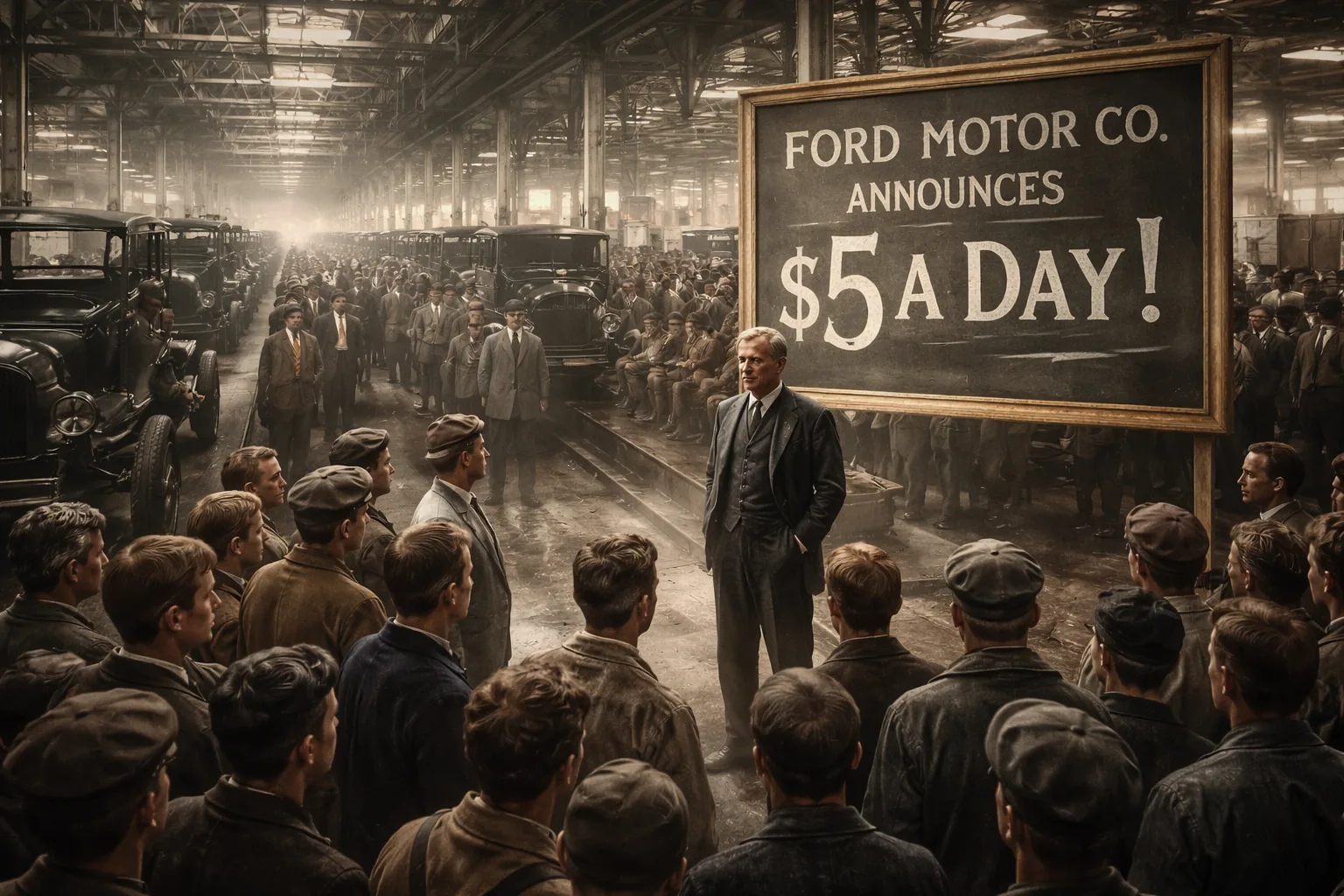
On January 5, 1914, Henry Ford stunned the industrial world by announcing something that sounded almost impossible: he would double his workers’ wages to $5 a day and shorten the workday from nine hours to eight. Newspapers called it revolutionary. Workers cried. Economists panicked. Capitalists scoffed. To the public, it looked like an act of radical generosity.

It wasn’t.

A Factory on the Brink of Collapse

Before the $5 day, Ford’s assembly lines were a human meat grinder. The work was monotonous, exhausting, and soul-crushing—tightening the same bolt, over and over, thousands of times a day. Workers quit in droves. In 1913 alone, Ford Motor Company had to hire over 52,000 men to keep a workforce of 14,000. People simply couldn’t stand the job.

The assembly line was efficient for cars—but devastating for human endurance.

Ford didn’t raise wages because he believed workers deserved more. He raised wages because his factory was bleeding manpower.

The Illusion of Benevolence

The $5 day turned Ford into a global folk hero overnight. Workers fainted when the announcement was made. Thousands mobbed Ford plants the next morning hoping to be hired. Other industrialists accused Ford of destroying capitalism.

But Ford himself was blunt: “If you pay people enough, they won’t leave.”

He also had another motive—one that bordered on brilliant manipulation.

Ford wanted his workers to buy the cars they were building. Higher wages meant more consumers. The same men assembling Model Ts would now be financially locked into Ford’s ecosystem, both as labor and as customers.

It wasn’t generosity. It was vertical integration of human lives.

The Moral Police

The raise came with strings—creepy ones.

To qualify for the full $5 wage, workers were investigated by Ford’s Sociological Department, a private moral police force that intruded into employees’ personal lives. Inspectors showed up at workers’ homes unannounced, checking for:

Alcohol use

Gambling

Cleanliness

“Proper” family behavior

Whether wives stayed home

Whether immigrants were “Americanizing” fast enough

Workers who failed these moral inspections lost their pay increase.

Ford wasn’t just building cars—he was trying to engineer society.

A Man of Progress and Prejudice

Henry Ford is often remembered as a mechanical genius, but his legacy is deeply poisoned by his ideology. He was a virulent antisemite, publishing conspiracy theories in his newspaper The Dearborn Independent. Adolf Hitler later praised Ford in Mein Kampf, calling him an inspiration. Ford’s portrait reportedly hung in Hitler’s office.

The same man who raised wages also helped spread some of the most toxic propaganda of the 20th century.

A Legacy Built on Contradictions

The $5 day reshaped labor forever. Other companies were forced to raise wages. The eight-hour workday spread. The modern middle class took its first shaky steps into existence.

But it came at a cost:

Workers traded freedom for surveillance

Efficiency replaced humanity

Mass production became mass control

Henry Ford didn’t just change how things were made—he changed how people lived, worked, and were watched.

On January 5, 1914, the world celebrated a miracle of kindness.

What it actually witnessed was capitalism learning how to wear a smile.

Share this

Email Share on X Facebook Reddit

Did this surprise you?