
← Back
10/16/1793 • 6 views

Marie Antoinette Executed During the French Revolution
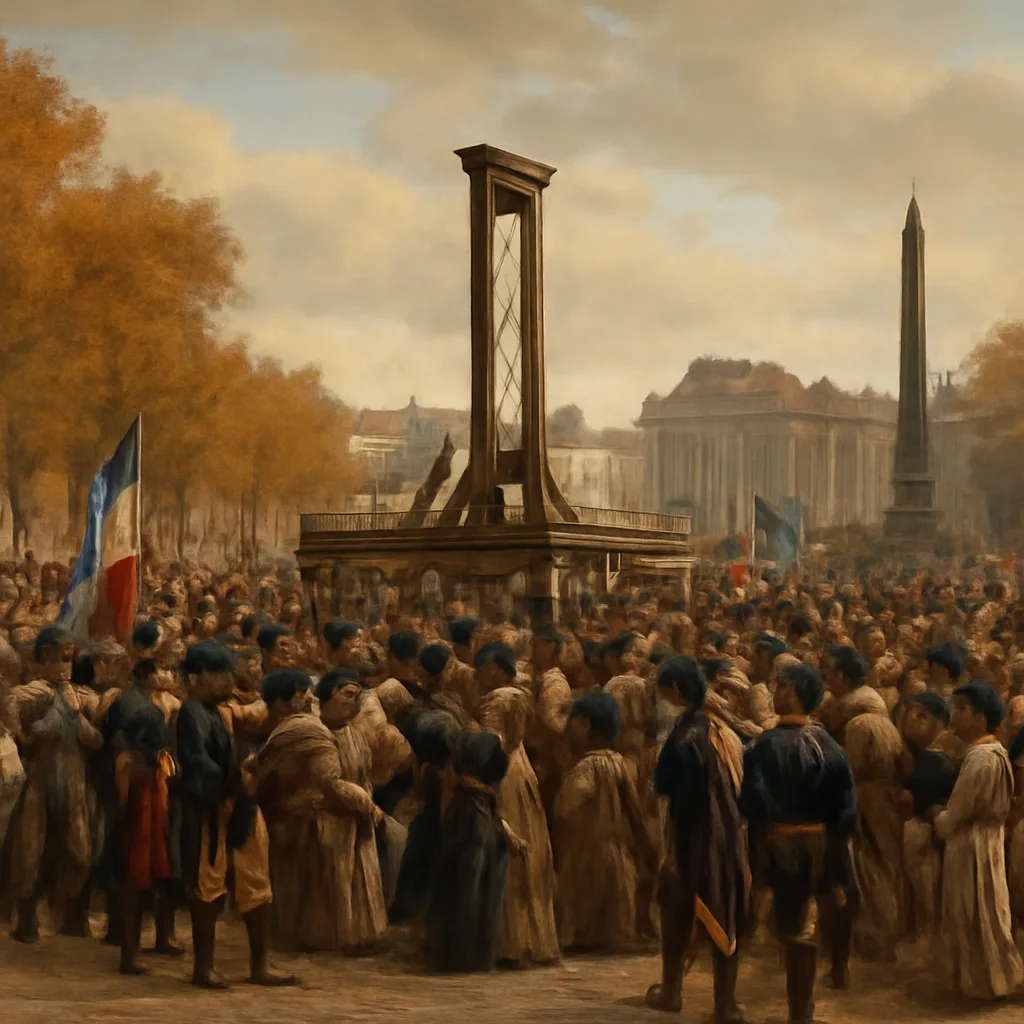
Crowd outside the Place de la Révolution in Paris, 1793, with a guillotine erected in the public square and carriages or guards in late 18th-century military and civilian dress.

On 16 October 1793, former Queen Marie Antoinette was executed by guillotine in Paris after a trial by the Revolutionary Tribunal, marking a definitive break with the ancien régime and intensifying revolutionary fervor across France.


Background and arrest
Marie Antoinette (1755–1793), born an archduchess of Austria, had been Queen of France as consort to King Louis XVI. The monarchy’s unpopularity, fiscal crisis, and revolutionary agitation culminated in the family’s arrest in 1792 following the flight to Varennes (1791) and the storming of the Tuileries (1792). Louis XVI was tried and executed in January 1793. Marie Antoinette was imprisoned in the Temple and later transferred to the Conciergerie, where she awaited trial.

Trial and charges
The Revolutionary Tribunal charged Marie Antoinette with a range of offenses including depletion of the national treasury, conspiracy against the security of the state, correspondence with foreign powers, and crimes against the people. Her trial in October 1793 was political as well as judicial: evidence included intercepted correspondence, testimony about her alleged role in attempts to restore the monarchy, and accusations linking her to counterrevolutionary plots. Defenders argued her actions were those of a queen acting in state interests; prosecutors maintained she had betrayed the nation.

Conviction and execution
On 16 October 1793 the Tribunal found Marie Antoinette guilty. She was condemned to death and transported to the Place de la Révolution (now Place de la Concorde) in Paris. Contemporary accounts describe her journey through the streets of Paris, where crowds gathered; some sources indicate she displayed composure and concern for her children’s welfare in her final hours. At approximately midday she was executed by guillotine.

Consequences and significance
Marie Antoinette’s execution had immediate and long-term significance. Domestically, it symbolized the Revolution’s determination to dismantle the monarchy and to punish perceived enemies of the Republic without regard to rank. Internationally, the regicide shocked European courts and hardened the resolve of monarchies that opposed revolutionary France, contributing to coalition wars against the Republic.

Historical interpretation
Historians debate aspects of Marie Antoinette’s trial and culpability. Some consider her a scapegoat for structural crises and revolutionary propaganda; others emphasize tangible links between royal attempts to secure foreign support and the counterrevolutionary climate. The trial’s fairness is widely questioned: proceedings were influenced by political pressures, sensational testimony, and the precarious security situation in Paris. Surviving records—trial transcripts, contemporary newspapers, and diplomatic correspondence—allow scholars to reconstruct events while noting biases in contemporary sources.

Memory and legacy
Marie Antoinette’s fate has been interpreted in many ways over time: as a tale of personal tragedy, an example of revolutionary justice, and a symbol used by royalists and revolutionaries alike. Her execution remains a focal point in studies of the French Revolution, illustrating the period’s radicalization and the personal human costs of revolutionary change.

Sources and verification
This summary is based on established historical records: trial documentation, contemporary eyewitness accounts, and the extensive secondary literature on the French Revolution. Where details are disputed—such as specific phrases reportedly spoken at the scaffold—this account avoids attributing unverified quotations and emphasizes broadly agreed facts: conviction by the Revolutionary Tribunal and execution on 16 October 1793 in Paris.

Share this

Email Share on X Facebook Reddit

Did this surprise you?