
09/02/1666 • 4 views
Scholars Reassess Death Toll from the Great Fire of London
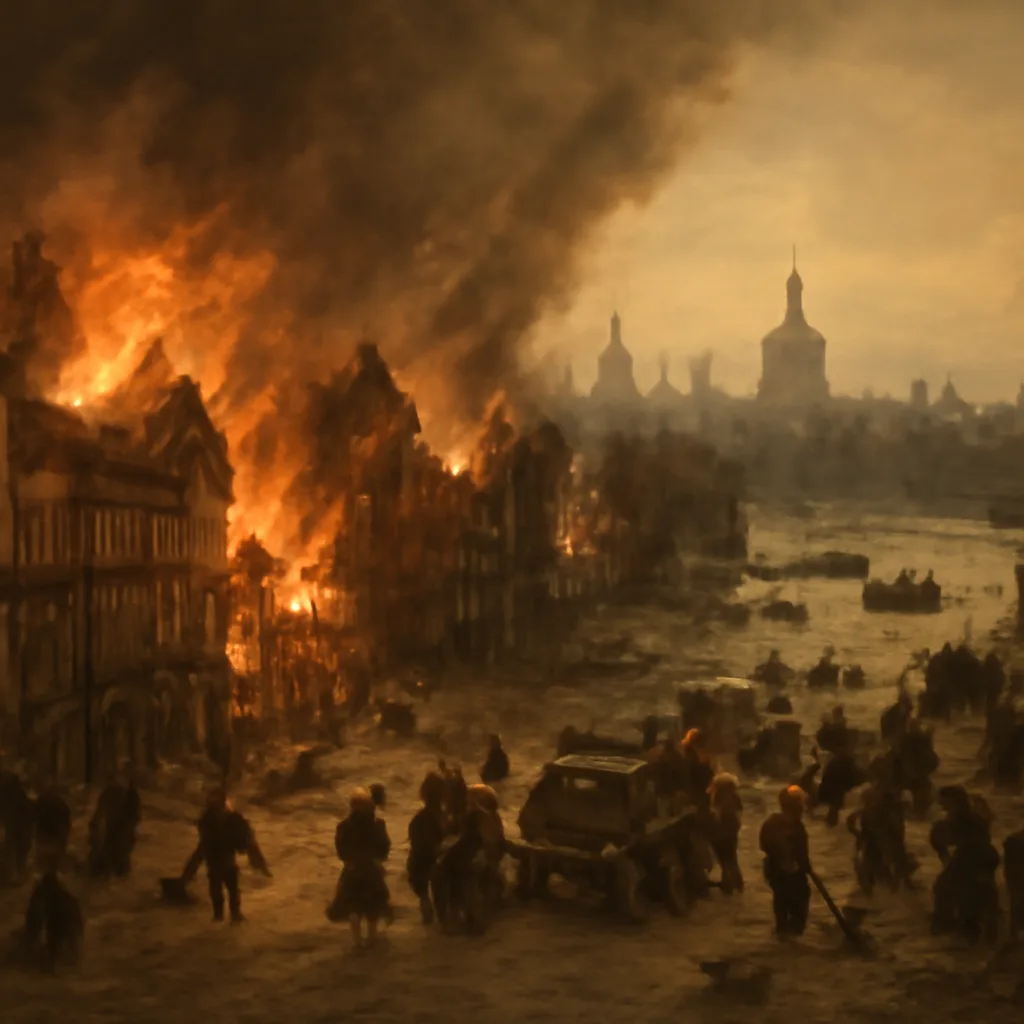
Historians and archival researchers have revised estimates of fatalities from the Great Fire of London (September 2–6, 1666), arguing that previously cited low death tolls understate the human cost when broader archival evidence and demographic methods are considered.
The traditional low-casualty narrative rests largely on early modern official records and eyewitness accounts that emphasized property loss and civic recovery. Contemporary pamphlets, the diary of Samuel Pepys and the official Reports to the King focused on material damage, economic disruption and relief efforts. The small number of deaths explicitly recorded in some immediate sources has long been read as evidence that evacuation and the nature of the fire—rapid but largely confined to buildings rather than open public spaces—kept fatalities low.
Recent research has broadened the evidence base. Historians and demographers have re-examined parish registers, burial records, workhouse and poor-relief accounts, court records, and wills from the years surrounding 1666. Some scholars emphasize indirect mortality: deaths from injuries not recorded as fire fatalities, deaths resulting from homelessness, displacement and disease in the months after the blaze, and fatalities among transient populations—such as itinerant laborers, servants and the very poor—who were less likely to appear in formal counts.
Methodological advances have also played a role. Researchers applying demographic reconstruction and excess-mortality techniques compare expected death rates for London in the 1660s with actual burial numbers in the months following the fire. Where burial totals spike above expected seasonal norms, those excess deaths may reflect unrecorded fire-related mortality or consequences of the disruption. Additionally, cross-referencing occupational and address data from tax lists and guild records with casualty and burial entries has allowed more precise tracing of individuals displaced or killed by the fire.
Scholars caution that precise numbers remain elusive. The period’s record-keeping was incomplete: many parish registers are missing or damaged, and the chaotic circumstances of the fire—mass displacement, breakdowns in local administration and the loss of records themselves—complicate reconstruction. There is also the problem of attribution: distinguishing deaths directly caused by burning from those caused by injuries, exposure, or disease in the aftermath, and separating fire-related deaths from unrelated mortality in a city that already faced high baseline death rates.
Consequently, recent publications do not assert a single revised figure universally accepted by historians; rather, they propose ranges and argue that the long-standing “six deaths” claim is an inadequate shorthand. Some scholars suggest that documented immediate fatalities were higher than early pamphlets indicated, while others point to measurable increases in burials in certain parishes as evidence of additional, previously uncounted deaths in the weeks and months that followed.
Beyond numbers, this reassessment affects how the Great Fire is contextualized in London’s social history. Recognizing a broader mortality impact highlights vulnerabilities among the poor and transient, the limits of contemporaneous relief mechanisms, and the long-term human consequences of urban disasters. It also reframes debates about official responses, rebuilding priorities and the social geography of recovery in late 17th-century London.
The debate remains active. Historians continue to publish archival findings, refine demographic models and discuss interpretive frameworks. While a definitive, single revised death toll may remain unattainable, the scholarly consensus is moving toward acknowledging that the human cost of the Great Fire was likely greater and more complex than the traditional account suggests, and that a fuller accounting requires attention to indirect and under-recorded deaths as well as the social conditions that shaped who was recorded and who was not.