
← Back
10/03/1990 • 4 views

Germany Reunified After Decades of Cold War Division
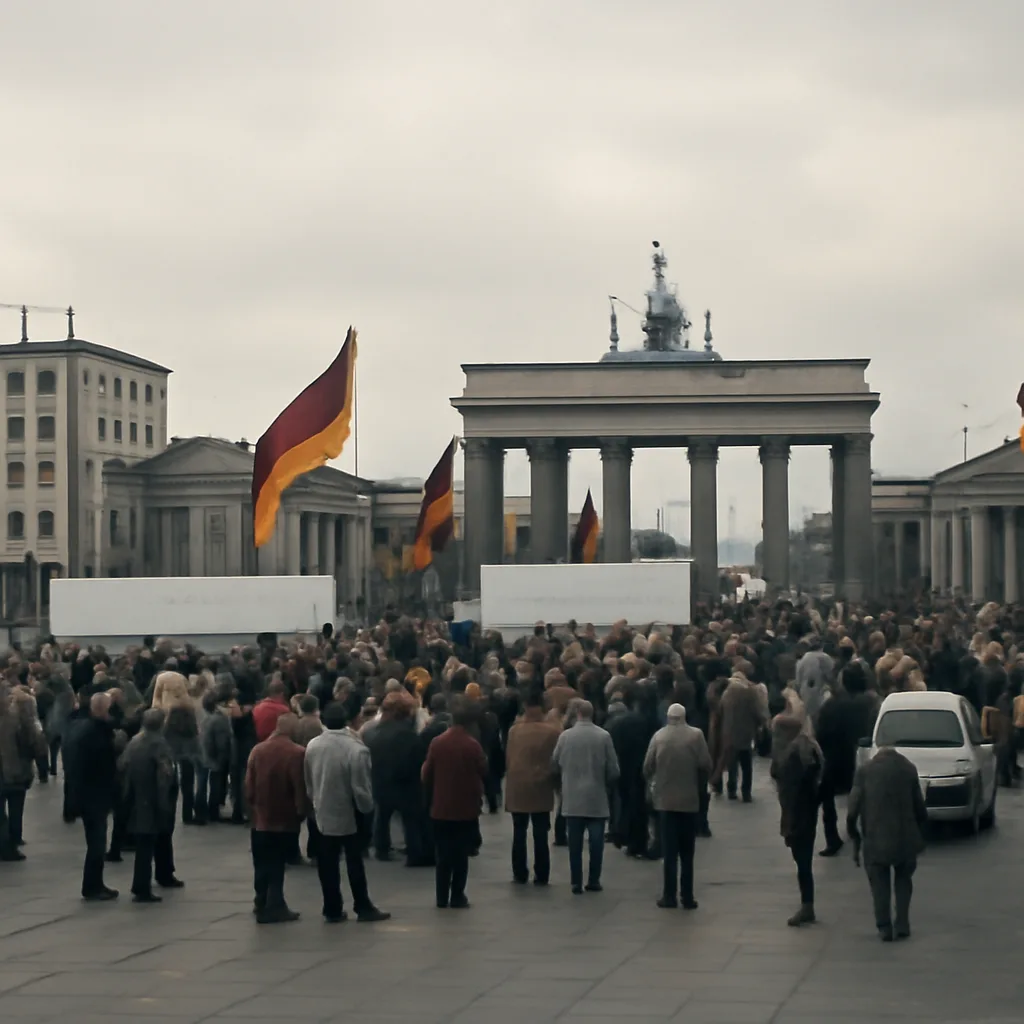
Crowds and officials amid flags of the Federal Republic of Germany in Berlin around October 1990, marking celebrations and public gatherings as East and West Germany were reunified.

On October 3, 1990, the German Democratic Republic (East Germany) and the Federal Republic of Germany (West Germany) were formally united into a single German state, ending 45 years of division resulting from World War II and the Cold War.


Background and division
After World War II, Germany was divided into occupation zones controlled by the United States, the United Kingdom, France and the Soviet Union. Tensions between the Western Allies and the Soviet Union hardened into the Cold War. In 1949 separate German states were established: the Federal Republic of Germany (FRG or West Germany) and the German Democratic Republic (GDR or East Germany). Over the next four decades the two states followed different political, economic and social systems—liberal democracy and market economy in the West, one-party socialist rule and a planned economy in the East. The inner-German border, and especially the Berlin Wall (erected in 1961), became potent symbols of the Iron Curtain.

Paths to change
By the late 1980s economic stagnation in the East, political reforms in the Soviet Union under Mikhail Gorbachev (notably glasnost and perestroika), and growing public protest in the GDR created momentum for change. Mass demonstrations in East German cities, emigration through neighboring countries, and the fall of the Berlin Wall on November 9, 1989, weakened the GDR regime and opened political space for negotiation over the country’s future.

Negotiations and legal steps
Reunification required diplomatic agreement among the two German states and the four wartime Allied powers (the United States, the Soviet Union, the United Kingdom and France). Two main legal-political routes were considered: a treaty creating a new state or accession of the GDR to the Federal Republic under Article 23 of the West German Basic Law. Political leaders of both German states moved toward the latter option. Important steps included the March 1990 free elections in the GDR, which brought pro-unification parties to power, and intensive international negotiations culminating in the “Two Plus Four” talks (the two German states plus the four occupying powers), which resolved remaining external aspects of sovereignty, borders and security.

Unification on October 3, 1990
On October 3, 1990, the GDR formally acceded to the Federal Republic of Germany. The five re-established East German states (Länder) joined the Federal Republic, the Basic Law became the constitution for the entire country, and Berlin became the capital of reunified Germany. The Treaty on the Final Settlement with Respect to Germany (commonly called the Two Plus Four Agreement), signed earlier that year, had set the international framework by confirming Germany’s borders and ending the post‑war Allied rights.

Immediate consequences and challenges
Reunification was celebrated across Germany and abroad as the end of Cold War division in central Europe. At the same time, integrating two fundamentally different political economies posed immense challenges: restructuring state-owned enterprises in the East, aligning legal and social systems, and addressing disparities in income, employment and infrastructure. The economic and social transformation required large fiscal transfers from West to East, and many East Germans experienced unemployment and social dislocation during the transition. Reunification also raised questions about Germany’s role in Europe and the world, which were addressed through continued diplomatic engagement and NATO membership arrangements clarified during the Two Plus Four talks.

Legacy
German reunification reshaped Europe’s post‑Cold War order and had wide geopolitical and societal effects. For many Germans it fulfilled the aspiration of national unity; for others it introduced difficult economic and social adjustments whose effects persisted for decades. Historians and economists continue to study both the achievements and the costs of the reunification process, including long-term challenges in economic convergence and regional identity. October 3 is observed annually in Germany as the Day of German Unity (Tag der Deutschen Einheit) to mark the formal reunification date.

Share this

Email Share on X Facebook Reddit

Did this surprise you?