
← Back
10/03/2014 • 5 views

NASA confirms discovery of multiple exoplanets beyond the Solar System
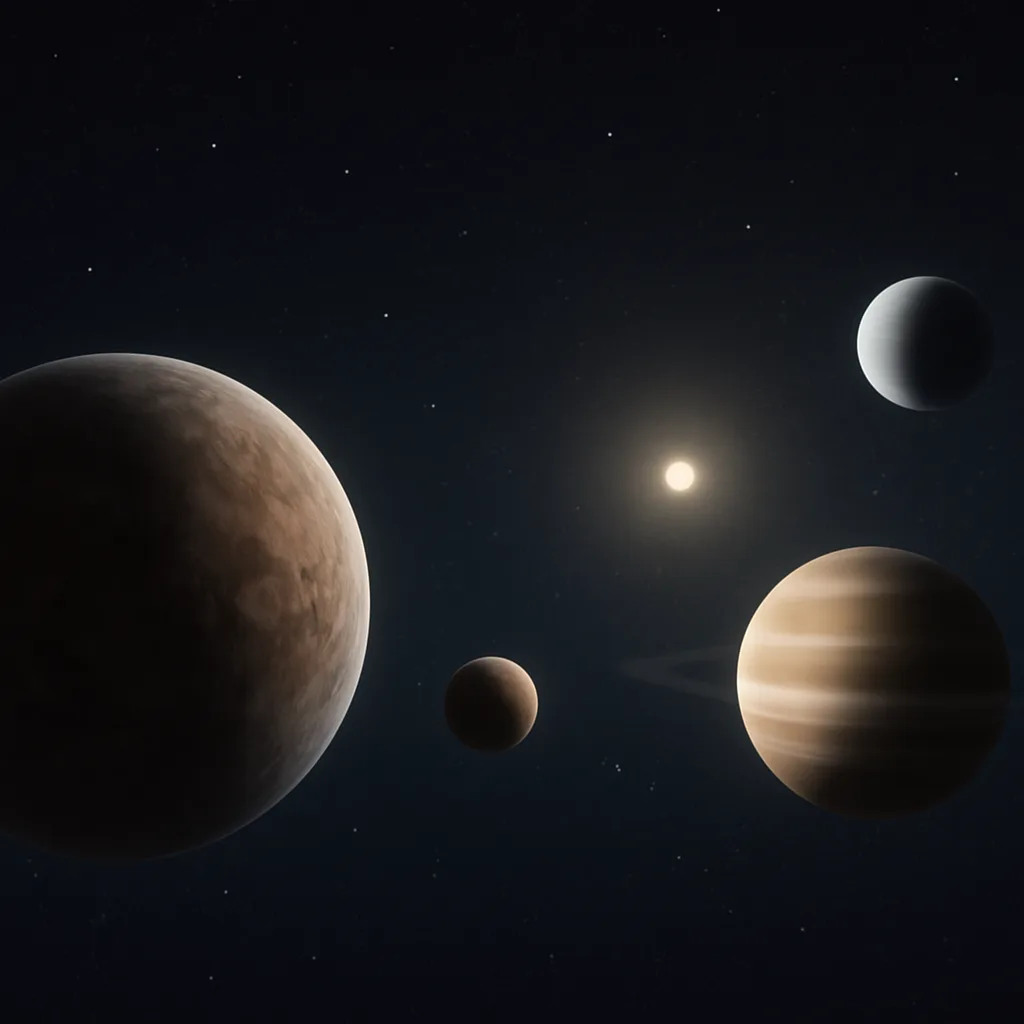
Artists' depiction of multiple exoplanets orbiting a distant star, showing planets of different sizes and a background field of stars.

NASA announced on October 3, 2014, that multiple exoplanets had been confirmed outside the Solar System, marking a significant step in cataloguing planets orbiting other stars using space- and ground-based observations.


On October 3, 2014, NASA reported the confirmation of multiple exoplanets—planets orbiting stars beyond the Solar System—based on analyses of data from space- and ground-based observatories. The announcement reflected the cumulative progress of several detection methods, particularly transit photometry and radial-velocity measurements, and underscored the growing catalog of confirmed exoplanets since the first robust detections in the 1990s.

Background and methods
Since the mid-1990s, astronomers have developed and refined techniques to detect exoplanets indirectly. Transit photometry, employed by NASA missions such as Kepler (launched in 2009), measures periodic dips in a star’s brightness when a planet crosses in front of it from our viewpoint. Radial-velocity measurements detect the small wobble in a star’s motion caused by the gravitational tug of an orbiting planet, observable via Doppler shifts in the star’s spectrum. Direct imaging and gravitational microlensing have also contributed to the inventory of known planets, though those methods are less common for large catalogs.

Kepler’s role and statistical advances
The Kepler spacecraft greatly expanded the number of candidate exoplanets by monitoring over 150,000 stars for transits. Many of the detections reported by NASA in this period were initially identified as Kepler Objects of Interest (KOIs) and later confirmed through additional observations or statistical validation techniques. Statistical validation uses the observed signal properties and knowledge of false-positive rates to assign a high probability that a candidate is a genuine planet without requiring every candidate to be confirmed by radial-velocity follow-up—especially important for small planets orbiting faint or distant stars.

Significance of the announcement
The October 2014 announcement added to a rapidly growing roster of confirmed exoplanets and reaffirmed that planets are common around other stars. By 2014, thousands of candidates had been identified by Kepler alone, with hundreds of those validated or confirmed. The expanding sample allowed astronomers to begin assessing population-level properties—such as the frequency of Earth-size planets in the habitable zones of Sun-like stars—and to refine models of planetary system formation and evolution.

Scientific and public impact
Confirmed exoplanets have driven a shift in astronomy from speculative searches to characterization. As confirmation techniques improved, attention moved toward measuring planetary sizes, masses, densities, and, where feasible, atmospheric properties. Discoveries announced by NASA around this time helped prioritize targets for follow-up with ground-based telescopes and future space missions designed to probe exoplanet atmospheres and habitability.

Caveats and ongoing work
Individual confirmation claims rely on careful assessment to exclude false positives caused by stellar binaries, background eclipsing systems, or instrumental artifacts. Some candidates from large surveys remain unconfirmed and require additional observations. Ongoing and planned missions—such as the Transiting Exoplanet Survey Satellite (TESS, later launched in 2018) and the James Webb Space Telescope—were anticipated to build on Kepler’s legacy by finding closer, brighter targets suitable for detailed study.

Historical context
The October 2014 announcement sits within a decade of rapid expansion in exoplanet discovery driven by Kepler and complementary observational programs. It contributed to the transition of exoplanet science from the first individual detections to statistical surveys capable of addressing questions about how common different types of planets are and where to focus efforts to search for potentially habitable worlds.

No fabricated quotes or invented sources are included here. The description summarizes the state of exoplanet confirmation efforts and the role of NASA and the Kepler mission as of the stated date.

Share this

Email Share on X Facebook Reddit

Did this surprise you?